T02: GPU, parallel, and graphics computing
On this page
- A. Prerequisites and observable goals
- B. The central question: is there enough independent work to pay for coordination?
- C. Memory hierarchy and synchronization scopes
- D. Derive a tree reduction
- E. Measure end-to-end and kernel-only costs separately
- F. Graphics is mathematics plus a staged computation
- G. Independent practice
- H. Complete solutions: T02
- Optional hardware extension: supplied but untested CUDA source
- I. Retention and readiness
A. Prerequisites and observable goals#
A01 vectors and matrices; A05 floating-point error; C08 reductions and graphs; C09 architecture; T01 measurement.
Decompose a reduction, reason about work/span and data transfer, explain basic GPU execution and memory scopes, and validate a CPU alternative before attempting optional CUDA execution.
Level: Advanced-entry track. CPU lab tested; optional CUDA source is supplied but not compiled or executed in this environment.
B. The central question: is there enough independent work to pay for coordination?#
A GPU can execute many arithmetic operations across many elements, but offloading requires more than replacing a loop with a kernel. Inputs must be accessible in the appropriate memory, work must be decomposed into independent or synchronized pieces, and outputs must be validated. Small jobs can spend more time launching and transferring than computing. A CPU implementation remains both a fallback and a correctness oracle.
SIMD applies one instruction to multiple data lanes. GPU SIMT execution organizes groups of threads that execute instructions together while exposing thread-level indexing. Divergent control flow can cause different paths to execute under masks rather than giving every branch a separate free processor. A mathematical operation’s parallelism does not establish its achieved hardware utilization.
In the basic CUDA model used by the optional example, a launch creates a grid of blocks, and each block contains threads. Threads in a block can cooperate through shared memory and block-scoped synchronization. Blocks ordinarily must be independently schedulable; do not implement a global barrier by having arbitrary blocks spin for one another. Specialized features exist on particular hardware, but they are outside this introductory kernel. Current NVIDIA documentation was checked for this model and the standard synchronization concepts, not by executing the kernel on a GPU. [CUDA]
C. Memory hierarchy and synchronization scopes#
Registers hold thread-local working values; shared memory provides explicitly managed block-local storage; global device memory stores larger arrays. These names specify access and lifetime concepts, not a promise that every access has a fixed latency. Coalesced accesses let neighboring lanes access nearby global locations efficiently. Random gathers, redundant loads, and low reuse can make data movement dominate arithmetic.
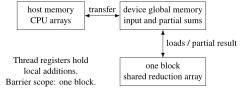
A barrier requires the relevant participating threads to reach it under valid control flow. Returning early from some threads before a block barrier can invalidate the intended algorithm. Instead, out-of-range threads contribute the operation’s identity, such as zero for addition, and participate in the reduction. Host code also needs an appropriate synchronization or event mechanism before consuming a kernel result; a launch can be asynchronous with respect to the host. [CUDA]
D. Derive a tree reduction#
To sum eight numbers, first sum adjacent pairs in parallel, then pairs of those results, then the final two values. The total number of additions is , the same as a sequential sum, while the dependency depth is . For a power of two, work is additions and span is . Ideal execution on processors is bounded below by both and , so in an idealized unit-cost model.
On a GPU, each block can reduce a chunk and write one partial sum. A second kernel or a CPU can combine partials. The supplied optional kernel loads up to two input values per thread, places local sums in shared memory, and repeatedly halves the active reduction width with barriers. The CPU combines the much smaller partial array in double precision. This is a teaching implementation, not an optimized production reduction library.
Floating-point addition is not associative. The reduction tree changes rounding order, so exact equality to a serial floating-point sum is not a universal correctness requirement. Compare against a higher-quality reference such as math.fsum for the CPU lab, use absolute and relative tolerances appropriate to magnitude, and test cancellation and dynamic range. A fast but numerically unsuitable reduction is not interchangeable with a stable one.
E. Measure end-to-end and kernel-only costs separately#
A simple offload model is
If CPU time is ms, launch plus transfer is ms, and kernel work is ms, end-to-end GPU time is ms: slower despite a ten-times-faster compute phase. Keeping data on the device across several operations can amortize transfer, but then the compared workload must include those operations and their memory use.
Arithmetic intensity is useful operations per byte moved under a stated memory boundary. A reduction has little arithmetic per input byte and is often sensitive to bandwidth and reduction overhead. A matrix multiply can reuse tiles of inputs across many multiply-adds, raising arithmetic intensity when implemented well. Counting theoretical reuse is not proof that an implementation achieves it.
The optional CUDA program reports device-event kernel time and a host-wall interval including its transfer/launch/synchronization work, with allocation policy documented in the source. No CUDA result is included in this book because nvcc and a GPU were not available where its code was tested. The CPU reduction tests did run. This separation prevents a hardware capability assumption from becoming a fabricated benchmark.
F. Graphics is mathematics plus a staged computation#
A simple graphics pipeline transforms object coordinates into world, view, and clip coordinates, assembles primitives, rasterizes covered samples, and evaluates shading and depth tests. Homogeneous coordinates allow translation to be represented by a matrix acting on an augmented vector . Perspective division converts clip coordinates to normalized coordinates by dividing by the appropriate homogeneous component; points with problematic denominators require clipping rather than blind division.
Normals do not generally transform like position vectors under nonuniform scaling. To preserve orthogonality to transformed tangents, the normal direction transforms by the inverse transpose of the invertible linear part, then is normalized. This follows from . Singular transforms require separate handling. This is an example of linear algebra determining implementation correctness rather than serving as decorative notation.
Parallel graphics work still needs consistent resource lifetimes, synchronization, color and coordinate conventions, and performance measurement. Rendering a plausible image is not proof that a transform or physical model is correct. Use small geometry with analytically known positions and normals before testing a complex scene.
G. Independent practice#
F foundation C standard course work T transfer S optional stretch L runnable lab or project. Attempt the complete set before opening its solutions.
For a reduction of values using a balanced binary tree, compute addition work and dependency span. Explain why processors do not make its time zero or remove synchronization costs.
A CPU operation takes ms. GPU launch costs ms, each direction’s transfer costs ms, and the kernel takes ms. Compute modeled end-to-end speedup. Then recompute when a tiny workload takes ms on CPU but has the same transfer/launch costs and a ms kernel.
Explain why a block reduction should substitute zero for an out-of-range input rather than having that thread return before a shared barrier. Also explain why a block-scoped barrier is not a grid-wide barrier.
For , tangent , and normal , compare with as normals to . Verify by dot products.
Implement starters/reduction_lab.py, including pairwise and Kahan summation. Compare ordinary summation and both methods with math.fsum on the supplied tests, including cancellation. State that no one ordering or compensation method eliminates all floating-point error. The CUDA file is an unassigned hardware extension, not required for completing this CPU lab.
Optional small hints
For T02.02, add all GPU costs before dividing times. For T02.04, a normal must remain orthogonal to the transformed tangent. For T02.05, inspect the running correction rather than assuming it is always zero.
H. Complete solutions: T02#
Compare the first step where your work differs. A corrected answer is not yet an independent success.
T02.01Show solution
Work and span are separate lower bounds
Work is additions. Span is addition stages. Even with enough processors for every independent addition at a stage, later stages depend on earlier results. Real execution adds loads, stores, synchronization, scheduling, and launch overhead. The model establishes available parallelism, not an exact kernel duration.
Back to T02.01T02.02Show solution
A fast kernel can lose the complete comparison
The first GPU total is ms, giving modeled speedup . The small workload’s total is ms, giving speedup , or about times slower. These results assume the stated costs and no overlap. A resident-data or overlapped pipeline is a different experiment requiring a new timing boundary.
Back to T02.02T02.03Show solution
Participation and scope are part of the algorithm
The reduction’s barriers assume the participating block threads reach the synchronization point. Out-of-range inputs should contribute the additive identity zero while threads still follow the common synchronization structure. A premature return can break that structure. A block barrier synchronizes only that block’s threads and shared-memory cooperation; it cannot force arbitrary other blocks to complete. A multi-stage reduction uses separate launches or another explicitly supported global coordination mechanism rather than an unsafe spin barrier.
Back to T02.03T02.04Show solution
Inverse transpose preserves the defining condition
. Naively transforming the normal gives , whose dot product with is , not zero. The inverse transpose is , so the transformed normal direction is . Its dot product is , as required. Normalize afterward if a unit normal is needed. The derivation assumes the linear transform is invertible.
Back to T02.04T02.05Show solution
Complete CPU alternative
Pairwise summation changes the reduction tree. Kahan summation tracks a correction for some rounding lost by a running sum; it is still finite-precision computation and can fail on particular severe cancellation orders. The reference tests include such cases rather than claiming universal exactness. The code rejects nonfinite inputs under its educational contract.
"""T02.05 CPU fallback: changing reduction order changes rounding."""
import math

def pairwise(values: list[float]) -> float:
    work = list(values)
    if any(not math.isfinite(x) for x in work):
        raise ValueError("finite inputs required")
    while len(work) > 1:
        work = [work[i] + work[i + 1] if i + 1 < len(work) else work[i]
                for i in range(0, len(work), 2)]
    return work[0] if work else 0.0

def kahan(values: list[float]) -> float:
    total = correction = 0.0
    for value in values:
        if not math.isfinite(value):
            raise ValueError("finite inputs required")
        y = value - correction
        new = total + y
        correction = (new - total) - y
        total = new
    return total

if __name__ == "__main__":
    values = [0.1] * 10000
    print("loop", sum(values), "tree", pairwise(values),
"kahan", kahan(values), "fsum", math.fsum(values))Optional hardware extension: supplied but untested CUDA source#
The following complete program is included so a future GPU run has a concrete starting point. Compile only on a configured CUDA system, validate its result before interpreting timings, and record toolkit, compiler, driver, device, workload, and transfer policy. No speedup or successful compilation is claimed for this source here.
// T02 optional CUDA extension. Not compiled or executed in the reference environment.
#include <cuda_runtime.h>
#include <chrono>
#include <cmath>
#include <iostream>
#include <numeric>
#include <stdexcept>
#include <vector>
void check(cudaError_t status) {
    if(status!=cudaSuccess) throw std::runtime_error(cudaGetErrorString(status));
}
struct DeviceArray {
    float* data=nullptr;
    explicit DeviceArray(std::size_t n) {
        check(cudaMalloc(reinterpret_cast<void**>(&data),n*sizeof(float)));
    }
    ~DeviceArray() { if(data) cudaFree(data); }
    DeviceArray(const DeviceArray&)=delete;
    DeviceArray& operator=(const DeviceArray&)=delete;
};
struct Event {
    cudaEvent_t handle;
    Event() { check(cudaEventCreate(&handle)); }
    ~Event() { cudaEventDestroy(handle); }
    Event(const Event&)=delete;
    Event& operator=(const Event&)=delete;
};
constexpr unsigned block_size=256;
__global__ void reduce_blocks(const float* input,float* output,std::size_t n) {
    __shared__ float partial[block_size];
    const unsigned lane=threadIdx.x;
    const std::size_t i=std::size_t(blockIdx.x)*block_size*2+lane;
    float value=i<n?input[i]:0.0F;
    if(i+block_size<n) value+=input[i+block_size];
    partial[lane]=value;
    __syncthreads();
    for(unsigned stride=block_size/2;stride;stride/=2) {
        if(lane<stride) partial[lane]+=partial[lane+stride];
        __syncthreads(); // all threads participate, including inactive lanes
    }
    if(lane==0) output[blockIdx.x]=partial[0];
}
int main() {
    try {
        constexpr std::size_t n=1U<<20;
        const unsigned blocks=static_cast<unsigned>((n+2*block_size-1)/(2*block_size));
        std::vector<float> input(n,1.0F),partial(blocks);
        const auto begin=std::chrono::steady_clock::now();
        DeviceArray device_input(n),device_output(blocks);
        Event start,stop;
        check(cudaMemcpy(device_input.data,input.data(),n*sizeof(float),cudaMemcpyHostToDevice));
        check(cudaEventRecord(start.handle));
        reduce_blocks<<<blocks,block_size>>>(device_input.data,device_output.data,n);
        check(cudaGetLastError());
        check(cudaEventRecord(stop.handle));
        check(cudaEventSynchronize(stop.handle));
        float kernel_ms=0;
        check(cudaEventElapsedTime(&kernel_ms,start.handle,stop.handle));
        check(cudaMemcpy(partial.data(),device_output.data,blocks*sizeof(float),cudaMemcpyDeviceToHost));
        const double result=std::accumulate(partial.begin(),partial.end(),0.0);
        const double total_ms=std::chrono::duration<double,std::milli>(
            std::chrono::steady_clock::now()-begin).count();
        if(result!=static_cast<double>(n)) throw std::runtime_error("wrong reduction");
        std::cout<<"n="<<n<<" result="<<result<<" kernel_ms="<<kernel_ms
                 <<" allocation_transfer_compute_ms="<<total_ms<<"\n";
    } catch(const std::exception& e) { std::cerr<<e.what()<<"\n"; return 1; }
}
I. Retention and readiness#
Retrieve A01 transformations, A05 rounding, C10 synchronization scopes, and T01 timing boundaries. Readiness requires a correct reduction and a defensible decision about whether offload pays for its costs. Continue with verified hardware tooling, parallel algorithms, graphics pipeline mathematics, and numerical error analysis; profile before replacing a maintained GPU library with a custom kernel.