Module 26: Sequences, series, and the meaning of convergence
On this page
- A. Prerequisites and observable goals
- B. The central idea: infinitely many terms require a limiting definition
- C. Definitions and basic tests
- D. Why the tests and geometric formula hold
- E. A recognition procedure
- F. Worked examples
- G. Independent practice
- H. Complete solutions: Module 26
- I. Retention and readiness
A. Prerequisites and observable goals#
Limits at infinity, geometric sums, inequalities, and indexed notation.
Distinguish a sequence of terms from a sequence of partial sums, evaluate geometric and telescoping series, and use the term test only in its valid direction.
B. The central idea: infinitely many terms require a limiting definition#
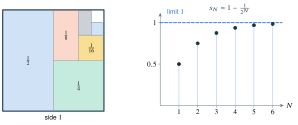
A sequence is a function whose inputs are successive integers: . A series is an instruction to add sequence terms, interpreted through the partial sums . The statement means , not that an infinite addition can be treated as an ordinary finite sum without justification. The limit of and the limit of answer different questions.
C. Definitions and basic tests#
A sequence converges to if for every there is an integer such that implies . This is the sequence version of a limit: the input eventually exceeds every fixed cutoff, rather than moving continuously near a point.
If a series converges, then . Consequently, if the terms fail to tend to zero, the series diverges. The converse is false: is necessary but not sufficient. A monotone bounded sequence converges; the bounds and monotonicity must apply to the sequence under discussion, whether terms or partial sums.
For a geometric series with first term and ratio ,
If and , it diverges. The exceptional zero sequence when must not be excluded by an overgeneralized slogan. Convergent series can be added or multiplied by constants; arbitrary rearrangement of conditionally convergent series is a later caution, not a generally free operation. [O2Seq]
D. Why the tests and geometric formula hold#
If , then , proving the necessary term condition. Notice why the proof cannot be reversed: small increments need not prevent an accumulated total from growing indefinitely.
For a finite geometric sum , subtract to get . For ,
Only after this finite identity is established do we take the limit. If , , giving the infinite formula. The indexing determines how many powers occur; check the first term before applying it.
E. A recognition procedure#
For a sequence, compute or bound its limiting terms. For a series, first inspect whether terms can tend to zero. Then look for a constant ratio (geometric) or cancellation in a finite partial sum (telescoping). Write several terms or the partial sum explicitly rather than canceling imagined infinities. If no special pattern applies, use the general tests in the next modules. A convergence test usually does not reveal an exact sum value.
F. Worked examples#
A sequence limit. For , divide numerator and denominator by to find . Therefore a series having these terms diverges by the term test, even though the sequence itself converges.
A telescoping sum. Since ,
The cancellation is performed in a finite sum. The exact tail after terms is , information stronger than mere convergence.
Why term decay is insufficient. In the harmonic series, terms from through contribute at least . There are arbitrarily many such blocks, so partial sums grow without bound even though . Grouping these positive terms is safe and provides a direct divergence proof.
G. Independent practice#
F foundation C standard course work T transfer S optional stretch L runnable lab or project. Attempt the complete set before opening its solutions.
Find the limit of . Does converge?
Determine whether and converge as sequences.
Evaluate . Find the exact error after terms through .
Evaluate .
Evaluate using a finite partial sum.
Explain why knowing does not determine whether converges. Give two positive examples with opposite outcomes.
Let and . Prove the sequence converges and find its limit.
A ball is dropped from height m and rebounds to of the previous height each time. Under this idealized model, find the total vertical distance traveled through infinitely many rebounds.
Optional small hints
For M26.05, decompose into and identify the two uncanceled terms at each end. For M26.07, prove both an upper bound and monotonicity before passing to the recurrence limit. For M26.08, the initial fall is counted once; later rebound heights are traversed twice.
H. Complete solutions: Module 26#
Compare the first step where your work differs. A corrected answer is not yet an independent success.
M26.01Show solution
A convergent term sequence can produce a divergent series
Dividing by gives . Since that nonzero limit violates the necessary condition for a convergent series, . The sequence convergence is not the series convergence.
Back to M26.01M26.02Show solution
Oscillation may or may not shrink
The even and odd subsequences of have limits and , so no common limit exists. But , so squeezing gives . Oscillation alone is not a divergence test for sequences; its amplitude matters.
Back to M26.02M26.03Show solution
A geometric value and its exact tail
The ratio is , of magnitude less than one. Hence the sum is . After the first terms the partial sum is , so the exact positive remainder is . The error is indexed by the number of included terms, not by an unexplained last exponent.
Back to M26.03M26.04Show solution
Use the actual first term
The first included term is , with ratio . Thus the sum is . Starting at instead would give a different total; the first-term check catches that indexing error.
Back to M26.04M26.05Show solution
Two boundary terms survive at each end
Since , the partial sum is
Taking gives . All cancellation took place in the finite identity, so no subtraction of divergent infinite harmonic series was used.
Back to M26.05M26.06Show solution
A necessary condition cannot decide the outcome
Both and are positive and tend to zero. The first has divergent partial sums by the block comparison explained above; the second telescopes to a finite sum . Thus the zero term limit is compatible with either outcome and cannot certify convergence.
Back to M26.06M26.07Show solution
Bounded monotonicity justifies taking a limit
The base term satisfies . If , then , establishing the bound by induction. Also for , because , so . The sequence is increasing and bounded, hence converges to some . Continuity of square root gives , so . Only lies in the established interval.
Back to M26.07M26.08Show solution
Translate repeated motion into a geometric sum
The initial drop contributes m. Rebound heights are for , each traveled upward and downward. Thus
This is a statement about the idealized distance model; it does not assert that real impacts continue indefinitely or that the same simple law describes their timing.
Back to M26.08I. Retention and readiness#
Retrieve M16.05 and M24.01. Explain which sequence must converge to define a series sum. Advance when you can reject “the terms go to zero, therefore it converges” and can keep starting indices straight in a new geometric problem.