Module 04: Radians, trigonometry, geometry, and units
On this page
- A. Prerequisites and observable goals
- B. The central idea: angles are inputs with a geometric scale
- C. Essential identities and coordinate formulas
- D. Why the point’s height is not the intercept
- E. A short decision procedure
- F. Worked examples
- G. Independent practice
- H. Complete solutions: Module 04
- I. Retention and readiness
A. Prerequisites and observable goals#
Algebra, function graphs, and basic right-triangle geometry.
Use exact unit-circle values, solve simple trigonometric equations, interpret slope with units, and write a line from a point and a slope.
B. The central idea: angles are inputs with a geometric scale#
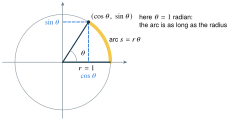
An angle in radians is the ratio of arc length to radius: . A full circle has arc length , hence angle radians. Radian measure is dimensionless, but writing “rad” reminds us of the input convention. The derivative formulas in calculus use radians. A calculator in degree mode can produce a plausible-looking but wrong limit.
On the unit circle, the point at angle has coordinates . Therefore sine and cosine describe projections of a rotating radius onto coordinate axes. Their identities are geometric, not merely a table to memorize. They also model oscillation and periodic motion, making them useful for animation as well as standard exams.
C. Essential identities and coordinate formulas#
The circle equation gives . Where denominators are nonzero,
Sine is odd, cosine even: , . Both have period . Useful addition identities are
They give and .
For distinct horizontal coordinates, the line through and has slope . Point-slope form is
The distance formula is . A circle with center and radius satisfies . Standard geometry and trigonometry definitions: [O1F].
D. Why the point’s height is not the intercept#
The slope compares a change in height to a change in horizontal position. If a line passes through and has slope , then from that point to any on the line,
which rearranges to and extends to . Thus . The vertical-axis intercept is the height at input zero; here it is , not . Checking gives . The incorrect guess gives there, so it fails the given point.
Units help separate a value from a slope. If is seconds and meters, then has units meters while has units meters per second. Multiplying gives meters, allowing the equation’s two sides to have matching units.
E. A short decision procedure#
For angles, convert degrees to radians by multiplying by . Use a reference angle and quadrant signs for exact trig values. When solving a trigonometric equation, find all requested angles in the interval, not just the calculator’s principal answer. For a line, identify a point and a slope, use point-slope form, and verify the point. If horizontal change is zero, the line is vertical and has no finite slope; use instead of .
F. Worked examples#
Example 1: exact values. The angle is . Its reference angle is and it lies in quadrant II, where sine is positive and cosine negative. Hence , , and .
Example 2: geometric units. A wheel of radius m turns through radians without slipping. The travel distance is m. The units are meters; the angle is not an additional length factor.
Finish the intercept. A line has slope through . First write . Completion: . The intercept is because moving left from to increases height by .
G. Independent practice#
F foundation C standard course work T transfer S optional stretch L runnable lab or project. Attempt the complete set before opening its solutions.
Convert to radians and find its sine and cosine exactly.
Find every solution of in .
Simplify and state where the original expression is defined.
Find the line through with slope , its vertical-axis intercept, and its value at .
Find the slope and equation of the line through and .
A circular path has radius m. A runner moves through radians in s. Find arc length and average speed.
The height is measured in meters with in seconds. Give its range, period, and the units of .
Explain why , and use it to find the average of the two values and for any .
Optional small hints
For M04.07, a full cycle occurs when the angle increases by . For M04.08, start with the cosine double-angle identity, not a numerical example.
H. Complete solutions: Module 04#
Compare the first step where your work differs. A corrected answer is not yet an independent success.
M04.01Show solution
Reference angle and signs
Multiplying by gives . The reference angle is and the angle is in quadrant III, so both coordinates are negative. Thus . Their squared sum is , as required by the unit circle.
Back to M04.01M04.02Show solution
All solutions in the requested interval
The positive reference angle with sine is . Sine is positive in quadrants I and II, giving . Adding another full turn leaves , so no additional representatives belong to the requested interval.
Back to M04.02M04.03Show solution
An identity with restrictions
Use . Then only where . The simplified expression is . The simplified sine itself exists at those excluded inputs, but the original quotient does not.
Back to M04.03M04.04Show solution
Point, slope, and intercept
Point-slope form gives . Expand and subtract : . At input zero the height is , so the intercept is . At , . Moving from to raises the height by , agreeing with .
Back to M04.04M04.05Show solution
Two points determine a nonvertical line
The slope is . Through ,
Substituting gives , checking the second point.
Back to M04.05M04.06Show solution
Distance and a rate have different units
Arc length is . Average speed is distance divided by elapsed time: . The straight-line chord is shorter than the traveled arc and is not the correct distance for speed along the path.
Back to M04.06M04.07Show solution
Read a periodic model
Since sine ranges from to , ranges from to , or . A full cycle satisfies , so . The coefficient has units radians per second, conventionally because radians are dimensionless.
Back to M04.07M04.08Show solution
Derive rather than memorize
The identity rearranges to ; dividing by gives the requested half-angle identity. The arithmetic mean of and is . This is an exact all-input identity, not an approximation or an average over an interval.
Back to M04.08I. Retention and readiness#
Return to M02.06 and M03.07 to connect transformations and units. Before starting derivatives, solve M04.04 from a blank page and explain why the is not the intercept. For trigonometry, independently retrieve the unit-circle values at and determine quadrant signs.