C10: Operating systems, concurrency, and safe coordination
On this page
- A. Prerequisites and observable goals
- B. The central question: who may access shared state, and when?
- C. Memory and files are resources with observable failure modes
- D. A race is not merely an occasional wrong answer
- E. Condition variables wait for a predicate, not a remembered notification
- F. Deadlock, ordering, and what tests can establish
- G. Independent practice
- H. Complete solutions: C10
- I. Retention and readiness
A. Prerequisites and observable goals#
C03 ownership and lifetime; C06 queues; C09 machine state and virtual memory.
Distinguish processes and threads, explain blocking and asynchronous work, identify races and deadlocks, and implement a bounded queue whose closure and lifetime contracts are explicit.
Level: Degree core; advanced memory-model work requires further study.
B. The central question: who may access shared state, and when?#
An operating system manages execution, memory mappings, devices, and persistent resources while providing isolation and controlled sharing. A process supplies an execution context and virtual address space. Threads within a process ordinarily share its address space and resources while having their own execution state and call stacks. A separate stack is not a universal privacy barrier: a program can pass a pointer into it to another thread, which reintroduces lifetime and synchronization obligations.
Concurrency means multiple activities have overlapping lifetimes and may interleave. Parallelism means activities execute simultaneously on available hardware. A single-core event loop can be concurrent without executing two instructions simultaneously. A multicore program can execute in parallel and still spend much of its time waiting on a shared lock. More threads do not by themselves create more useful parallel work.
A system call requests an operating-system service through a defined boundary. It can block, fail, or return partial progress. A system call is not necessarily a process switch, and not every library function is a system call. Scheduling decides which runnable threads get execution time, with policies and fairness properties that vary. A mutex does not automatically promise first-in-first-out service or a hard maximum waiting time.
C. Memory and files are resources with observable failure modes#
Demand paging can populate or map memory when accessed. A page fault may be handled normally or report an invalid/prohibited access; it is not synonymous with a crash. File descriptors on POSIX-like systems and handles on Windows identify operating-system resources through platform-specific interfaces. Opening a file can fail; reading can reach end-of-file or return less than requested; writing and later persistence are not identical events.
A filesystem organizes names, metadata, and storage. Buffered writes, atomic namespace changes, and durable persistence are separate properties. A successful application-level write does not universally guarantee survival of immediate power loss under every filesystem and hardware configuration. Backups must be restored and checked, not merely created. C11 uses database backup APIs rather than pretending that copying one file from a live database always captures all its state. [OSTEP][SQL]
Interprocess communication can use pipes, sockets, shared memory, or platform facilities. A byte stream still needs framing. Shared memory still needs synchronization. Asynchronous I/O separates request submission from completion; it does not mean the operation has completed when submission returns. An event loop must avoid blocking work that prevents other completions from being processed. Backpressure prevents producers from creating work faster than consumers can safely retain it.
D. A race is not merely an occasional wrong answer#
Imagine two activities both reading a counter value 0, calculating 1, and storing 1. One increment is lost in this illustrative interleaving. In C++, concurrent conflicting non-atomic accesses without a suitable happens-before relationship constitute a data race and cause undefined behavior; the language does not limit the result to this particular lost-update trace. A program appearing to work during a stress test does not establish that the race is absent.
A mutex protects a shared invariant by allowing only one holder in a critical section. Every relevant access must follow the same protocol. Locking only writes while allowing unsynchronized reads does not generally solve the problem. RAII lock wrappers release the mutex on ordinary scope exit, including exceptions. Keep ownership and lock lifetime visible, and avoid calling unknown or long-running code while holding a lock unless the interface explicitly permits that risk.
An atomic operation provides indivisible access under the language memory model. A relaxed atomic counter is suitable for certain independent counting tasks, but relaxed ordering alone does not publish unrelated non-atomic data. In a simple one-producer/one-consumer publication pattern, the producer writes immutable payload then performs a release store to a flag; a consumer’s acquire load that observes that release establishes visibility of the preceding payload writes. Correctness still depends on the flag’s initial state, no conflicting later payload writes, and adequate object lifetime. volatile is not a replacement for this synchronization. [CPP]
E. Condition variables wait for a predicate, not a remembered notification#
A bounded queue needs producers to wait when full and consumers to wait when empty. A condition variable lets a waiting thread release the mutex and sleep, then reacquire the mutex before continuing. Wakeups can occur without the desired condition being true, and another thread can change the state before the awakened thread gets the lock. Therefore use a predicate loop or predicate overload, not a one-time if followed by an unchecked wait.
The queue’s predicates are “closed or nonempty” for consumers and “closed or not full” for producers. The shared state is protected by one mutex. Closing sets a persistent Boolean state and wakes both groups. New pushes fail after closure; existing items remain available for draining; popping a closed empty queue returns no item. A notification is only a prompt to check the state. The predicate is the durable truth the program reasons about.
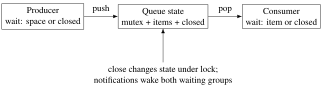
Schematic coordination contract. The arrows do not imply simultaneous execution or fairness guarantees.
The owner’s shutdown sequence must stop or join producers, close the queue as appropriate, let consumers drain, and join all users before destroying the queue. Closing does not make it safe to destroy a mutex or condition variable that another thread is still using. The test uses joining threads and verifies exactly-once delivery of generated integer items.
F. Deadlock, ordering, and what tests can establish#
A deadlock can arise when thread A holds lock X and waits for Y while thread B holds Y and waits for X. A global lock order prevents that cycle when all users follow it. Acquiring multiple locks through an appropriate deadlock-avoiding utility is another option. Timeouts can detect lack of progress but do not automatically restore a consistent state. Priority inversion is different: a high-priority thread can wait for a resource held by a low-priority one, possibly delayed by medium-priority work. Real-time systems may need specialized protocols and schedulability analysis.
AddressSanitizer and UndefinedBehaviorSanitizer check selected runtime defects in executed paths; they are not a data-race proof. ThreadSanitizer is a different tool and was not part of the recorded runs. Stress tests, timeouts, invariants, code review, and formal reasoning provide different evidence. The queue’s safety argument comes from exclusive access to its state and well-defined ownership; its tests exercise useful schedules but do not prove fairness or absence of every possible hang in every environment.
G. Independent practice#
F foundation C standard course work T transfer S optional stretch L runnable lab or project. Attempt the complete set before opening its solutions.
Explain how a one-thread event loop can be concurrent but not parallel. Contrast a process with a thread and identify what sharing still needs explicit coordination.
Two C++ threads execute counter++ on the same non-atomic integer without synchronization. Give an illustrative lost-update interleaving, then state why that is not a complete description of the C++ program’s permitted behavior.
A consumer uses if (queue.empty()) cv.wait(lock); and then removes the front item. Explain two ways it can proceed with an empty queue. Replace the design with a predicate that also handles shutdown.
Two subsystems acquire locks X and Y in opposite orders. Draw a wait cycle and propose a consistent acquisition policy. Explain why adding a timeout alone does not prove the protected state remains correct.
Implement the move-only-value bounded queue in cpp/bounded_queue.hpp. Require positive capacity, block on full/empty predicates, reject pushes after close, drain queued items after close, and return an empty optional when closed and empty. Run the multi-producer/multi-consumer test, then explain object-lifetime, exception, and shutdown assumptions.
Optional small hints
C10.03: a notification does not reserve an item for a particular waiter. C10.05: both producer and consumer predicates must include the closed state, and closure must notify both groups.
H. Complete solutions: C10#
Compare the first step where your work differs. A corrected answer is not yet an independent success.
C10.01Show solution
Overlapping lifetimes versus simultaneous execution
An event loop can submit several I/O operations and handle their completions over time, so multiple requests are in progress concurrently. With one executing thread it does not execute two handlers simultaneously. A process supplies an address-space context and resource isolation; threads within it share memory and many resources while maintaining separate execution states. Shared queues, counters, object lifetimes, and publication still require coordination when multiple threads access them. Event-loop code also needs state-machine correctness across callbacks even without parallel execution.
Back to C10.01C10.02Show solution
The model boundary matters
An intuitive interleaving is A reads 0, B reads 0, A writes 1, B writes 1, leaving 1 instead of 2. But in C++ the unsynchronized conflicting non-atomic operations are a data race, so behavior is undefined rather than restricted to this interleaving model. Use an atomic increment for an independent counter or a mutex protecting the larger invariant. Merely making one load or store atomic may not preserve a multi-variable transaction; choose synchronization from the actual invariant.
Back to C10.02C10.03Show solution
Recheck under the lock
A spurious wakeup can occur without an item. Alternatively, a notification wakes multiple consumers or another consumer removes the item before this one reacquires the mutex. Use a predicate such as closed || !queue.empty() with the condition-variable wait. After waiting, if the queue is empty, closure means there will be no item to return; otherwise remove one while holding the lock. The exact return value and producer rejection behavior must be part of the shutdown contract.
C10.04Show solution
Break the circular wait
A holds X and waits for Y; B holds Y and waits for X. The wait graph forms a cycle. Require every path to acquire X before Y, or use a suitable joint-lock acquisition strategy. A timeout can release an operation from waiting, but partially completed updates may need rollback or a consistent failure state. Returning “timeout” while leaving half an invariant changed merely converts a liveness problem into a correctness problem. Document which operations can be retried and whether they have already taken effect.
Back to C10.04C10.05Show solution
Reference queue
#pragma once
#include <condition_variable>
#include <cstddef>
#include <deque>
#include <mutex>
#include <optional>
#include <stdexcept>
#include <type_traits>
#include <utility>

// C10.05: close rejects new pushes but permits draining queued values.
// The owner must close and join all users before destroying this object.
template<class T> class BoundedQueue {
    static_assert(std::is_nothrow_move_constructible_v<T>);
    const std::size_t capacity_;
    std::deque<T> queue_;
    std::mutex mutex_;
    std::condition_variable readable_, writable_;
    bool closed_ = false;
public:
    explicit BoundedQueue(std::size_t capacity) : capacity_(capacity) {
        if (!capacity) throw std::invalid_argument("capacity must be positive");
    }
    BoundedQueue(const BoundedQueue&) = delete;
    BoundedQueue& operator=(const BoundedQueue&) = delete;
    bool push(T value) {
        std::unique_lock lock(mutex_);
        writable_.wait(lock, [&] { return closed_ || queue_.size() < capacity_; });
        if (closed_) return false;
        queue_.push_back(std::move(value));
        lock.unlock();
        readable_.notify_one();
        return true;
    }
    std::optional<T> pop() {
        std::unique_lock lock(mutex_);
        readable_.wait(lock, [&] { return closed_ || !queue_.empty(); });
        if (queue_.empty()) return std::nullopt;
        T value = std::move(queue_.front());
        queue_.pop_front();
        lock.unlock();
        writable_.notify_one();
        return value;
    }
    void close() {
        { std::lock_guard lock(mutex_); closed_ = true; }
        readable_.notify_all();
        writable_.notify_all();
    }
};
All reads and writes of queue contents and closure state occur while holding the same mutex. Wait predicates are evaluated under that mutex. Push changes state before notifying readers; pop changes state before notifying writers; close changes persistent state and notifies everyone. The type restriction requires nothrow move construction so removing an item does not strand a partly moved value during an exception. Allocation during push can still fail; RAII releases the lock during stack unwinding. The owner must join every user before destruction. The recorded test checks bounded multi-producer/multi-consumer delivery, closure, and draining with assertions enabled even in release builds. It does not establish FIFO fairness among waiting threads or a hard real-time deadline.
Back to C10.05I. Retention and readiness#
Retrieve C03’s ownership lifetime and C06’s abstract queue contract. Advance when you can write the predicate for every wait, identify the synchronization protecting every shared field, and explain the shutdown sequence without relying on timing luck.