EL00: The Engineering Lab route: calibrated to real jobs, built around one drone
On this page
- A. Prerequisites and observable goals
- B. The destination, and the route
- C. Calibrated to real jobs: the skills matrix
- Degrees, citizenship, and clearances
- D. The five phases at a glance
- E. Module by module
- Phase 1: Concept. Will it fly, and for how long? (paper design; no purchases)
- EL-S: a software-only PX4 lab, long before any hardware
- Phase 2: Structure. Will it survive, and can it be made? (first hardware: printed test parts)
- Phase 3: Power and sensing. Does the hardware match the model? (bench electronics; propellers only on a shielded stand)
- Phase 4: Control. Can your software fly it? (simulation first)
- Phase 5: Flight. Prove it in the air.
- F. Hardware milestones, safety gates, and money
- G. Tools: when each is installed, and what forces WSL2
- H. The hardware engine: architecture
- I. How every module runs
- J. Prove it without AI: how each phase ends
- K. What a hiring engineer can see after each phase
- L. How this track fits the rest of the book
- M. Honest limits, and the honest estimate
- N. The route in months
- The 45 postings behind the skills matrix (collected 26 September 2026)
- Sources for this chapter (checked 26 September 2026; rules, trade, and tools rechecked 17 October 2026)
A. Prerequisites and observable goals#
Nothing beyond Calculus I, which can run alongside this track, and LM, the chapter on how to learn from this book.
Read the skills matrix and say which of 45 live SpaceX, Tesla, and Lockheed Martin postings want each skill, where this track teaches it, and which roles gate on a degree, citizenship, or a clearance; describe the five phases and 29 modules, the physics and mathematics each one teaches just before the project needs it, and its hours; know every hardware milestone, the safety gate before it, and where your budget decides; know which tools each module installs and which force WSL2; describe the hardware engine’s architecture, which parts you write, and which the companion code provides; know how each phase ends without AI.
Level: Track plan. The 45 job postings were collected live on 26 September 2026; tool versions and regulations were checked the same day against the sources at the end of this chapter, and the rules, trade facts, and tools were rechecked on 17 October 2026. They change quickly: recollect the skills matrix at the start of every phase (section C shows how), and recheck each tool before you install it.
B. The destination, and the route#
By the end of this track you will have designed, analysed, built, tested, and flown your own multicopter, with your own C++ attitude controller proven in simulation before it touched the hardware. Every analysis will run in a Python hardware engine whose physics core you wrote and whose every other line you can read and change, and every number in it will carry a unit, and every key result a second check that says how independent it is. Every physical test will start with a prediction written down before the measurement. And each of the five phases ends the way engineering ends in industry: with a design review, a written report, and an interview in which you defend your choices without notes and without AI.
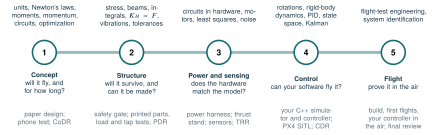
Five phases. Above each: the physics and mathematics it teaches, inside the module that first needs them. Middle: the question the phase answers. Below: its hardware milestones and the design review that closes it.
C. Calibrated to real jobs: the skills matrix#
How it was built. On 26 September 2026, 45 live engineering postings were read in full: 15 each from SpaceX, Tesla, and Lockheed Martin, three per company in each of five areas (mechanical design; test; controls and GNC, meaning guidance, navigation, and control; avionics and flight software, or embedded firmware at Tesla; and manufacturing), mixing early-career and senior roles. Each came from the company’s own careers system: SpaceX’s public job feed (2594 open jobs that day), Tesla’s careers site (8339 listings), and Lockheed Martin’s careers site, now hosted on Eightfold. Every posting’s skills were tagged with one fixed list, separately for basic qualifications, preferred qualifications, and responsibilities. Every count below was computed by script from that tagging.
What the postings actually ask for. Five findings, in order of how much they should shape your preparation:
- The most-requested skills are professional, not exotic. Communication and documentation appear in 35 of the 45 postings, requirements and verification in 28, ownership in a fast-paced team in 25, hands-on testing in 21, 3D CAD and mechanical design in 20, Python in 20, data analysis in 20, root-cause analysis in 18, hands-on building in 18, and C or C++ in 17. This track’s design reviews, test reports, and development log are practice for the first of these, not decoration.
- Mathematics is rarely named, because the degree stands in for it. Differential equations appear in none of the 45 postings, linear algebra in 2, and probability and statistics in 7. Hiring filters on the degree and tests the mathematics in interviews, which is why every phase ends with a closed-book checkpoint and a mock interview.
- Industry CAD is fragmented. SolidWorks and CATIA each appear in 6 postings, Siemens NX in 5 (four at SpaceX), and Creo in 4 (all Lockheed Martin). EL11 teaches NX and maps its concepts to the others; the concepts transfer, the menus do not.
- MATLAB and Simulink appear in 8. This track is Python-first; EL20 includes a short MATLAB bridge so the gap does not surprise you.
- Software is the exception on degrees (next table). Across SpaceX’s whole feed, experience can replace the degree in 277 of 351 software postings but in only 1 of 329 aerospace and mechanical postings.
| Skill | Which roles want it (of 45 postings: S = SpaceX, T = Tesla, L = Lockheed Martin) | Where the track covers it |
|---|---|---|
| Mathematics and physics | ||
| Calculus, trigonometry, physics fundamentals | 2 (S 1, T 0, L 1); required in 1 | Every module, just in time (EL01 onward); your calculus courses |
| Linear algebra | 2 (S 0, T 1, L 1); mostly controls/GNC; required in 2 | EL02 vectors and the mixer matrix; EL08 ; EL15 least squares; EL18–EL22 |
| Differential equations | none of these postings | EL09 vibrations; EL19 dynamics; EL20–EL21 control |
| Probability and statistics | 7 (S 2, T 1, L 4); mostly controls/GNC, manufacturing; required in 4 | EL10 tolerance stacks; EL15 calibration uncertainty; EL16 noise; EL22 Kalman filter |
| Numerical methods | 2 (S 0, T 1, L 1); required in 2 | EL01 integrating sensor data; EL08 finite elements; EL19 ODE integrators |
| Optimization | 3 (S 1, T 1, L 1); mostly controls/GNC; required in 2 | EL03 best battery size; EL05 trade studies; EL21 LQR |
| Mechanics | ||
| Statics and dynamics | 11 (S 4, T 3, L 4); mostly design, controls/GNC; required in 7 | EL01 forces and Newton’s second law; EL02 moments and balance; EL19 rigid bodies |
| Strength of materials, fatigue | 8 (S 5, T 2, L 1); mostly design, test; required in 1 | EL07 (fatigue introduced there; depth is a stretch) |
| Structures, composites, material selection | 10 (S 3, T 2, L 5); mostly design, manufacturing; required in 3 | EL07 materials; EL10 carbon-fibre plate and printed parts |
| Vibrations and modal analysis | 4 (S 3, T 0, L 1); mostly controls/GNC; required in 0 | EL09 |
| Fluids, aerodynamics, propulsion | 14 (S 9, T 1, L 4); mostly design, test, controls/GNC; required in 3 | EL03 momentum theory; EL14–EL15 electric propulsion. Partial: no CFD; rockets are F10 |
| Thermal and heat transfer | 6 (S 3, T 2, L 1); mostly design, test; required in 2 | Partial: EL14 motor and ESC heating only |
| Mechanisms, fasteners, joints | 7 (S 3, T 1, L 3); mostly design; required in 0 | EL10; EL12; EL25 assembly |
| Design and CAD | ||
| 3D CAD and mechanical design | 20 (S 9, T 6, L 5); mostly design, manufacturing, test; required in 15 | EL01 build123d; EL10; EL11 Siemens NX; EL12 the frame |
| Drawings, GD&T, tolerance analysis | 16 (S 4, T 4, L 8); mostly design, manufacturing, test; required in 7 | EL10; EL11 |
| Design for manufacture and assembly | 14 (S 6, T 6, L 2); mostly manufacturing, design; required in 4 | EL10; EL12; EL25 |
| Finite-element analysis | 6 (S 5, T 0, L 1); mostly design, manufacturing; required in 2 | EL08 (hand calculation vs FEA vs test) |
| Computational fluid dynamics | 1 (S 1, T 0, L 0); required in 0 | Not covered (a stretch pointer in EL03) |
| PLM and configuration management | 13 (S 3, T 2, L 8); mostly design, test, manufacturing; required in 0 | EL11 concepts (Teamcenter); EL12 design baselines. Partial |
| Manufacturing | ||
| Machining, 3D printing, composites | 5 (S 1, T 2, L 2); mostly manufacturing, design; required in 2 | EL10; EL12 fabrication; EL25 build |
| Process development, tooling, fixtures | 10 (S 4, T 3, L 3); mostly manufacturing; required in 6 | Partial: EL10 print process; EL15 test fixture; EL25 build procedure |
| Quality, SPC, inspection | 8 (S 2, T 2, L 4); mostly manufacturing; required in 3 | EL10 measurement and capability; EL15. Partial |
| Root cause and failure analysis | 18 (S 6, T 6, L 6); mostly manufacturing, test, design; required in 5 | EL17; EL26 anomaly reports; every phase review |
| Lean and Six Sigma | 6 (S 1, T 3, L 2); mostly manufacturing; required in 1 | Not covered |
| Welding, sheet metal, casting | 5 (S 3, T 2, L 0); mostly manufacturing; required in 2 | Not covered (the drone does not need them) |
| Automation and robotics | 5 (S 2, T 2, L 1); mostly manufacturing; required in 1 | Partial: EL20–EL21 control |
| Electrical and embedded | ||
| Circuits and schematics | 8 (S 4, T 3, L 1); mostly avionics/software; required in 3 | EL04; EL13 |
| Power electronics, motors, drives | 7 (S 4, T 2, L 1); mostly controls/GNC, avionics/software; required in 2 | EL04; EL14 |
| Batteries and energy | 6 (S 0, T 6, L 0); mostly avionics/software; required in 0 | EL01; EL04; EL06 safety |
| Harnesses and wiring | 2 (S 1, T 1, L 0); mostly test; required in 0 | EL13; EL25 |
| Sensors, instrumentation, data acquisition | 13 (S 4, T 5, L 4); mostly test, controls/GNC, design; required in 3 | EL01 phone test; EL15 load cells; EL16 IMU |
| Embedded hardware | 9 (S 1, T 4, L 4); mostly avionics/software; required in 3 | EL15 microcontroller; EL16; EL25 |
| PCB design | 1 (S 1, T 0, L 0); required in 1 | Stretch in EL13 (KiCad) |
| RF and EMI | 2 (S 0, T 0, L 2); required in 0 | Partial: EL06 radio rules; EL13 noise and grounding |
| Controls and GNC | ||
| Classical control (PID) | 10 (S 4, T 3, L 3); mostly controls/GNC, avionics/software; required in 8 | EL20 (builds on F01) |
| State-space control | 3 (S 1, T 1, L 1); mostly controls/GNC; required in 2 | EL21 |
| Estimation and Kalman filtering | 7 (S 2, T 3, L 2); mostly controls/GNC; required in 1 | EL22 (the EL01 drill previews it) |
| Guidance, navigation, orbital mechanics | 6 (S 3, T 0, L 3); mostly controls/GNC; required in 3 | Partial: EL22–EL23 navigation; orbits are F10 |
| Flight dynamics and 6-DOF simulation | 5 (S 3, T 0, L 2); mostly controls/GNC; required in 2 | EL18; EL19 |
| Simulation and modelling | 15 (S 5, T 5, L 5); mostly controls/GNC, avionics/software; required in 7 | Every module’s framework analysis; EL19; EL23 |
| System identification | 1 (S 0, T 1, L 0); required in 0 | EL28 |
| Software | ||
| Python | 20 (S 8, T 7, L 5); mostly controls/GNC, avionics/software, test; required in 10 | Every module (the hardware engine) |
| C and C++ | 17 (S 7, T 5, L 5); mostly avionics/software, controls/GNC, test; required in 12 | EL15 firmware; EL19–EL23; EL27 |
| MATLAB and Simulink | 8 (S 2, T 3, L 3); mostly controls/GNC; required in 5 | Partial: an EL20 bridge section; the track itself uses Python |
| Flight software, real-time, RTOS | 14 (S 4, T 5, L 5); mostly avionics/software, controls/GNC; required in 6 | EL20; EL23 PX4 (NuttX); EL27 |
| Software- and hardware-in-the-loop testing | 8 (S 2, T 3, L 3); mostly controls/GNC; required in 2 | EL23 SITL; EL25 HITL |
| Communication protocols | 7 (S 3, T 3, L 1); mostly avionics/software, test; required in 2 | EL14 DShot; EL16 sensor buses; EL23 MAVLink and uORB |
| Linux | 5 (S 1, T 1, L 3); mostly avionics/software; required in 2 | EL23 (WSL2 Ubuntu) |
| Testing, version control, CI | 14 (S 4, T 4, L 6); mostly avionics/software, controls/GNC, test; required in 4 | Every lab’s tests; your Git history; EL29 public CI |
| Data analysis and tooling | 20 (S 10, T 5, L 5); mostly test, controls/GNC, manufacturing; required in 4 | Every module; EL01 onward |
| Test | ||
| Test planning | 14 (S 5, T 6, L 3); mostly test, design, avionics/software; required in 5 | EL07 onward; EL15; EL17; EL26 |
| Hands-on testing and test stands | 21 (S 8, T 8, L 5); mostly test, design, controls/GNC; required in 11 | EL01 phone test; EL07; EL09; EL15 thrust stand; EL26 flight test |
| Environmental, qualification, acceptance testing | 15 (S 8, T 4, L 3); mostly test, manufacturing, design; required in 2 | Partial: EL09 vibration; EL17 qualification concepts |
| Systems engineering | ||
| Requirements, verification, validation | 28 (S 10, T 9, L 9); mostly controls/GNC, avionics/software, design; required in 2 | EL01 onward; EL05; EL17; EL28 |
| Trade studies | 9 (S 4, T 3, L 2); mostly design, controls/GNC; required in 0 | EL05 |
| FMEA, reliability, risk | 11 (S 4, T 4, L 3); mostly test, manufacturing, design; required in 0 | EL05 risks; EL17; EL24 |
| Design reviews and interface control | 17 (S 7, T 2, L 8); mostly design, controls/GNC, test; required in 1 | CoDR EL05; PDR EL12; TRR EL17; CDR EL24; final EL29 |
| Project management | 6 (S 5, T 0, L 1); mostly manufacturing; required in 0 | Partial: phase plans and reviews |
| Working style | ||
| Communication and documentation | 35 (S 13, T 8, L 14); mostly design, test, avionics/software; required in 12 | Every review, test report, and development-log entry |
| Hands-on building (incl. student teams) | 18 (S 9, T 7, L 2); mostly design, test, manufacturing; required in 12 | Phases 2, 3, and 5: the drone itself |
| Ownership in a fast-paced team | 25 (S 12, T 6, L 7); mostly design, test, controls/GNC; required in 9 | The whole project, end to end |
“Required in” counts the postings that list the skill among their basic (required) qualifications. Areas list the posting areas where the skill appears at least twice. Partial and not-covered rows are stated plainly; the track covers what the drone needs, plus what the postings demand most.
Degrees, citizenship, and clearances#
| SpaceX | Tesla | Lockheed Martin | |
|---|---|---|---|
| Engineering degree required | 6 | 0 | 6 |
| Engineering or other STEM degree (physics, mathematics, computer science) required | 7 | 0 | 4 |
| Degree or equivalent experience | 2 | 13 | 2 |
| No degree listed | 0 | 2 | 3 |
| US person or citizen required (stated) | 15 | 0 | 9 |
| Security clearance required | 0 | 0 | 12 |
The honest reading. At SpaceX, 13 of these 15 engineering roles require a bachelor’s degree in engineering or a related STEM field; the two that accept experience instead are both flight software. Every SpaceX role requires ITAR eligibility (US person status). At Lockheed Martin, 10 of 15 require a degree, 12 require a security clearance, and the six postings that do not state citizenship all require a clearance, which requires it. Tesla is the outlier: 13 of 15 accept a degree or equivalent experience, often adding “evidence of exceptional ability,” two list no degree at all, and several count student design teams or projects as experience. This track builds the skills, the evidence, and the interview fluency; it does not replace the degree for the roles that gate on one. Section M returns to what that means for your choices.
Rechecking the matrix. At the start of every phase, collect a fresh set of postings the same way: three per company in each of the five areas, from the companies’ own careers sites, mixing early-career and senior roles. Save each one with its date and URL, tag its skills with the same fixed list (the table’s rows), separately for basic qualifications, preferred qualifications, and responsibilities, and recount. Let the new counts, not this edition’s, set the next phase’s emphasis. The 45 postings behind this edition are listed at the end of the chapter.
D. The five phases at a glance#
| Phase | Modules | You finish with | Hours |
|---|---|---|---|
| 1. Concept | EL01–EL05 | A closed sizing loop: requirements, mass budget, propulsion and power sized from first principles and data, a trade study that chooses your drone’s class within your budget, and a Concept Design Review package | 112 |
| 2. Structure | EL06–EL12 | The safety gate passed; a frame designed in code and in Siemens NX, analysed by hand, by finite elements, and by test; printed parts load-tested and tap-tested against predictions; a Preliminary Design Review | 154 |
| 3. Power and sensing | EL13–EL17 | A power harness you soldered, motors and ESCs characterized, a thrust stand you built with a test report of predicted versus measured, sensor noise measured, a Test Readiness Review | 116 |
| 4. Control | EL18–EL24 | Your own 6-DOF simulator and attitude controller in C++, a Kalman filter, your controller running as a PX4 module in software-in-the-loop simulation, an FMEA, and a Critical Design Review | 170 |
| 5. Flight | EL25–EL29 | The drone built, first flights on stock PX4, then your controller in the air, system identification that closes the loop between model and flight, and a public final review | 108 |
| Total, including a checkpoint at the end of each phase | 660 | ||
At about 9 hours a week that is roughly 17 months. The mathematics (Calculus II and III, linear algebra, differential equations, probability and statistics) runs alongside, from this book’s chapters or from courses you take, and is shared with the AI Lab; each module teaches its slice just in time and points to those chapters for depth.
E. Module by module#
This book teaches EL01 in full, in the next chapter. The entries below map the rest of the route: what each module teaches, its hours, and what it needs before you start it.
Phase 1: Concept. Will it fly, and for how long? (paper design; no purchases)#
- EL01 Why a drone hovers: forces, units, and your first design loop (20 h; the next chapter). Units as exponent bookkeeping, mass versus weight versus gram-force, Newton’s second law and free-body diagrams, what an accelerometer measures (tested with your phone), thrust-to-weight, the mass budget with growth allowances, energy and flight time, the mass spiral, verifiable requirements, and your first parametric CAD part. Math: derivatives as rates (Module 12), trapezoid accumulation (preview of Modules 16 and 23). You write: the hover, energy, mass-budget, CAD, and integration cores. Code reading: PX4’s hover thrust estimator. Needs: Calculus I through the chain rule (Modules 08–11); Python 3.14.
- EL02 Balance: vectors, moments, the centre of mass, and the mixer (20 h). Vectors and components, torque as in the plane, equilibrium of forces and moments, the centre of mass from sums (then integrals, Module 19), how an off-centre battery changes each motor’s share, yaw from propeller drag torque, and the matrix that turns roll, pitch, yaw, and thrust commands into four motor commands. Math: first contact with vectors and matrices (A01). Physical test: find a real object’s centre of mass by balancing, predicted from CAD. Needs: EL01; right-triangle trigonometry (Module 04).
- EL03 Why propellers push: momentum theory and hover power (22 h). Momentum and mass flow, the actuator disk, induced velocity, ideal hover power , figure of merit, disk loading, air density with altitude and temperature, thrust and power coefficients, and the optimum battery with Module 14’s optimization. Cross-check: momentum theory against the manufacturer’s thrust tables. Needs: EL01; Module 14’s optimization for the optimum battery.
- EL04 The electrical side on paper: circuits, batteries, and brushless motors (24 h). Charge, current, voltage, resistance, power, Kirchhoff’s laws; battery internal resistance and voltage sag; C-ratings; the brushless motor’s constants (, , winding resistance, no-load current); the motor and propeller operating point by Newton’s method (Module 15); flight time with a sagging battery. Needs: EL01 and EL03; Module 15’s Newton’s method.
- EL05 Trade studies and the Concept Design Review (18 h). Closing the sizing loop by fixed-point iteration, sweeping two design variables with contour plots, weighted trade matrices and their traps (sensitivity), cost as a design variable, and the choice of your drone’s class and first bill of materials within the budget you set. A one-page supply-chain sidebar checks every part against the FCC Covered List, the Blue UAS list, and the 2026 import duties (section F), the same rules that decide what drone companies can sell. It ends with your CoDR (section J says how to run a review). Needs: EL01–EL04, and your budget and the equipment you own.
- Checkpoint 1 (8 h): see section J.
EL-S: a software-only PX4 lab, long before any hardware#
- EL-S PX4 in simulation, and its logs (about 10 h, in addition to the 29 modules’ 660; it needs WSL2, which AI Lab Module 3 also installs). Build PX4 v1.17.x, fly scripted missions in Gazebo Harmonic with MAVSDK-Python, inject one failure (a lost GPS, a dying battery) and watch the failsafe state machine respond, then analyze the flight logs with pyulog and write one predicted-versus-measured note. Drone companies’ 2027 internship postings ask for exactly this (software-in-the-loop testing and log analysis), and it costs no hardware and no money. It introduces each tool it uses (MAVSDK, the failsafe state machine, pyulog) at the level the lab needs; EL23 and EL24 go deeper and reuse the setup with your own drone and controller. Needs: WSL2 Ubuntu 24.04.
Phase 2: Structure. Will it survive, and can it be made? (first hardware: printed test parts)#
- EL06 Safety gate: LiPo batteries, propellers, the shop, and the FAA (10 h). Before any hardware work. LiPo charging, storage, transport, damaged packs, and fire response; propeller safety and the props-off rule; soldering and shop safety; the FAA’s recreational and Part 107 rules, registration, Remote ID, airspace, and the FPV visual-observer rule; FCC rules for video and control radios. Gate: your written safety plan reviewed by a mentor or an experienced pilot, a safety quiz, and your TRUST certificate (free). Needs: EL05’s bill of materials, the thing it makes safe to buy and use.
- EL07 Stress, strain, and beams: will the arm break? (24 h). Stress, strain, Hooke’s law, strength and stiffness of printed plastics, carbon-fibre plate, and aluminium, safety factors, bending derived from the moment diagram, with as an integral, and cantilever deflection by integrating twice. Math: integrals as accumulated sums (Modules 16–19, just in time). Physical test: a printed arm coupon loaded with weights, deflection predicted first. Needs: EL02’s moments and EL06’s gate; integrals (Modules 16–19) are taught here.
- EL08 Finite elements: when hand calculations run out (26 h). Springs in series and parallel, the stiffness matrix, solving (A01’s linear systems, just in time), your own 1D bar and beam solver, mesh convergence, then 3D finite elements on your CAD arm with gmsh and scikit-fem, and stress concentration at holes. The three-way check: hand calculation against FEA against the EL07 test. Needs: EL07; A01’s linear systems are taught here.
- EL09 Vibrations: natural frequencies, resonance, and the FFT (24 h). The mass-spring-damper and its differential equation (Module 25, A06), natural frequency, damping, resonance, the arm’s first bending mode, motor speeds as forcing frequencies, sampling, aliasing, and the FFT. Physical test: a tap test on your printed arm, recorded with your phone’s microphone, against the predicted frequency. Needs: EL07; differential equations (Module 25, A06) are taught here.
- EL10 Design for manufacture: tolerances, GD&T, printing, and machining (24 h). Fits and clearances, tolerance stacks by worst case and by root-sum-square (probability and statistics just in time: A03–A04), GD&T’s datums and feature controls, 3D-printing design rules (orientation, infill, holes, heat-set inserts), machining and carbon-plate cutting rules, drawings from code, and checking your motor’s real mounting pattern. Physical test: a printed fit coupon measured with calipers against prediction. Needs: EL07 and Geometry bridge B1 (projections); probability and statistics (A03–A04) are taught here.
- EL11 Industry CAD: Siemens NX, and how it maps to build123d (16 h). Sketches and constraints, features and history, assemblies, drawings with GD&T, and PLM concepts (Teamcenter), in Siemens’s free student edition of NX’s successor, Designcenter; your arm rebuilt there and its mass properties cross-checked against build123d; the same concepts named in CATIA, SolidWorks, and Creo. Needs: EL10’s drawings and GD&T, and Geometry bridge B2 (sketches); a Windows PC for Designcenter.
- EL12 The frame and the Preliminary Design Review (22 h). The full frame assembly, clearances, the stack and battery mounts, every analysis run on the real design, interface definitions, and the PDR. Milestones: after the review passes, the frame is fabricated (printed or cut) and the Phase 3 bench set is bought (section F). Needs: EL07–EL11.
- Checkpoint 2 (8 h).
Phase 3: Power and sensing. Does the hardware match the model? (bench electronics; propellers only on a shielded stand)#
- EL13 Circuits in hardware: power distribution, measurement, and soldering (22 h). Wire gauge and voltage drop, connectors, fuses, voltage regulators, grounding and noise, using a multimeter, and soldering technique. Physical tests: your harness’s voltage drop and your pack’s internal resistance, each predicted first. Needs: EL04 and EL06’s LiPo and soldering sections; the second purchase (section F).
- EL14 Brushless motors and ESCs, measured (22 h). Back-EMF and the – relation derived, three-phase commutation, what an ESC does, PWM and DShot, and measuring a motor’s constants against its data sheet. Needs: EL04 and EL13.
- EL15 The thrust stand: predicted versus measured propulsion (26 h). Load cells and strain-gauge bridges, a 24-bit ADC, microcontroller firmware in C++, calibration by least squares (A02, just in time), measurement uncertainty, a test plan, and the three-way check: momentum theory against the maker’s table against your stand. Milestone: your first formal test report. Needs: EL03, EL13, and EL14; least squares (A02) is taught here.
- EL16 Sensors, noise, and filtering (24 h). MEMS gyroscopes and accelerometers (EL01’s accelerometer returns), noise, bias, and random walk, sampling and filtering, magnetometer calibration, and barometric altitude. Math: random variables, variance, and the Gaussian (A03). Physical test: your flight controller’s noise at rest and with motors spinning (propellers off). Needs: EL13; random variables (A03) are taught here.
- EL17 Test engineering and the Test Readiness Review (14 h). Test plans and procedures, pass and fail criteria, anomaly investigation and root cause, qualification and acceptance testing, and an introduction to FMEA. Needs: EL15 and EL16.
- Checkpoint 3 (8 h).
Phase 4: Control. Can your software fly it? (simulation first)#
- EL18 Rotations and frames (20 h). Rotation matrices, Euler angles and gimbal lock, quaternions, body and world frames (PX4’s north-east-down), and angular velocity. Math: matrix multiplication and orthogonality (A01–A02, W06). Needs: EL02; A01–A02 and W06.
- EL19 Rigid-body dynamics and your 6-DOF simulator in C++ (26 h). Angular momentum, the inertia tensor from your CAD, Euler’s equations, the quadrotor’s forces and moments, and numerical integration (Euler, semi-implicit Euler, RK4) with energy checks. Cross-check: your simulator against analytic cases and against an independent quadcopter simulator (section L). Needs: EL02 and EL18; your C++.
- EL20 PID: rate and attitude control in your simulator (26 h). Linearization about hover (Module 13), step responses, cascaded rate and attitude loops as PX4 structures them, saturation and anti-windup, derivative filtering, control allocation, and tuning by measurement. Builds on F01. Includes a short MATLAB and Simulink bridge. Needs: EL19 and F01’s PID; Module 13’s linearization.
- EL21 State space, stability, and LQR (20 h). State-space models, eigenvalues and stability (A02), controllability, pole placement, LQR, discretization, and the effect of sample rate and delay. Needs: EL20; eigenvalues (A02).
- EL22 Estimation: from complementary filter to Kalman filter (26 h). Fusing gyroscope and accelerometer, the one-dimensional Kalman filter derived, attitude estimation, tuning from EL16’s measured noise, and PX4’s EKF2 read and compared on your logs. Math: Gaussians and covariance (A03–A04, G04). Needs: EL16, EL18, and EL20; A03–A04 and G04.
- EL23 PX4 and software-in-the-loop: your controller as a PX4 module (28 h). WSL2 Ubuntu, building PX4, uORB, modules, parameters, MAVLink, Gazebo with a model of your drone generated by the engine, QGroundControl, and your attitude controller ported into PX4 and tested by scripted flights. The practices flight-software postings name are drilled here: mission state machines, fault handling, tests run in simulation before any hardware, and debugging on Linux. Needs: EL19–EL22; WSL2 Ubuntu, already set up for EL-S (or in AI Lab Module 3).
- EL24 FMEA, failsafes, and the Critical Design Review (16 h). Failure modes and effects, failsafe design (radio loss, low battery, geofence, motor failure), the first-flight test plan, documentation with system diagrams and requirements, and the CDR. Milestone: the rest of the flight hardware purchased after the review passes, within your budget (section F). Needs: EL17 and EL23.
- Checkpoint 4 (8 h).
Phase 5: Flight. Prove it in the air.#
- EL25 Build, integrate, and hardware-in-the-loop (22 h). Assembly, wiring, firmware, calibration, motor order and direction, failsafes, props-off function tests, and hardware-in-the-loop runs of your controller. Needs: EL24’s review passed and the third purchase (section F).
- EL26 Flight-test engineering and first flights on stock PX4 (22 h). Flight-test plans and cards, a build-up approach (tethered, then hover, then steps), go/no-go criteria, log analysis, and predicted versus measured for hover throttle, flight time, and vibration. Prerequisites: registration, Remote ID, and TRUST, or a Part 107 certificate (section F). Needs: EL25, plus the legal prerequisites above.
- EL27 Your controller in the air (22 h). Staged hand-over from PX4’s controller to yours, step and disturbance tests compared with your simulations, and anomaly reports. Needs: EL23 and EL26.
- EL28 System identification: closing the loop between model and flight (20 h). Estimating thrust coefficients, inertia, and time constants from flight logs by least squares, updating every model, and the final predicted-versus-measured report. Needs: EL26 and EL27; least squares (A02).
- EL29 Final design review and public release (14 h). The final review, a flight video with numbers on screen, the cleaned public repository, and your three portfolio bullets. Needs: Everything before it.
- Checkpoint 5 (8 h).
F. Hardware milestones, safety gates, and money#
| Module | Milestone | Gate before it |
|---|---|---|
| EL01 | Phone accelerometer test | None: no batteries, motors, or propellers |
| EL-S | PX4 software-in-the-loop lab | None: no hardware |
| EL05 | First bill of materials, bought in three steps | Your budget and the equipment you own, settled before any purchase |
| EL06 | Purchase 1: tools and printing materials you do not already own (calipers, filament or a print service, weights for load tests) | EL05’s bill of materials; EL06’s shop-safety section |
| EL07 | Printed test coupons, loaded with weights | EL06 safety gate passed |
| EL09–EL10 | Tap test; fit coupons | EL06 |
| EL12 | Frame fabricated | PDR passed |
| EL12 | Purchase 2, the bench set: the motors, ESCs, and propellers chosen at the PDR, a LiPo pack with a proper charger and fire-safe storage, the flight controller, thrust-stand parts, and a multimeter and soldering station if you lack them | PDR passed; EL06’s LiPo sections |
| EL13 | Power harness, multimeter, soldering | EL06 (LiPo and soldering sections) |
| EL15 | Thrust stand, propellers on | Shielding, a written procedure, eye protection, TRR (EL17 formalizes it) |
| EL16 | Flight controller on the bench | Propellers off |
| EL23 | Software-in-the-loop only | None: no hardware |
| EL24 | Purchase 3: the rest of the flight hardware (receiver and radio, GPS, a Remote ID module, spare propellers, arms, and a pack) | CDR passed |
| EL25 | Full build, hardware-in-the-loop | CDR passed; propellers off until EL26 |
| EL26 | First flight, stock PX4 | Registration, Remote ID, TRUST or Part 107; flight-test plan approved |
| EL27 | First flight with your controller | SITL and HITL evidence reviewed; staged hand-over plan |
The rules your drone will fly under in the United States (EL06 teaches them in full; checked 26 September 2026 and rechecked 17 October 2026, when the FAA’s pages had only regrouped these rules under a “Fly SMART” heading; elsewhere, your national aviation authority sets the equivalent rules). A drone flown only for recreation must be registered if it weighs more than 0.55 lb (about 249.5 g) at take-off, and then must broadcast Remote ID; a home-built drone uses an FAA-accepted broadcast module or flies only inside an FAA-Recognized Identification Area. Recreational pilots pass the free TRUST test, follow a recognized community-based organization’s safety guidelines, stay at or below 400 ft in uncontrolled airspace, and keep visual line of sight, which means a co-located visual observer when flying with FPV goggles. Flying that is not purely recreational falls under Part 107: a Remote Pilot Certificate (knowledge test, then free recurrent training every 24 months) and registration of every drone whatever its weight. The FAA advises flying under Part 107 whenever you are not sure which rules apply, and flights that produce material to advance a career or business fit its reading of non-recreational use. Plan to earn the Part 107 certificate before Phase 5; drone companies ask for it too. Two newer rules matter. States add their own: from 1 November 2026, for example, Oklahoma law (SB 1441) makes it an offense to fly intentionally below 400 ft over fenced or posted critical infrastructure (substations, cell towers, pump and gas-regulator stations, regulated dams, rail yards) without written consent, with no exemption for hobby flights; check your own state’s laws and choose test sites accordingly. And the FAA’s Part 108 rule for routine flight beyond visual line of sight has been under White House review since 10 July 2026 and is not yet law, so none of this track’s flights assume it.
Money. Decide your budget, and list what you already own (a 3D printer, a soldering station, a multimeter), before you buy anything. EL05 turns that budget into a first bill of materials, bought in three steps so that money follows evidence: tools and printing materials after EL06, the bench set after EL12’s PDR, and the rest of the flight hardware after EL24’s CDR. Facts that affect it, as of 17 October 2026 (recheck every one on the day you buy; EL05 shows how):
- FCC. After the December 2025 Covered List action, a further FCC rule in force since 13 October 2026 bars new FCC authorizations for any device containing logic-bearing parts from listed companies (DJI and Autel among them), and the same rulemaking requires online marketplaces to display each product’s FCC ID. Gear that was already authorized can still be sold, used, and repaired with identical parts. Exemptions for Blue UAS and Buy American products run to 1 January 2028, and toy drones were exempted in June 2026.
- Import duties (Proclamation 11055, August 2026). From 3 September 2026: 25% on imported drones of 25 kg or less without thermal imaging, sub-250 g models included, and 100% on thermal-imaging drones, drones over 25 kg, and docking stations. From 9 February 2027: 25% on imported airframe parts (propellers, rotors, landing gear, and other parts under tariff heading 8807). The lower rates for partner countries cannot yet be claimed, and there is no exemption for small personal orders. The 100% list also names two general electronics codes, static converters (8504.40.9580) and control boards (8537.10.9170), grouped with docking stations; whether a hobby ESC or flight controller falls under one of them is a classification question, so EL05 checks each part’s code. Motors (heading 8501) and batteries (8507) are not on the list.
G. Tools: when each is installed, and what forces WSL2#
| Module | Tool | Why, and what to know |
|---|---|---|
| EL01 | Python 3.14.2 and a virtual environment with pint 0.26.1, numpy 2.5.3, matplotlib 3.11.2, build123d 0.13.0 | Pinned in the companion code’s eng-lab/pyproject.toml; installed together and tested on Windows on 26 September 2026. build123d’s geometry kernel, OCP 8.0.1, ships a Windows wheel for Python 3.14, so no second Python and no WSL2. |
| EL01 | phyphox (free, iOS and Android) | The phone test’s recorder; exports CSV with units in the headers. |
| EL01 | build123d-mcp (optional, not needed) | A community MCP server that would let an AI assistant render and measure CAD directly. Version 0.3.90 is maintained but pins build123d below 0.12 (your designs use 0.13), and it runs generated code through a sandbox its own maintainer documents as escapable. The engine’s hwe/cad/drawing.py and boundary.py render and measure with the exact library your designs use. Installing it is your decision; section M’s recommendation is to wait for a release that supports build123d 0.13. |
| EL08 | gmsh 4.15.2, scikit-fem 12.0.2 | Meshing and finite elements; Windows wheels exist; installed into the same environment. |
| EL11 | Siemens Designcenter Student Edition (NX’s successor for students: Designcenter CAD plus NX CAM) | Free, no student verification, a one-year licence, Windows only; minimum age 15, a new account at each renewal, and new releases each June and December (Siemens, August 2026). Its predecessor’s licence watermarked drawings and blocked commercial NX from opening student files; assume the same until EL11 confirms. The 2026 announcement says CAD, CAM, and CAE but names no finite-element module; EL11 rechecks both. Fallback: Solid Edge Community Edition (free for personal use). |
| EL13 | KiCad (stretch) | Circuit and board design; free. |
| EL16 | QGroundControl 5.1.4 | Ground-control station; runs natively on Windows. |
| EL19–EL20 | Visual Studio 2026, CMake 4.2.3 | Your C++ simulator and controller. |
| EL-S, EL23 | WSL2 with Ubuntu 24.04, PX4 v1.17.x (pinned), Gazebo Harmonic; for ROS 2 work, ROS 2 Jazzy with the XRCE-DDS Agent v2.4.3 | PX4’s Windows development environment is WSL2 only: PX4 builds and runs its simulator in Ubuntu 24.04, and QGroundControl on Windows connects to it over UDP. Pin v1.17.x: v1.18’s release candidates (September 2026) change how MAVLink signing is set up and rename the RC-override and EKF2 sensor parameters. ROS 2’s new long-term release, Lyrical (May 2026), is fully supported only on Ubuntu 26.04 and Windows 11, and PX4 does not yet support Ubuntu 26.04, so stay on Jazzy as PX4’s guide recommends. Install Ubuntu 24.04 under WSL2 then (or earlier, if AI Lab Module 3 gets there first; both tracks share it). On a Mac, Gazebo on Apple Silicon is officially documented only from PX4 v1.18. |
| EL-S, EL23, EL26 | MAVSDK-Python 4.0.0, pymavlink 2.4.50, pyulog 1.2.4 | Scripted flights and log analysis; MAVSDK 4.0 is a breaking rewrite, so examples older than 2026 will not match. |
H. The hardware engine: architecture#
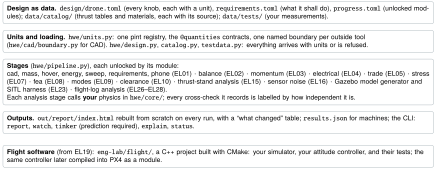
The engine in layers. Each module’s lab adds a stage and the core file it needs; python -m hwe status lists what is unlocked, what waits for your code, and what comes next.
Five rules the engine enforces.
- No number without a unit. Every public function checks the dimensions of its inputs and outputs, and a bare number is refused at the boundary.
- Design as data. Every knob lives in one text file, so every design change is a reviewable diff in your Git history.
- Every key result twice. Each key result gets a second route: a hand calculation, a different model or data set, or a measurement. The report labels how independent each route is (only a different method or different data can catch a wrong model) and flags any disagreement beyond its tolerance.
- Nothing typed by hand into a report. The report is regenerated from the design on every run.
- Your understanding sets the pace. A stage unlocks only when you reach the module that teaches it (
design/progress.tomlrecords which), and you must be able to read and change every line of it; each module includes a “read and change the engine” task.
| You write | The companion code provides |
|---|---|
The physics and engineering core of every module (hwe/core/: hover, energy, mass budget, integration, beams, stiffness matrices, natural frequencies, tolerance stacks, motor models, least squares, filters, the 6-DOF dynamics, the attitude controller in C++); your parametric parts after the first worked one; your requirements, predictions, test plans, test reports, design-review packages, and development log. | The units system, loaders, pipeline, report, and CLI; CAD boundaries and drawings; FEA meshing wrappers; the Gazebo model generator and SITL harness; data plumbing; starters for the files you write; tests that fail on real beginner mistakes; and the interactive explorers. |
- Your lab repository: your own copy of the companion code’s
eng-labfolder, under your own Git and designed to become public. Each module addslabs/elNN_<name>/with its tests andcheck.py, plus starters for the files you write. - Tests that were themselves tested. EL01’s tests were run against 86 copies of the code, each with one plausible beginner bug planted in it, and against four correct alternative designs: every bugged copy fails at least one test, and all four alternatives pass.
- The book holds the teaching; the repository holds the code. Attempt each step, let the tests judge it, and turn to the chapter’s worked listings, hint ladders, and solutions when you are stuck.
I. How every module runs#
- Spaced review first, from your error log.
- Picture first, then one idea at a time, with one small worked example, every symbol defined, a faded example, and a “say it back” prompt.
- The tinker loop. Every concept comes with a knob in the engine. You write a prediction, run
python -m hwe tinker, and explain the result; the log is part of the gate. - Predicted versus measured. Every physical test starts with a written prediction saved before the data exists, and ends with a table of prediction, measurement, difference, and why.
- Named misconceptions and mistakes, each with its symptom and the test that catches it.
- Worked, then faded, then solo in the lab, with a three-rung hint ladder per step; the tests say when your code is right.
- A code-reading drill from real flight or engineering code, pinned to a commit.
- A mastery gate: tests on your own code, a closed-book quiz, a teach-back, and the drill answers.
- A development-log entry, and optional stretch work where the advanced material lives.
- Safety boxes wherever hardware appears, and no hardware before its gate.
- AI in three zones, as LM’s section I sets them: none on first attempts, predictions, gates, or checkpoints; concepts and hints only after a logged attempt, each use recorded in your AI-use log (date, task, what you asked, what you then did yourself); chores any time.
J. Prove it without AI: how each phase ends#
Interviewers test your head, not your agent. Each phase ends with three parts, all without notes or AI. Gaps go into your error log and into the next phase’s spaced review.
| Phase | Closed-book checkpoint: derive and explain on paper | Mock design review | Mock interview |
|---|---|---|---|
| 1 | Hover and climb from a free-body diagram; and its consequences; moments and the centre of mass; momentum theory’s hover power; the optimum battery; battery sag; a unit conversion chain | Concept Design Review (CoDR) | SpaceX style: first principles, ownership, estimation |
| 2 | Beam stress and deflection from the moment diagram; the stiffness matrix of two springs; a single-degree-of-freedom natural frequency; a root-sum-square tolerance stack | Preliminary Design Review (PDR) | Tesla style: mechanical design, manufacturability, cost |
| 3 | Ohm’s and Kirchhoff’s laws on a harness; and ; least squares for a calibration line; aliasing; a strain-gauge bridge | Test Readiness Review (TRR) | Lockheed Martin style: test, requirements and verification, process |
| 4 | A rotation matrix; Euler’s equations for a symmetric quad; a PID loop’s step response; the one-dimensional Kalman gain | Critical Design Review (CDR) | SpaceX style: GNC and flight software |
| 5 | A flight-log analysis explained end to end; your model against your flight data | Final review | All three styles, one each |
Who runs the reviews. Ask someone to play a skeptical senior hardware engineer: a mentor, an engineer you know, a teacher, or a study partner. The reviewer asks one question at a time, judges your reasoning rather than whether a number matches, and grades the checkpoint against its row of the table above. Working alone, use that row as your checklist: derive each item on paper, closed book, then present the phase’s package (section K) aloud as if to a board, and log every question you could not answer. The company “styles” come from publicly described engineering cultures and this chapter’s skills matrix, not insider knowledge.
K. What a hiring engineer can see after each phase#
| Phase | Portfolio output |
|---|---|
| 1 | The CoDR package: requirements with verification methods, the sizing report from your hardware engine, the trade study; the repository’s first public version; a first draft of your three portfolio bullets. |
| 2 | The PDR package: CAD renders and drawings, the arm’s three-way analysis (hand, FEA, test), and test reports with predicted versus measured deflection, frequency, and fit. |
| 3 | The thrust-stand test report (the momentum theory, manufacturer, and measured curves on one plot), your stand’s firmware, and a bench-integration video. |
| 4 | Your C++ simulator and controller with their tests; a SITL video with step responses beside your predictions; the CDR package with its FMEA. |
| 5 | A flight video with telemetry on screen; the final predicted-versus-measured report across the whole design; the public repository; the final three bullets: the hardest problem you solved and how. |
L. How this track fits the rest of the book#
- Frontier engineering (Part X). This track is F00’s third flagship project, “Flight software you can fly,” built out in full. It covers the topics F00 plans for F02 (rotations and frames: EL18), F03 and F04 (Kalman filter, EKF, and sensor fusion: EL16 and EL22), F07 (multirotor dynamics and cascaded control: EL19–EL20), F08 (flight software, uORB, MAVLink, SITL: EL23–EL24), and F09 (piloting and Part 107: EL06 and EL26), so if you follow this track, it is your route through them. F01 (PID and pure pursuit) is EL20’s prerequisite; F10 (rocket and spacecraft GNC) stays separate, because rockets are beyond this drone.
- The AI Lab. Both tracks share the mathematics spine, WSL2 Ubuntu, and C++, and both compete for the same hours (section M).
- Earlier chapters for depth. Calculus Modules 12–19 (motion, optimization, integrals, work, centre of mass), 23 (numerical integration), 25 (differential equations), 33–40 (vectors, multiple integrals); A01–A02 (linear algebra), A03–A04 (probability and statistics), A06 and W05 (differential equations and trustworthy simulation), T04 (embedded, feedback, estimation), T05 (aerospace computing), and J04 (a numerical simulator validated against analytic solutions).
- Other people’s simulators. EL01 takes numbers from the quadcopter simulator in the author’s FateMMO engine, written in C++ (RK4 integration, thrust , drag, a battery model, and MAVLink telemetry, with an X500-class vehicle at ), and EL23 flies PX4’s own Gazebo simulation. A simulator someone else wrote is an independent cross-check for your own (EL19) and good code-reading material, never a substitute for code you write.
M. Honest limits, and the honest estimate#
- The degree. Section C’s evidence is plain: SpaceX’s and Lockheed Martin’s hardware engineering roles require an engineering or STEM bachelor’s degree, and Lockheed Martin’s usually require a clearance too. The routes this track strengthens without a degree are Tesla (13 of 15 accept equivalent experience), software-heavy roles such as flight software (which accept experience at SpaceX), drone companies, and technician and test roles; the route it strengthens most is an engineering degree itself, which you would start with a working drone, a portfolio, and a head start in every hard course. Which route is a decision for you; the track serves all of them.
- Time. About 660 hours here plus the shared mathematics; the AI Lab is about 2,200 hours. Together that is roughly three years at 20 hours a week. A realistic sequence: Phase 1 (paper, no purchases) alongside Calculus II and the AI Lab’s first modules, then a deliberate choice of which track leads, based on which of the two careers you want first.
- Money and breakage. Hardware breaks, especially during first flights; budget for spare propellers, arms, and a battery, and treat a crash as data, with an anomaly report.
- Safety and law. LiPo fires, spinning propellers, and airspace rules are real. The gates in section F are not optional, and the rules are rechecked when each gate arrives.
- build123d-mcp. Recommended: do not install it yet (section G); the engine already renders and measures with the same library your designs use. Revisit when it supports build123d 0.13.
- Scale. A 1 kg quadcopter is not a rocket. The physics, the discipline (requirements, reviews, predicted versus measured), and the software patterns transfer; the sizes, hazards, and paperwork do not.
N. The route in months#
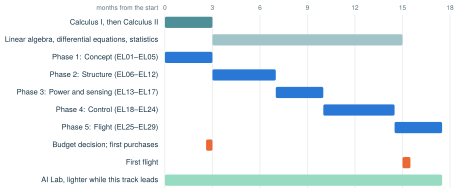
Months from the start, at about 9 hours a week. “Plan your path” in Part I fits this track beside the others at the hours you actually have. A plan, not a promise: each phase’s real hours, from your development log, correct the rest of the timeline.
The 45 postings behind the skills matrix (collected 26 September 2026)#
“US / clr”: whether the posting states that US-person status or citizenship is required, and whether a security clearance is required (a clearance itself requires US citizenship). Postings close and change; each entry is as it stood on 26 September 2026.
| Company | Title | Area | Level | Degree | US / clr |
|---|---|---|---|---|---|
| SpaceX | New Graduate Engineer, Mechanical (Starship) | design | entry | STEM degree | yes / – |
| SpaceX | Mechanical Design Engineer (Falcon) | design | entry | engineering degree | yes / – |
| SpaceX | Sr. Mechanical Design Engineer (Starship Components) | design | senior | STEM degree | yes / – |
| SpaceX | New Graduate Engineer, Launch & Test (Starship) | test | entry | STEM degree | yes / – |
| SpaceX | Propulsion Engineer (Raptor Test) | test | entry | engineering degree | yes / – |
| SpaceX | Lead Development Test Engineer (Starlink) | test | senior | engineering degree | yes / – |
| SpaceX | New Graduate Engineer, GNC- ’26/’27 (Starlink) | controls/GNC | entry | STEM degree | yes / – |
| SpaceX | GNC Engineer, Starlink Controls (Starlink) | controls/GNC | entry | STEM degree | yes / – |
| SpaceX | Sr. GNC Engineer (Starship) Controls | controls/GNC | senior | STEM degree | yes / – |
| SpaceX | Electrical Design Engineer (Falcon & Dragon Avionics) | avionics/software | entry | engineering degree | yes / – |
| SpaceX | Software Engineer, Flight Software (Starlink) | avionics/software | entry | degree or equivalent | yes / – |
| SpaceX | Sr. Software Engineer, Flight Software (Starship) | avionics/software | senior | degree or equivalent | yes / – |
| SpaceX | New Graduate Engineer, Manufacturing (Starship) | manufacturing | entry | STEM degree | yes / – |
| SpaceX | Manufacturing Engineer (Falcon & Dragon) | manufacturing | entry | engineering degree | yes / – |
| SpaceX | Sr. Manufacturing Engineer (Starship) | manufacturing | senior | engineering degree | yes / – |
| Tesla | Robotics Mechanical Design Engineer, Hand, Optimus | design | entry | degree or equivalent | – / – |
| Tesla | Mechanical Design Engineer, Interiors | design | mid | degree or equivalent | – / – |
| Tesla | Staff Mechanical Design Engineer, Battery Pack, Semi | design | senior | degree or equivalent | – / – |
| Tesla | Validation Engineer, Industrial Energy Products | test | entry | degree or equivalent | – / – |
| Tesla | High Voltage Distribution Test Engineer | test | mid | degree or equivalent | – / – |
| Tesla | Sr. Vehicle Test Engineer, Semi | test | senior | degree or equivalent | – / – |
| Tesla | Applied Reinforcement Learning Engineer, Whole Body Controls, Optimus | controls/GNC | entry | none listed | – / – |
| Tesla | Vehicle Dynamics Controls Engineer, Vehicle Controls | controls/GNC | mid | degree or equivalent | – / – |
| Tesla | Sr. Power Electronics Controls Engineer, Energy Products | controls/GNC | senior | degree or equivalent | – / – |
| Tesla | Embedded Firmware Engineer, Battery Management System | avionics/software | entry | degree or equivalent | – / – |
| Tesla | Embedded Software Engineer, Optimus | avionics/software | mid | degree or equivalent | – / – |
| Tesla | Software Engineer, Firmware Platforms, Vehicle Software | avionics/software | mid | none listed | – / – |
| Tesla | Associate Process Engineer, Cell Assembly | manufacturing | entry | degree or equivalent | – / – |
| Tesla | Associate Equipment Engineer, Model 3 | manufacturing | entry | degree or equivalent | – / – |
| Tesla | Sr. Manufacturing Engineer, Body | manufacturing | senior | degree or equivalent | – / – |
| Lockheed | Mechanical Engineer Asc -Early Career | design | entry | engineering degree | yes / – |
| Lockheed | Mechanical Design Engineer Sr - E3 | design | mid | engineering degree | – / yes |
| Lockheed | Design Engineer Stf - E4 | design | senior | engineering degree | – / yes |
| Lockheed | Test Engineer Associate - Early Career | test | entry | STEM degree | yes / yes |
| Lockheed | Orion Mechanical Systems Integration and Test Engineer Sr | test | mid | degree or equivalent | yes / – |
| Lockheed | Flight Test Engineer Stf - E4 | test | senior | degree or equivalent | yes / yes |
| Lockheed | Guidance/Navigation/Control Engineering Asc - E1 | controls/GNC | entry | engineering degree | yes / yes |
| Lockheed | Guidance/Navigation/Control Engineering - E2 | controls/GNC | mid | STEM degree | yes / yes |
| Lockheed | Guidance/Navigation/Control Engineering Stf - E4 | controls/GNC | senior | engineering degree | – / yes |
| Lockheed | Embedded Software Engineer Asc- Level 1 | avionics/software | entry | STEM degree | yes / yes |
| Lockheed | Firmware Engineer Sr - E3 | avionics/software | mid | engineering degree | yes / yes |
| Lockheed | Flight Software Engineer Staff, Space Protection Programs | avionics/software | senior | none listed | – / yes |
| Lockheed | ADP Skunk Works Manufacturing Engineer Asc - Early Career | manufacturing | entry | STEM degree | – / yes |
| Lockheed | Manufacturing Engineer CNC Machining - E2 | manufacturing | mid | none listed | yes / – |
| Lockheed | Quality Engineer Sr - E3 | manufacturing | mid | none listed | – / yes |
Sources for this chapter (checked 26 September 2026; rules, trade, and tools rechecked 17 October 2026)#
Job postings: SpaceX’s public job feed, boards-api.greenhouse.io/v1/boards/spacex/jobs; Tesla careers, www.tesla.com/careers/search; Lockheed Martin careers, lockheedmartin.eightfold.ai/careers. Tools: pypi.org/project/build123d/; pypi.org/project/cadquery-ocp-novtk/; pypi.org/project/pint/; pypi.org/project/gmsh/; pypi.org/project/scikit-fem/; github.com/pzfreo/build123d-mcp; phyphox.org/; docs.px4.io/main/en/dev_setup/dev_env_windows_wsl.html; github.com/PX4/PX4-Autopilot/releases; github.com/mavlink/qgroundcontrol/releases/tag/v5.1.4; pypi.org/project/mavsdk/; www.siemens.com/en-us/products/designcenter/cad-software/academic/student-software/; blogs.sw.siemens.com/designcenter/designcenter-student-edition-2026-free-cad-cam-cae-software/. Regulations: www.faa.gov/uas/recreational_flyers; www.ecfr.gov/current/title-14/section-48.15; www.faa.gov/uas/getting_started/remote_id; www.faa.gov/documentLibrary/media/Advisory_Circular/AC_91-57D.pdf; www.faa.gov/uas/commercial_operators/become_a_drone_pilot; www.ecfr.gov/current/title-14/part-107; www.fcc.gov/covered-list-faqs-uas-and-uas-critical-components; docs.fcc.gov/public/attachments/DA-25-1086A1.pdf; Proclamation 11055 on unmanned aircraft imports (August 2026), via www.federalregister.gov/. Mass growth: ntrs.nasa.gov/api/citations/20240014203/downloads/11-15-24%2020240014203.pdf.
Rechecked 17 October 2026. FCC rule in force 13 October 2026, www.federalregister.gov/documents/2026/09/11/2026-18535/protecting-against-national-security-threats-to-the-communications-supply-chain-through-the; exemptions to 1 January 2028, docs.fcc.gov/public/attachments/DA-26-1063A1.pdf; Proclamation 11055, www.whitehouse.gov/presidential-actions/2026/08/adjusting-imports-of-unmanned-aircraft-systems-and-unmanned-aircraft-systems-components-into-the-united-states/; CBP’s bulletin, content.govdelivery.com/accounts/USDHSCBP/bulletins/4281ea7; Oklahoma SB 1441, www.oklegislature.gov/cf_pdf/2025-26%20ENR/SB/SB1441%20ENR.PDF; Part 108’s review status, www.reginfo.gov/public/do/XMLViewFileAction?f=EO_RULES_UNDER_REVIEW.xml; PX4 v1.18 release notes, docs.px4.io/main/en/releases/1.18.html; PX4’s ROS 2 guide, docs.px4.io/main/en/ros2/user_guide.html; ROS 2 Lyrical, docs.ros.org/en/lyrical/Releases/Release-Lyrical-Luth.html; Siemens Designcenter, blogs.sw.siemens.com/designcenter/designcenter-student-edition-2026-free-cad-cam-cae-software/; Anduril’s 2027 flight-software internship, boards.greenhouse.io/andurilindustries/jobs/5239083007.