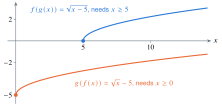
Composition sends one function’s output into another function. If f(u)=u and g(x)=x−5, then
(f∘g)(x)=f(g(x))=x−5.
Read the rightmost operation first. The domain requires both that g(x) exists and that its output belongs to the domain of f. By contrast, (g∘f)(x)=x−5. The first needs x≥5 and the second only x≥0. Function composition is not generally commutative.
An inverse function undoes a function on specified domains. An exponential changes an input additively into an output multiplicatively; its inverse, a logarithm, turns multiplicative change back into additive change. These structures will later explain both the chain rule and exponential growth.
Order matters. With f(u)=u and g(x)=x−5, the composition f(g(x))=x−5 (blue) exists only for x≥5, while g(f(x))=x−5 (orange) exists for x≥0. The two orders give different functions with different domains.
For b>0,b=1, the function bx has domain R and range (0,∞). Its inverse is logbx, defined for x>0:
y=logbx⟺by=x.
The natural exponential has base e and inverse ln. Change of base gives logbx=lnx/lnb for x>0,b>0,b=1; taking natural logs of by=x yields ylnb=lnx. One characterization of e is limn→∞(1+1/n)n; later calculus gives equivalent characterizations. For positive u,v and real r,
ln(uv)=lnu+lnv,ln(u/v)=lnu−lnv,ln(ur)=rlnu.
There is no analogous rule ln(u+v)=lnu+lnv. Exponents distribute over products, not sums: (uv)r=urvr for positive u,v, whereas (u+v)2 has a middle term.
A function has an inverse on its image exactly when it is one-to-one: different inputs have different outputs. The inverse notation f−1 does not mean 1/f. The identities are f−1(f(x))=x for inputs of f, and f(f−1(y))=y for outputs in its range. Domain and range exchange roles. These definitions follow the standard function and logarithm treatment [O1F].
Write u=bs and v=bt, which is possible because u,v>0. Then uv=bs+t. Applying the inverse logb gives logb(uv)=s+t=logbu+logbv. The law is not arbitrary symbol manipulation: multiplication of outputs corresponds to addition of exponents. Similarly, elnx=x needs x>0, while ln(ex)=x is valid for every real x.
A parabola x2 on all of R has no inverse function because 2 and −2 share output 4. Restricting to x≥0 makes it one-to-one and gives inverse x. Restricting to x≤0 instead gives inverse −x. The original domain determines the branch.
For a composition, replace the input of the outer function with the entire inner expression. For an inverse, first check one-to-one behavior or a stated restriction, write y=f(x), solve for x, then state the inverse’s domain. For exponential equations, isolate the exponential before taking logs. For log equations, record positivity before combining logs; algebraic candidates outside that domain are invalid.
Example 1: inverse with a branch. Let f(x)=(x−2)2+1 for x≥2. From y−1=(x−2)2, the domain gives x−2≥0, hence x=2+y−1. Therefore
f−1(x)=2+x−1,x≥1.
The reciprocal, 1/[(x−2)2+1], is entirely different.
Example 2: solve an exponential. The equation 5e2t=17 gives e2t=17/5. Taking ln gives 2t=ln(17/5), and t=21ln(17/5). This is exact. A decimal is an approximation, so use ≈ rather than = for a rounded value.
Finish the restriction. Solving ln(x−1)+ln(x+1)=ln8 suggests x2−1=8, so x=±3. Which survives? Both log inputs must be positive, requiring x>1; only 3 survives. This is a domain issue, not a rounding issue.
Compare the first step where your work differs. A corrected answer is not yet an independent success.
M03.01Show solution
Order of composition
For f∘g, substitute x2−4 into 2x+1:2(x2−4)+1=2x2−7. For g∘f, substitute 2x+1 into x2−4:(2x+1)2−4=4x2+4x−3. Both accept every real input, but their formulas differ. At x=0 their outputs are −7 and −3.
The square root needs 7−x≥0, but the logarithm needs the square root to be strictly positive. Thus 7−x>0, giving (−∞,7). At x=7 the inner square root exists but equals zero, which cannot be a real logarithm input.
Solve y=3x−7 for x:x=(y+7)/3. Therefore f−1(x)=(x+7)/3, with domain and range R. Check f−1(f(x))=(3x−7+7)/3=x, and f(f−1(x))=3(x+7)/3−7=x. Both identities hold on the stated domains.
From y=x2+4, obtain x=±y−4. The original x≤0 selects x=−y−4. Thus q−1(x)=−x−4, domain [4,∞), range (−∞,0]. In q−1(q(x))=−x2=−∣x∣=x, the last equality specifically uses x≤0.
Require x>2. On that domain, combine logs to get ln[x(x−2)]=ln15. Since ln is one-to-one, x2−2x=15, or (x−5)(x+3)=0. Only x=5 satisfies x>2. Checking gives ln3+ln5=ln15, so x=5.
Set 80e−0.3t=20, so e−0.3t=1/4. Taking logs gives −0.3t=−ln4, hence t=ln4/0.3 s, approximately 4.62 seconds. The exponent must be dimensionless, so the rate constant is 0.3s−1. Since the exponential decreases strictly for t≥0, this threshold time is unique.
On x>0, the power and reciprocal laws give 2lnx−lnx=lnx. Alternatively, combine products: ln[x2(1/x)]=lnx. The original combined expression needs 1/x>0, hence x>0. In isolation, ln(x2) is defined for every x=0 and equals 2ln∣x∣. Dropping the absolute value would incorrectly erase negative inputs from that larger domain.
Mix M02.03 with M03.02, and M01.06 with M03.04. Explain why f−1 and 1/f perform different jobs. Advance when you can handle a fresh logarithmic equation and explain which domain restriction rejects an algebraic candidate.