Module 02: Functions, inputs, domains, and graphs
On this page
- A. Prerequisites and observable goals
- B. The central idea: distinguish the rule from its output
- C. Definitions and graph language
- D. Why the input shift moves the graph
- E. Recognize what the problem requests
- F. Worked examples and a fading step
- Computing bridge: Function notation and program inputs
- G. Independent practice
- H. Complete solutions: Module 02
- I. Retention and readiness
A. Prerequisites and observable goals#
Module 01, especially parentheses and restrictions.
Read a function as an input-output rule, evaluate shifted inputs, identify domains and ranges, and translate graph transformations into coordinates.
B. The central idea: distinguish the rule from its output#
A real-valued function assigns exactly one real output to each input in its domain. The symbol names the rule; names its output at input . The parentheses in are function notation, not multiplication by a number . You can rename the input placeholder without changing the rule:
In both cases, the instruction is “double the square of the input, subtract three times the input, then add four.” Consequently,
Substituting means filling every box with the same complete input. When the input is , the whole expression goes into every box. It is not an instruction to add after computing .
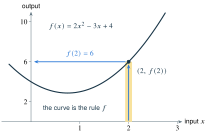
C. Definitions and graph language#
The domain is the set of allowed inputs. The range is the set of outputs actually attained. A graph contains ordered pairs ; its horizontal coordinate is an input and its vertical coordinate an output. A vertical line cannot meet a function graph in two distinct points. A horizontal line may: different inputs can have the same output.
For a formula with no prescribed domain, use its natural real domain: exclude denominator zeros, require even-root inputs to be nonnegative, and later require logarithm inputs to be positive. A contextual domain may be smaller. A time variable for a launched object is often restricted to the physical flight interval even though its polynomial formula accepts every real number.
For a point , the transformed graph
contains the point . This coordinate rule explains horizontal changes rather than relying on a misleading “opposite sign” slogan. Absolute values, piecewise formulas, and excluded endpoints require attention to their definitions. A piecewise function is one rule specified by cases; choose the case using the input before evaluating.
D. Why the input shift moves the graph#
Suppose . To obtain the old output , the new input must satisfy , hence . Thus the old graph point at input moves right by . The graph is not moving left simply because the formula contains a minus sign. Input arithmetic is evaluated before the function acts; output arithmetic happens afterward.
For , reaching old input requires . All horizontal coordinates are halved. For , horizontal coordinates stay fixed and heights double. These are different transformations. Graphing software can illustrate them, but a window can hide asymptotes, holes, or distant behavior; use algebra to identify those features. Definitions checked against standard function treatment [O1F].
E. Recognize what the problem requests#
If it asks for , substitute. If it asks for , substitute the whole expression and simplify only afterward. If it asks to solve , find inputs that give the specified output. If it asks for a domain, list restrictions and intersect them; do not try to find a derivative. If it asks for range, consider which outputs are possible, using a graph, algebra, or known bounds.
F. Worked examples and a fading step#
Example 1: an input versus an output change. Let . Then
Their difference is , generally nonzero. At , the first is and the second is ; this accidental agreement at one input is not an identity. At , they are and . A single counterexample disproves an all-input claim.
Example 2: a domain. For , require and . Therefore the domain is . The square-root endpoint is included because the denominator is then , not zero.
Pause and finish. If , where does move under ? Solve , then transform the height. Completion: , , giving .
Computing bridge: Function notation and program inputs#
In a pure numerical function, replacing the input by is analogous to calling the same function with a new argument, not adding to its returned value. For , whereas . They are different programs as well as different formulas. C01 makes this distinction with input values, returned values, and explicit state. A function with side effects requires additional reasoning: evaluating a call twice can change state, unlike substituting twice into a fixed mathematical function.
G. Independent practice#
F foundation C standard course work T transfer S optional stretch L runnable lab or project. Attempt the complete set before opening its solutions.
For , find and without confusing the input with the output.
For , compare with . What does the comparison establish?
Find the real domain of .
Let for and for . Find and all solutions of .
Give the domain and range of . Explain both endpoints.
A graph of contains . Find the corresponding point on .
Does the relation define all of as one function of ? Give two function branches and their domains.
A data table contains , , . Does it prove for all real ? Construct a different polynomial agreeing with all three entries.
Optional small hints
For M02.06, solve . For M02.08, add a nonzero polynomial that vanishes at the three listed inputs.
H. Complete solutions: Module 02#
Compare the first step where your work differs. A corrected answer is not yet an independent success.
M02.01Show solution
Substitute into every input position
For the number , write . Parentheses make the square apply to the entire negative input. For ,
The last constant does not change because it was not an input slot.
Back to M02.01M02.02Show solution
Two different operations
The first expression is . The second is . Since , input addition cannot generally be moved outside a function. This is a counterexample to a proposed identity, not a statement that the two expressions can never agree for any function or input.
Back to M02.02M02.03Show solution
Intersect restrictions
The radical requires , so . The denominator excludes . Intersecting gives . At the numerator is zero and denominator is , so the endpoint is allowed.
Back to M02.03M02.04Show solution
Choose the correct branch first
Negative input uses , giving . The inputs use , giving . To solve , the negative branch gives , or , but is not in that branch’s domain. The nonnegative branch gives , with candidates , of which only belongs. Thus the solution is .
Back to M02.04M02.05Show solution
Possible inputs and possible heights
The input must satisfy , so the domain is . The square root takes every value in . Subtracting those values from produces . The maximum height occurs at ; there is no lowest height because the square root grows without bound.
Back to M02.05M02.06Show solution
Transform coordinates, not just a formula
The old input is . Set to get . The new height is . Therefore the corresponding point is . Direct verification: .
Back to M02.06M02.07Show solution
A relation with two outputs
At , the relation allows and , so the full circle fails the function requirement. Solving for gives branches and . Both have domain . Together they describe the circle; separately each assigns one output to every allowed input.
Back to M02.07M02.08Show solution
Finite data do not determine a unique global rule
The polynomial matches the table, but so does
At each listed input, one of the three added factors is zero. At , however, , while . Thus the rules differ. Tables are evidence about listed inputs, not proofs of a global formula or a limit.
Back to M02.08I. Retention and readiness#
Retrieve M01.02 and M01.06 alongside M02.01. Explain the difference among , , and solving . The correct explanation names a rule, an output, and an input-finding task, respectively. Advance when you can do M02.04 and a fresh domain problem without looking at solutions; otherwise repair input notation before using a difference quotient.