Derivative rules, chain rule, implicit differentiation, and geometric formulas.
After
Separate position, velocity, speed, and acceleration; construct related-rate equations; and interpret signs and units at a specified instant.
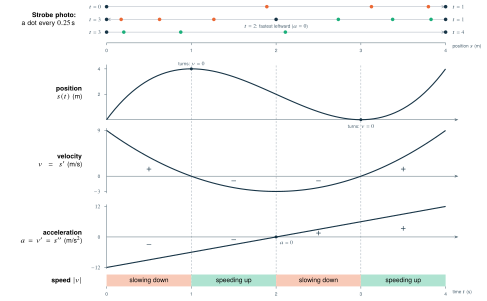
Picture 12.1. One particle, four views. Top: a strobe photo of a particle on a straight track, s(t)=t3−6t2+9t metres, one dot every quarter second. Dots far apart mean fast; black dots mark the start, the turns, the fastest moment of the leftward run, and the end. It runs right, turns at t=1, runs left, turns at t=3, and runs right again. Below: the same motion as graphs against time. Read down any column: speed rises (aqua) where v and a have the same sign and falls (orange) where their signs differ. On (2,3) the acceleration is positive, yet the particle slows: it is moving left while being pushed right.
B. The central idea: differentiate the relationship that stays true#
A higher derivative differentiates a derivative. If s(t) is position, then v(t)=s′(t) is velocity and a(t)=v′(t)=s′′(t) is acceleration. Their units are position units, position units per time, and position units per time squared. Speed is ∣v∣, not v itself.
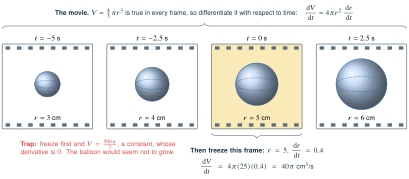
Related-rate problems connect several changing quantities. The geometry or physical relationship is true at every time in a neighborhood of the instant of interest. Differentiate that relationship first, retaining the variables that are changing; only afterward insert the instantaneous numerical values. Replacing a changing radius by its current value before differentiating would incorrectly turn it into a constant.
Picture 12.2. Differentiate the movie, then freeze the frame. A balloon filmed every 2.5 seconds while its radius grows at 0.4 cm/s (section F’s first example). The formula V=34πr3 holds in every frame, so it can be differentiated with respect to time. The numbers r=5 and dr/dt=0.4 hold in one frame only (yellow), so they go in last.
Where v=0, the derivative of speed is sgn(v)a. Thus speed increases when v and a have the same sign and decreases when they have opposite signs. Positive acceleration alone does not mean speeding up: a left-moving particle with v<0 and a>0 is slowing down.
For a geometric relation, attach explicit time dependence mentally. If x(t)2+y(t)2=L2 with constant L, then
2xdtdx+2ydtdy=0.
If L also changed, its derivative would not be zero. A sphere has V=4πr3/3, giving dV/dt=4πr2dr/dt. A cone has V=πr2h/3; when its liquid surface radius and height are linked by similar triangles, substitute that relationship before differentiating. Related-rate modeling framework: [O1Rates].
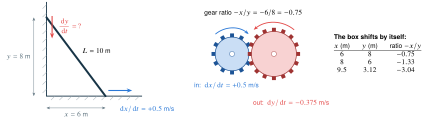
Imagine a fixed ladder leaning against a wall. As its base moves farther from the wall, its top moves down. Differentiating x2+y2=L2 gives
dtdy=−yxdtdx(y=0).
The negative sign predicts the opposite directions. The ratio x/y is dimensionless, so the output rate has the same length-per-time units as the input rate. Geometry explains the sign before numerical substitution.
Picture 12.3. The ladder is a gearbox between two rates. Differentiating x2+y2=102 gives dtdy=−yx⋅dtdx. The ratio −x/y is read off the picture at this instant, and its minus sign is the meshing that turns the output the opposite way: base out, top down. Unlike a real gearbox, this one shifts by itself as the ladder slides. At x=9.5 m the top falls three times as fast as the base moves out.
Motion likewise demands interval thinking. For s(t)=t3−6t2+9t, the velocity factors as 3(t−1)(t−3). Its sign changes at 1 and 3; those are candidates for direction changes, not necessarily zero position. The acceleration 6t−12 changes sign at 2, a different event. A particle can pass position zero while moving, or stop at a nonzero position.
Draw or describe the geometry, name the changing quantities, and record which rates are known. Write a relationship containing the requested variable. Remove extra variables using geometry when possible. Differentiate with respect to time. Insert the values valid at the stated instant, solve for the unknown rate, and check its sign and units. If the result’s units are wrong, revisit the equation rather than merely relabeling the answer.
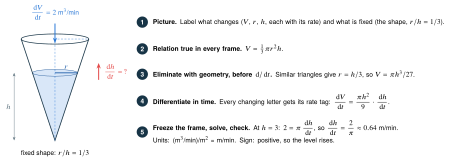
Picture 12.4. The Rate Workbench, run on section F’s cone. Your Modular Workbench for related rates: five moves, one per line. The two similar right triangles (dashed: the container; shaded: the water) are what lets move 3 replace r by h/3 before differentiating. Skip move 3 and move 4 needs dr/dt, which nobody gave you.
An expanding sphere. Suppose dr/dt=0.4 cm/s and r=5 cm at the instant of interest. Differentiate before substituting:
dtdV=4πr2dtdr=4π(25)(0.4)=40πcm3/s.
A radius rate becomes a volume rate through an area factor 4πr2.
A conical container. A cone has fixed radius-to-height ratio r/h=1/3. Thus V=πh3/27, not a formula with a constant liquid radius. Differentiating gives V′=πh2h′/9. If the inflow is 2 m3/min and the depth is 3 m, then 2=πh′, so h′=2/π m/min. As depth increases, the wider surface makes the same inflow raise the level more slowly.
A game-development connection. A normalized animation input u=t/T changes at rate 1/T. For a normalized path E(u) over distance L, position is s(t)=LE(t/T). The chain rule gives speed scale L/T and acceleration scale L/T2. Doubling the duration halves corresponding velocities and quarters corresponding accelerations.
A speedometer’s needle shows velocity. How fast that needle swings is acceleration, the second derivative of position. How fast an accelerometer’s needle swings is jerk, the third derivative: the jolt you feel when a driver stabs the brakes. Higher derivatives need no new rules. They are the same rules applied again, so every slip you can make once you can make twice. Two habits keep them clean.
Habit 1: rewrite once, then step the exponent down each time. For t>0 let s(t)=t24. Parentheses Rewrite first: s=4t−2. Each derivative brings the exponent down as a factor, then subtracts one:
s=4t−2d/dtv=−8t−3d/dta=24t−4d/dtj=−96t−5.
Final sweep after every step: the exponents run −2,−3,−4,−5, each one more negative than the last, and the coefficient’s sign flips each time because each new factor (−2, then −3, then −4) is negative. Two slips to catch. The more common one is a dropped minus sign on the exponent: writing 24t4 for 24t−4. The other is stepping the exponent the wrong way: writing −8t−1 because −2+1 felt like the move.
Habit 2: the Wheel turns, the Fortress holds. For y=sin(3x), each derivative clicks the Derivative Wheel once and brings out one more factor of 3 from the inside. The angle 3x never changes:
Four clicks bring sine back to sine, so the pattern repeats every four derivatives. To find a very high derivative of sinx, divide the order by 4 and click only the remainder.
Notice that y′′=−9y: the second derivative is the function itself times a negative number. That one equation describes every spring, pendulum, and vibrating panel near equilibrium (Module 25 and A06 solve it). It is why sines and cosines appear whenever something oscillates.
A 2 m tall person walks away from a 6 m lamp at 1.5 m/s. Find the growth rate of the person’s shadow and the speed of the shadow’s tip along the ground.
(Notation disguise; bookkeeping.) For t>0 seconds a position in metres is s(t)=t36+2t. Rewrite it with exponents, then find v(t) and a(t), and evaluate a(1).
(Implicit second derivative: keep the partner.) On the circle x2+y2=25, find y′′ in terms of x and y, then evaluate it at (3,4). Check with the explicit upper semicircle y=25−x2.
(Motion sign chart.) A particle moves with s(t)=t3−9t2+24t metres for t≥0 seconds. Find the time intervals on which it speeds up and those on which it slows down.
(The dropped partner.) A rectangle’s length grows at 3 cm/s while its width shrinks at 2 cm/s. At the instant when the length is 20 cm and the width 12 cm, is the area increasing or decreasing, and how fast?
(Two movers; check by a second route.) Two drones leave the same point at the same moment and altitude. One flies north at 6 m/s, the other east at 8 m/s. How fast is the distance between them growing after 10 s? Then write the distance as a function of time directly and check your rate.
(Trig rates: Magic Triangles; Angle Fortress.) A tracking camera stands on level ground 2 km from a launch pad. A rocket rises vertically, and when it is 2 km up it is climbing at 300 m/s. How fast is the camera’s elevation angle increasing, in radians per second and in degrees per second?
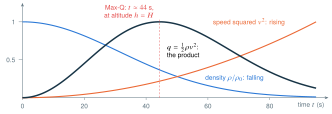
Picture 12.5. Max-Q is a tug of war. The straight-line model of part (d), with acceleration 10 m/s2 along a path climbing at 60∘. Each curve is scaled so its largest value on the plot is about 1. Speed squared rises while density falls, so their product rises, peaks, and falls. In this model the peak always comes at altitude h=H.
Why rockets throttle down near Max-Q. (a) Use the chain rule to show that
dtdq=q(v2dtdv−H1dtdh).
(b) At one instant a rocket is at h=11.0 km, moving at v=400 m/s, climbing at dh/dt=280 m/s, and accelerating along its path at dv/dt=12 m/s2. Find ρ,q in kilopascals, and dq/dt. Is q still rising? (c) What path acceleration would make dq/dt=0 at that instant? In one sentence, explain how throttling down limits the peak load. (d) The straight-line model: from rest, the rocket accelerates at a constant a along a straight path climbing at angle γ, so v=at and h=21at2sinγ. Find the time when dq/dt=0, and show that the altitude at that moment is exactly H, whatever a and γ are. (Module 14’s first-derivative test confirms this moment is the maximum.)
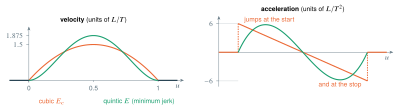
Picture 12.6. Smooth position is not smooth acceleration. Velocity (left) and acceleration (right) against the fraction of the move completed, u=t/T, for the cubic easing Ec (orange) and the minimum-jerk quintic E (aqua). The cubic’s acceleration jumps the instant the move starts and stops, a jolt a passenger or a camera gimbal feels. The quintic’s starts and ends at zero.
A move without a jolt. (a) Check that E(0)=0 and E(1)=1, and that E′ and E′′ are both zero at u=0 and at u=1. Factor E′(u) and E′′(u) completely. (b) Find the peak speed in terms of L and T, and compare it with the cubic’s 3L/(2T) from M12.08. (c) Find the largest acceleration magnitude (where is E′′′=0?) and compare it with the cubic, whose acceleration jumps from 0 to 6L/T2 the instant the move begins. (d) A gimbal turns a camera through 90∘ in 1.5 s along this profile. Find its peak angular speed and peak angular acceleration.
In a real-time game engine for a tactical shooter, a smoke grenade does not pop to full size. One short function scales the cloud’s radius over the first moments of its life, and the bots’ perception code uses that radius to decide whether a bot can see through the cloud:
C++
inlineconstexprf32smokeDeploymentScale(f32remaining,f32totalDuration){if(totalDuration<=0.f||remaining<=0.f)return0.f;constf32age=1.f-std::clamp(remaining/totalDuration,0.f,1.f);constf32t=std::clamp(age/0.05f,0.f,1.f);returnt*t*(3.f-2.f*t);}// in the bots' perception codeconstf32deployedRadius=burst.visualRadius*smokeDeploymentScale(timer.remaining,timer.totalTtl);
Here f32 is the engine’s name for a 32-bit float. For a smoke grenade, the engine’s tuning table, grenadeTuning, gives the burst a lifetime of 16 s and a visualRadius of 4.2 m. The timer starts with remaining equal to the lifetime and counts down by the frame time.
(A game engine’s smoke cloud.) Let t be the time in seconds since the burst. (a) Read the code: show that age is t/16, that the cloud finishes growing at t=0.8 s, and that for 0≤t≤0.8 its radius is R(t)=4.2Ec(t/0.8) metres, with M12.08’s cubic easing Ec(u)=3u2−2u3. (b) The bots treat the cloud as a sphere. Find dR/dt and the rate at which the cloud’s volume grows at t=0.4 s. (c) Find both rates again at t=0.2 s and at t=0.6 s. The radius grows equally fast at those two moments; why does the volume not? (d) A designer changes 0.05f to 0.10f. Without redoing the whole problem, what happens to the cloud’s top expansion speed?
Optional small hints
For M12.01, split distance at the direction change. For M12.07, let x be lamp-to-person distance and q the shadow length; the tip is at x+q. For M12.08, solve the four endpoint equations before differentiating with respect to time.
Compare the first step where your work differs. A corrected answer is not yet an independent success.
M12.01Show solution
Motion requires a sign chart
Velocity is v=2t−4 m/s and acceleration is a=2 m/s2. The particle stops at t=2 s. It moves left before 2 and right afterward. Evaluate s(0)=0,s(2)=−4, and s(5)=5. Displacement is 5−0=5 m. Total distance is ∣−4−0∣+∣5−(−4)∣=4+9=13 m. Adding absolute displacements over the monotone segments avoids cancellation.
Because v<0 and a>0, velocity is moving toward zero, so the particle is slowing down. Locally, speed is ∣v∣=−v. Its derivative is −a=−2 m/s2. The speed is 6 m/s at the instant; the negative rate describes how that positive speed changes.
The velocity is y′(t)=20−10t, so launch velocity is 20 m/s. At the top, velocity is zero: t=2 s. Height there is 40−20=20 m. Landing satisfies y(t)=5t(4−t)=0, giving t=0 or 4; the return-to-ground time is 4 s. The physical flight domain is [0,4].
Start with A=πr2. Differentiating gives A′=2πrr′. Insert the instantaneous values to obtain A′=2π(3)(0.2)=1.2π cm2/s. The factor 2πr has length units, turning a radius rate into an area rate.
Substitute r=h/2 into V=πr2h/3 to get V=πh3/12. Thus V′=(πh2/4)h′. At depth 4,2=4πh′, giving h′=1/(2π) m/min. The surface area πr2=4π m2 at this depth provides an independent check: volume rate divided by surface area gives the same depth rate.
Shadow length and tip position are different variables
Similar triangles give 6/(x+q)=2/q. Cross-multiply: 6q=2x+2q, hence q=x/2. Differentiating gives q′=x′/2=0.75 m/s. The tip position is x+q, so its speed is x′+q′=1.5+0.75=2.25 m/s. Reporting only q′ as the tip speed would omit the person’s motion.
The conditions at zero give d=0 and c=0. At one, a+b=1 and 3a+2b=0. Subtract twice the first equation from the second to get a=−2, then b=3. Thus E(u)=3u2−2u3.
s′(t)=TLE′(u)=T6Lu(1−u),u=t/T.
On [0,1],u(1−u)=1/4−(u−1/2)2≤1/4, so the maximum speed is 3L/(2T) at t=T/2. Endpoint velocities vanish, but endpoint accelerations need not; this is not a guarantee of smooth acceleration when stitching arbitrary segments.
Two fraction subtractions, then a division by zero
f′(x)=35x5/3−1=35x2/3, because 35−1=35−3=32. Then f′′(x)=35⋅32x2/3−1=910x−1/3, because 32−1=32−3=−31. To be sure f′(0) exists, use the definition rather than the formula: hf(0+h)−f(0)=hh5/3=h2/3→0, so f′(0)=0. (The same check on x1/3 gives h−2/3, which blows up: a formula’s value is not proof of a derivative.) But f′′(0) would need 0−1/3=1/01/3, which is undefined, and its difference quotient 35h2/3/h=35h−1/3 blows up too: f′′(0)does not exist. Near 0,f′′ grows without bound in size, positive on the right and negative on the left. The slope changes smoothly through 0, but the rate at which it changes blows up there, which the graph alone does not show.
y′=5⋅(−sin(2x))⋅2=−10sin(2x). Then y′′=−10cos(2x)⋅2=−20cos(2x)=−4⋅5cos(2x)=−4y. Then y′′′=−20(−sin(2x))⋅2=40sin(2x). The angle stays 2x on every line (Angle Fortress), and the Wheel runs cos→−sin→−cos→sin.
50=4⋅12+2. Twelve full turns of the Wheel change nothing, and two clicks take sin→cos→−sin. So dx50d50sinx=−sinx. For sin(2x) the clicks are the same, and each of the fifty derivatives also brings out a factor 2:−250sin(2x), about −1.13×10¹⁵sin(2x).
At (3,4):y′′=−6425. Check: y=(25−x2)1/2 gives y′=−x(25−x2)−1/2, and the product rule gives y′′=−(25−x2)−1/2−x2(25−x2)−3/2=−25(25−x2)−3/2. At x=3 that is −25/163/2=−25/64. The two routes agree, and the negative sign says the upper semicircle is concave down.
It speeds up on (2,3) and (4,∞) and slows down on (0,2) and (3,4), the same pattern as Picture 12.1. At t=3 it moves left at its greatest speed in that stretch, ∣v(3)∣=∣27−54+24∣=3 m/s.
The diameter is 50, so r=25 cm. Differentiate the movie: dV/dt=4πr2dr/dt. Freeze the frame: 100=4π(625)dr/dt, so dr/dt=2500π100=25π1≈0.0127 cm/s. Using r=50 would give 1/(100π), four times too small. Units: (cm3/s)/cm2 = cm/s.
dtdA=dtdℓw+ℓdtdw=(3)(12)+(20)(−2)=36−40=−4 cm2/s. The area is decreasing at 4 cm2/s: the shrinking width costs more area than the growing length adds. The dropped-partner product (3)(−2)=−6 has the wrong value and the wrong units.
After 10 s, x=80 m east and y=60 m north, so D=802+602=100 m. From D2=x2+y2,2DD′=2xx′+2yy′, so
D′=Dxx′+yy′=10080(8)+60(6)=100640+360=10 m/s.
Direct route: D(t)=(8t)2+(6t)2=100t2=10t, so D′=10 m/s at every moment. Both routes agree. Because both drones started together, their separation grows at a constant rate.
With h in metres, tanθ=h/2000. Differentiate with respect to time (Magic Triangles): sec2θ⋅dtdθ=20001dtdh. At h=2000,tanθ=1, so θ=π/4 and sec2θ=1+tan2θ=2. Then
(b) h/H=11/8.5≈1.2941, so ρ=1.225e−1.2941≈1.225(0.27414)≈0.3358 kg/m3. Then q=21(0.3358)(400)2≈26.9 kPa. The bracket is 4002(12)−8500280=0.0600−0.0329=0.0271 per second, so dq/dt≈26,865(0.0271)≈727 Pa/s, about 0.73 kPa/s. Yes, q is still rising.
(c) Set the bracket to zero: dtdv=2Hvdtdh=2(8500)400(280)≈6.6 m/s2. Less thrust means less acceleration, so the rising-speed term shrinks and q levels off at a lower peak: the structure never sees the load it would have seen at full thrust. In the straight-line model of part (d) the peak load is q∗=ρ0e−1aH/sinγ, directly proportional to a.
(d) Here dv/dt=a and v=at, so v2dtdv=t2; and dtdh=atsinγ. Setting the bracket to zero gives t2=Hatsinγ, so t2=asinγ2H. Then
h=21asinγ⋅t2=21asinγ⋅asinγ2H=H.
For Picture 12.5’s a=10 m/s2 and γ=60∘:t=17000/(10sin60∘)≈44.3 s, v≈443 m/s, and q=21ρ0e−1v2≈44.2 kPa. Real ascents fly curved paths, throttle, and meet a non-isothermal atmosphere, so their Max-Q comes elsewhere; the model’s value is that it shows the tug of war cleanly.
Both factorizations vanish at u=0 and at u=1, so the move starts and ends with zero velocity and zero acceleration.
(b) By the chain rule (as in M12.08), v=TLE′(u)=T30L[u(1−u)]2. Since u(1−u)≤41, with equality at u=21, the peak speed is 16T30L=8T15L,25% more than the cubic’s 2T3L. Starting and stopping gently means hurrying in the middle.
(c) a=T2LE′′(u).E′′′(u)=60−360u+360u2=60(6u2−6u+1), which is zero at u=21±63. At u1=21−63:u1(1−u1)=41−363=61 and 1−2u1=33, so E′′(u1)=60⋅61⋅33=310. By symmetry E′′(u2)=−310. The largest acceleration magnitude is 310T2L≈5.77T2L, slightly less than the cubic’s 6L/T2, and reached gradually rather than in an instant. The quintic’s jerk at the start is E′′′(0)L/T3=60L/T3, finite; the cubic’s acceleration jump is an instantaneous jolt.
(d) With L=90∘ and T=1.5 s: peak angular speed 8(1.5)15(90)=112.5∘/s, and peak angular acceleration 310⋅1.5290≈231∘/s2, about 4.03 rad/s2.
(a) The timer starts at 16 and loses dt each frame, so remaining=16−t and age=1−1616−t=16t, the fraction of the cloud’s life used so far. The code’s t (call it u to avoid a clash with time) is u=0.05t/16=0.8t, clamped to [0,1], so growth ends at t=0.8 s. The returned value u⋅u⋅(3−2u)=3u2−2u3=Ec(u), so R(t)=4.2Ec(t/0.8) m.
(b) Chain rule: dtdR=4.2Ec′(u)⋅0.81 with Ec′(u)=6u(1−u). At t=0.4 s, u=21, so Ec(u)=21,R=2.1 m, and dtdR=0.84.2(1.5)=7.875 m/s. This is M12.08’s peak speed 3L/(2T) with L=4.2 m and T=0.8 s. The volume rate is dtdV=4πR2dtdR=4π(4.41)(7.875)≈436 m3/s.
(c) At t=0.2 s, u=0.25:E=0.15625, so R≈0.656 m, and E′=1.125, so dR/dt≈5.906 m/s; then dV/dt=4π(0.656)2(5.906)≈32 m3/s. At t=0.6 s, u=0.75:E=0.84375, so R≈3.544 m, and again dR/dt≈5.906 m/s, but dV/dt=4π(3.544)2(5.906)≈932 m3/s. The radius rate is the same, but the volume rate is multiplied by the area factor 4πR2, which is (3.544/0.656)2≈29 times larger later. Section F’s first worked example said it: a radius rate becomes a volume rate through an area factor.
(d) The new constant doubles the growth time to T=1.6 s with the same L=4.2 m. The top speed 3L/(2T) is halved, from 7.875 to about 3.94 m/s. Section F predicted it: doubling the duration halves the corresponding velocities.
1. t28=8t−2, so the derivative is −16t−3=−t316. The exponent goes down: −2−1=−3. 2. dxd[2xy]=2y+2xy′. The second term keeps its x. 3. dtd[r(t)3]=3r(t)2r′(t). The outer doll gives 3r2, and the inner doll gives the rate tag r′.
Move 4: 2DdtdD=2xdtdx, and the 302 term becomes 0 because it is constant. Move 5: at x=40,D=402+302=50 m, so dtdD=5040(8)=6.4 m/s. That is less than 8 m/s because part of the drone’s motion swings the line of sight around instead of lengthening it. Far away, x/D→1 and the rate approaches 8 m/s.
Revisit M05.05 and M10.07. Explain why r=3 is inserted after differentiating an expanding-circle equation. Advance when you can name the changing quantities in a fresh word problem, derive their relation, and distinguish a signed rate from its magnitude.