Module 21: Trigonometric integrals and trigonometric substitution
On this page
- A. Prerequisites and observable goals
- B. The central idea: use identities to expose a derivative pattern
- C. Recognizable patterns and branch choices
- D. Why the substitutions remove the radical
- E. Choose the least complicated substitution
- F. Worked examples
- G. Independent practice
- H. Complete solutions: Module 21
- I. Retention and readiness
A. Prerequisites and observable goals#
Trigonometric identities, substitution, inverse trigonometry, and absolute values.
Choose a parity-based trig integration strategy and use a trig substitution while preserving its interval and square-root sign.
B. The central idea: use identities to expose a derivative pattern#
Trigonometric integration reorganizes products until one factor is the derivative of a useful substitution. Trigonometric substitution instead changes a radical expression into a trigonometric identity. The first starts with trigonometric functions; the second often starts with an algebraic square root. Both are substitutions justified by identities, not unrelated collections of tricks.
C. Recognizable patterns and branch choices#
For , an odd sine power can reserve one and turn the remaining sine squares into . An odd cosine power works symmetrically. When both powers are even, use
For tangent/secant products, an even secant power can reserve for ; an odd tangent power together with a secant factor may reserve for . Cases outside these patterns can need identities, parts, or another approach.
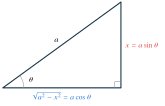
For , the standard substitutions are
Choose the interval explicitly. For example, , , ensures because cosine is nonnegative there. Without that branch condition the square root is . For with secant substitution, is convenient; a negative- branch needs separate treatment. [O2Trig]
D. Why the substitutions remove the radical#
The Pythagorean identities , , and turn a difference or sum of squares into a single square. The differential also changes: gives . Omitting this Jacobian factor changes the integral.
After integration, a right-triangle relation or inverse trig identity returns the result to . A triangle is a memory aid on the chosen branch, not permission to ignore signs for negative inputs. Different-looking primitives can agree up to a constant on their common interval; differentiation is the decisive check.
E. Choose the least complicated substitution#
Try an ordinary substitution before a trig substitution. For , the nearby makes simpler. Reserve trig substitution for radicals whose remaining factors do not already match a straightforward derivative. With definite bounds, transform both endpoints and maintain their order. With indefinite integrals, convert every trig term back before the final answer.
F. Worked examples#
Odd sine power. For , reserve one sine and write . Let , :
The answer is ; the negative sign comes from the differential.
A circle radical. For on , use on the principal branch. The integrand times differential becomes . Half-angle integration yields , hence
This primitive will produce familiar circular areas at appropriate bounds.
G. Independent practice#
F foundation C standard course work T transfer S optional stretch L runnable lab or project. Attempt the complete set before opening its solutions.
Evaluate .
Evaluate .
Evaluate on an interval avoiding secant singularities.
Evaluate .
Evaluate on , stating a trig-substitution branch.
Evaluate using trigonometric substitution.
For , evaluate using .
Evaluate as an improper limit. Explain why the endpoint singularity does not force divergence.
Optional small hints
For M21.04, reserve . For M21.06, choose with . For M21.08, replace the upper endpoint by , then take .
H. Complete solutions: Module 21#
Compare the first step where your work differs. A corrected answer is not yet an independent success.
M21.01Show solution
The differential supplies the sign
Let , so . The integral is , or . Its derivative is .
Back to M21.01M21.02Show solution
An even power calls for a half-angle identity
Using gives . It is half the interval length, consistent with the complementary equal integrals of sine squared and cosine squared.
Back to M21.02M21.03Show solution
Reserve the derivative of tangent
Let and . The integral is on each interval avoiding . The primitive does not define an antiderivative across those singularities.
Back to M21.03M21.04Show solution
Reserve the derivative of secant
Write the integrand as . With , it becomes , giving . This is a different derivative pattern from M21.03 despite the similar symbols.
Back to M21.04M21.05Show solution
Choose a branch before dropping an absolute value
Set , . Then and . Their ratio is , so the primitive is . Differentiating gives on the stated interval.
Back to M21.05M21.06Show solution
The differential and denominator powers both matter
With on the principal tangent interval, and , since secant is positive. Thus the integral is . The relation gives . Differentiation simplifies to for all real .
Back to M21.06M21.07Show solution
Restrict secant to the specified positive branch
For , choose . Then and . The integral becomes , hence on . Checking by chain rule gives , using .
Back to M21.07M21.08Show solution
An unbounded height may still have finite accumulated area
For , substitute , taking the transformed upper bound . The quotient times differential becomes . Thus the truncated integral is . As , , so the limit is . The integrand is unbounded at the endpoint, but the defining improper limit is finite; singularity alone does not decide convergence.
Back to M21.08I. Retention and readiness#
Retrieve M04.08, M01.06, and M17.05. Explain why includes an absolute value until the branch is chosen. Advance when you can decide between an ordinary substitution and a trigonometric one without relying only on the presence of a radical.