Module 22: Partial fractions and a mixed integration strategy
On this page
- A. Prerequisites and observable goals
- B. The central idea: decompose complexity into integrable pieces
- C. The algebraic template
- D. Why a linear numerator is needed over a quadratic
- E. A strategy hierarchy, not an infallible flowchart
- F. Worked examples
- G. Independent practice
- H. Complete solutions: Module 22
- I. Retention and readiness
A. Prerequisites and observable goals#
Factoring, polynomial division, rational identities, logarithms, and previous integration methods.
Decompose rational functions including repeated and irreducible factors; select methods for an unlabeled integral; and preserve domain intervals in a primitive.
B. The central idea: decompose complexity into integrable pieces#
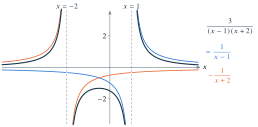
A rational function is a quotient of polynomials. Its denominator’s factorization suggests pieces with simpler antiderivatives. Partial fractions is an algebraic identity valid where the original denominator is nonzero; integration comes afterward. It is not legal to split a denominator additively, such as turning into .
C. The algebraic template#
First perform polynomial division if the numerator degree is at least the denominator degree. For a proper rational remainder, include one constant numerator for every power of a linear factor and a general linear numerator for every power of an irreducible real quadratic:
The quadratic is irreducible over the reals when . Repeated quadratic factors require a linear numerator for each power as well. Some coefficients may turn out zero, but they cannot be omitted before solving unless justified by symmetry or another valid argument.
Multiply by the common denominator, obtaining a polynomial identity. Match coefficients or use convenient inputs to determine constants. Substitution at an excluded input is allowed in the resulting polynomial identity; it does not make the original rational function defined there. Basic primitives include , powers , and inverse tangents after completing a square. [O2PF]
D. Why a linear numerator is needed over a quadratic#
For , part of the numerator can match the denominator’s derivative , yielding a logarithm. The remaining constant over a completed square yields an arctangent. A constant-only template could miss the logarithmic portion. This is algebraic flexibility, not a notation convention without consequences.
For example,
Multiplying out gives , verifying the identity on the original domain. Integrating yields on any interval avoiding .
E. A strategy hierarchy, not an infallible flowchart#
Simplify algebra first. Look for a direct derivative pattern, then a short substitution. Products whose polynomial or logarithmic part simplifies under differentiation may invite parts. Trig products suggest identities; quadratic radicals may suggest trig substitution. Proper rational functions suggest partial fractions. After any transformation, reassess rather than committing blindly to the first choice.
Some elementary functions have no elementary antiderivative. That does not mean their definite integrals do not exist. Numerical approximation, a defined special function, or a series may be appropriate. A computer algebra output should be checked by differentiation, with intervals and branches still examined by you.
F. Worked examples#
Divide before decomposing. Since , its primitive is . A long partial-fraction system was unnecessary.
A repeated factor. To decompose , write . Multiplying gives . Comparing constant, quadratic, and linear coefficients gives , , . Therefore the integral is
The coefficient and arbitrary integration constant have different jobs.
G. Independent practice#
F foundation C standard course work T transfer S optional stretch L runnable lab or project. Attempt the complete set before opening its solutions.
Evaluate .
Evaluate .
Evaluate .
Evaluate .
Evaluate .
Evaluate on a domain interval, using an appropriate irreducible-quadratic numerator.
Without a method label, evaluate and . Explain why your approaches differ.
A student decomposes as and uses one endpoint evaluation to assign a finite value to . Identify the valid step and the invalid step; investigate each side of the singularity.
Optional small hints
For M22.04, include terms for both and . For M22.05, write the numerator as the derivative of the denominator plus a constant. For M22.08, the FTC cannot be applied across as though the integrand were continuous.
H. Complete solutions: Module 22#
Compare the first step where your work differs. A corrected answer is not yet an independent success.
M22.01Show solution
Determine constants by a polynomial identity
Write . Multiplication gives , so , . Thus , giving on each interval avoiding . Recombining the derivatives recovers the original rational function.
Back to M22.01M22.02Show solution
A difference of logarithmic derivatives
The identity follows by combining the right side. Integrating gives , valid separately on intervals avoiding . The logarithms can be combined as , but the original domain exclusions remain.
Back to M22.02M22.03Show solution
Division handles the polynomial part
Polynomial division yields . Thus the primitive is . Multiplying checks the division before integration.
Back to M22.03M22.04Show solution
Do not omit the lower repeated power
Set . Multiplying gives . At , ; at , ; the quadratic coefficient gives . Hence
The last primitive has a minus sign because .
Back to M22.04M22.05Show solution
Separate a logarithm from an inverse tangent
The denominator derivative is , so . Completing the square gives . Therefore
The denominator is always positive. The arctangent derivative contributes before its minus sign, checking the constant factor.
Back to M22.05M22.06Show solution
An irreducible quadratic needs a linear numerator
Use . Multiplication gives , so . Integrate :
A constant-only numerator over could not represent the necessary term.
Back to M22.06M22.07Show solution
Select the structure rather than the visual template
For the first, gives . For the second, divide: . Its integral is . In the first, the numerator matches the denominator derivative; in the second, polynomial division is the shorter transformation.
Back to M22.07M22.08Show solution
A correct primitive does not authorize crossing a pole
The decomposition is correct for , with primitive . But as , so diverges to . On the other side, as . The ordinary improper integral is therefore divergent; its definition requires each piece to converge independently. Canceling the two infinities is not permitted. A symmetrically coordinated principal value is a different object, not the integral requested.
Back to M22.08I. Retention and readiness#
Return to M01.03, M20.07, and M17.04. Explain why a valid antiderivative on each side of a pole does not make a definite integral across the pole finite. Advance when you can choose among at least three integration methods on a mixed set and justify your choice before computing.