Module 33: Vectors, lines, planes, and surfaces in space
On this page
- A. Prerequisites and observable goals
- B. The central idea: direction and magnitude become one object
- C. Vector operations and spatial equations
- D. Why products measure geometry
- E. Recognize the spatial object
- F. Worked examples
- Computing bridge: Coordinates belong to a chosen basis
- G. Independent practice
- H. Complete solutions: Module 33
- I. Retention and readiness
A. Prerequisites and observable goals#
Coordinate geometry, square roots, trigonometry, and systems of linear equations.
Use vector arithmetic and products, construct lines and planes, compute geometric distances and areas, and identify basic quadric surfaces from traces.
B. The central idea: direction and magnitude become one object#
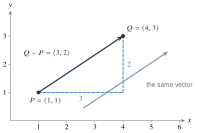
A point names a location; a vector names a displacement or another directed quantity. The vector from to is . A vector can be translated without changing its components; a point cannot. Scalars, vectors, and equations of sets are different mathematical objects and require different operations.
C. Vector operations and spatial equations#
For , length is . A nonzero vector’s unit direction is . The dot product is the scalar
Nonzero vectors are perpendicular exactly when their dot product is zero. Projection onto a nonzero is .
The three-dimensional cross product is the vector
It is perpendicular to both factors, has magnitude , and follows right-hand orientation. Swapping the factors reverses its sign. Its magnitude is parallelogram area; half is triangle area. A scalar triple product’s absolute value gives parallelepiped volume.
A line through in nonzero direction is . A plane through with nonzero normal is . Point-to-plane distance for is . Geometry and vector identities: [O3Vectors].
D. Why products measure geometry#
The dot product extracts the component of one vector along another; multiplying that projected length by the other’s length gives . The projection formula scales the target direction by exactly this component. A plane’s normal dot every in-plane displacement is zero, explaining its equation.
The cross product’s magnitude is base times perpendicular height, the parallelogram area. Its direction provides an oriented normal. This is the same normal construction used later for tangent planes and surface flux; a sign error today becomes an orientation error in vector calculus.
E. Recognize the spatial object#
One equation in three coordinates usually describes a surface, not a curve. Two independent plane equations usually intersect in a line. A parametric vector equation in one parameter usually describes a curve. To recognize a surface, hold one coordinate fixed and examine the resulting traces. For example, has circular horizontal traces and parabolic vertical traces; has a saddle. A missing coordinate indicates a cylinder extending along that coordinate direction, not necessarily a circular cylinder.
F. Worked examples#
A plane through three points. Let , , . In-plane vectors are and . Their cross product is , so the plane is , or . Substituting all three points checks the result.
A projection. For and , the projection is . The leftover has dot product zero with , confirming the decomposition into parallel and perpendicular parts.
A quadric trace. The surface has circles of radius in horizontal planes, never empty. It is a one-sheet hyperboloid. In contrast, requires and has two separated sheets.
Computing bridge: Coordinates belong to a chosen basis#
A vector is not intrinsically tied to one list of coordinates. A game camera, a world frame, and an object’s local frame can assign different coordinate lists to the same geometric direction. A01 explains matrices as maps between such representations. When applying a change of frame, identify which coordinates are input, which are output, and whether you are moving an object or merely redescribing it. The order of matrix multiplication follows that choice and generally cannot be reversed.
G. Independent practice#
F foundation C standard course work T transfer S optional stretch L runnable lab or project. Attempt the complete set before opening its solutions.
For and , find , its length, and a unit vector in that direction.
Find the angle between and , and project onto .
Find for , , and the area of the triangle they span.
Find the line through parallel to . Determine where it intersects the plane .
Find a plane through with normal , and the distance from the origin to this plane.
Find a parametric equation for the intersection of and .
Identify each surface using traces: , , and in three-dimensional space.
Decide whether the lines and are parallel, intersecting, or skew. Find their minimum distance.
Optional small hints
For M33.05, use the point-normal form before expanding. For M33.06, set . For M33.08, write the squared distance between two arbitrary points on the lines.
H. Complete solutions: Module 33#
Compare the first step where your work differs. A corrected answer is not yet an independent success.
M33.01Show solution
Subtract endpoint coordinates in the requested direction
The displacement is . Its length is . Dividing by that nonzero length gives unit vector . Its squared component sum is one, checking normalization.
Back to M33.01M33.02Show solution
Dot product gives both angle and projection
The dot product is , and both lengths are . Thus , so . Projection is . Subtracting it from gives a vector perpendicular to , as a dot-product check confirms.
Back to M33.02M33.03Show solution
Cross product supplies an oriented normal and an area
The component formula gives . Its dot products with and are zero. Its length is , so the triangle area is square units. The cross product itself is a vector, not the scalar area.
Back to M33.03M33.04Show solution
Use one shared parameter for all coordinates
The line is . The condition gives , so . The intersection point is . Substituting a different parameter into each coordinate would no longer describe the same point on the line.
Back to M33.04M33.05Show solution
Normal dot displacement gives the plane
The equation is , or . The origin-to-plane distance is . The numerator is an algebraic offset; dividing by normal length converts it to geometric distance.
Back to M33.05M33.06Show solution
Two constraints leave one free parameter
The second plane gives . Substituting into the first gives . Hence the intersection is , . Direct substitution satisfies both planes. Its direction is perpendicular to both plane normals.
Back to M33.06M33.07Show solution
Missing coordinates and trace shapes classify the surfaces
The first is a sphere centered at the origin with radius . The second is an upward circular paraboloid: horizontal traces are circles for , and vertical traces are parabolas. The third is a parabolic cylinder, because every fixed slice has the same parabola and is unrestricted. Calling the third merely a planar parabola would ignore the free spatial coordinate.
Back to M33.07M33.08Show solution
Nonparallel lines need not meet in space
Their directions and are not parallel. Every point on the first has and every point on the second has , so they never intersect: they are skew. Squared distance between their points is , with equality at . The minimum distance is therefore , realized along the segment from to , perpendicular to both directions.
Back to M33.08I. Retention and readiness#
Retrieve M31.06 and M04.05. Explain whether a dot product, cross product, norm, or set of equations is the requested object. Advance when you can verify a proposed normal by dot products and a proposed point by substitution.