Module 36: Partial derivatives, differentiability, and the chain rule
On this page
- A. Prerequisites and observable goals
- B. The central idea: coordinate rates are pieces of a full local model
- C. Definitions and sufficient conditions
- D. Why every dependency path contributes
- E. How to solve without losing a variable
- F. Worked examples
- G. Independent practice
- H. Complete solutions: Module 36
- I. Retention and readiness
A. Prerequisites and observable goals#
Multivariable domains and limits, ordinary differentiation, and vector notation.
Compute partial and mixed derivatives, distinguish them from total differentiability, and track all dependency paths in a multivariable chain rule.
B. The central idea: coordinate rates are pieces of a full local model#
The partial derivative changes while holding fixed. The partial derivative changes while holding fixed. They are ordinary derivatives of coordinate slices. A full multivariable derivative is stronger: one linear map must predict the first-order change for all small input displacements, not merely the coordinate axes.
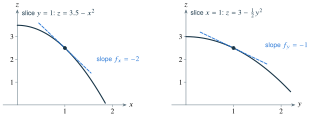
C. Definitions and sufficient conditions#
At an interior point,
The function is differentiable at if
Differentiability implies continuity and existence of partial derivatives. Existence of partial derivatives alone implies neither continuity nor differentiability. Continuous partial derivatives in a neighborhood of a point are a sufficient condition for differentiability there. [O3Diff]
We use : differentiate in , then in . If the relevant second partials are continuous in a neighborhood, (Clairaut’s theorem). Without appropriate regularity, interchanging the order is not automatically justified.
If is differentiable and are differentiable, then
For , and , with all outer partials evaluated at the current inner inputs. [O3Chain]
D. Why every dependency path contributes#
A small time change produces and . Differentiability says . Substituting the two input changes and dividing by gives the chain rule. The neglected error terms vanish in the limit under the stated differentiability assumptions.
For the polynomial at , the exact expansion has error . Dividing by leaves that distance itself, which tends to zero. This is an explicit differentiability proof. It uses a first-order error test, not only the existence of derivatives along two axes.
E. How to solve without losing a variable#
Identify which variables are independent. For a partial derivative, circle the variable being changed and treat the others as constants. For compositions, draw a small dependency tree: each path from the output to the requested input contributes a product, and parallel paths add. For implicit relations defining , differentiate every occurrence of ; when and sufficient smoothness holds, and . If , those solved formulas cannot be used without further analysis.
F. Worked examples#
Partial versus total change. For , and . If , then
Direct substitution gives , whose ordinary derivative checks the result.
A smooth implicit graph. For near a point with , differentiation with respect to gives , so . The choice identifies the upper hemisphere as a function locally; near the equator, the solved graph formula becomes singular.
A necessary warning. Define off the origin and . Both coordinate partials at zero equal zero because the axis restrictions are identically zero. Yet the diagonal path gives , so the function is not continuous and therefore not differentiable there.
G. Independent practice#
F foundation C standard course work T transfer S optional stretch L runnable lab or project. Attempt the complete set before opening its solutions.
Find for .
Find and for , and justify their equality.
For , , , find by the chain rule and by direct simplification.
Let , , . Find both from the chain rule and from the simplified composition.
The equation defines a positive near . Find there.
Prove differentiability of at an arbitrary point by explicitly bounding the error after its linear terms.
For and motion , find the temperature rate at .
Define off zero and . Show that every directional derivative at zero exists, yet the function is not differentiable there.
Optional small hints
For M36.05, verify the point lies on the surface before differentiating. For M36.06, the error is , and . For M36.08, along a unit vector the directional difference quotient is , not the linear expression predicted by the coordinate partials.
H. Complete solutions: Module 36#
Compare the first step where your work differs. A corrected answer is not yet an independent success.
M36.01Show solution
Hold the other input fixed
Differentiating with respect to gives . Differentiating with respect to gives . The factors and in the exponential terms are chain-rule derivatives of its inner product with the other variable held fixed.
Back to M36.01M36.02Show solution
The mixed-order equality has a smoothness justification
First , so . Conversely , so . Both are continuous everywhere, as are the other second partials, so Clairaut’s sufficient hypotheses hold. Direct computation also verifies the equality here.
Back to M36.02M36.03Show solution
Two dependency paths collapse by a trigonometric identity
The chain rule gives . Substituting cancels the cross terms, leaving . Directly , giving the same derivative. Ignoring either input path would miss part of this cancellation.
Back to M36.03M36.04Show solution
Two independent parameters require two different partials
Here . Thus , while . The composition is , whose partials confirm . The sign difference comes from .
Back to M36.04M36.05Show solution
Check geometry and the nonzero implicit denominator
The point satisfies . Differentiating gives and . Thus and . At the stated point, . The denominator is nonzero, consistent with a local positive graph.
Back to M36.05M36.06Show solution
A uniform error estimate proves differentiability
Expand exactly: . The partials at are , and the error is . For , . This proves differentiability at every point and identifies its derivative as the linear map .
Back to M36.06M36.07Show solution
Evaluate outer derivatives at the moving point
The partials are and . At , the point is and velocity is . Thus in temperature units per time unit. The negative sign means the moving particle experiences cooling at that instant.
Back to M36.07M36.08Show solution
All directional rates need not assemble into one linear map
For a unit direction and nonzero , , since . Therefore every directional derivative exists and equals . Coordinate partials are and , so differentiability would require directional derivative . At , . Equivalently, along , the linear error divided by distance stays nonzero. Thus no single linear derivative exists, despite all directional derivatives existing.
Back to M36.08I. Retention and readiness#
Retrieve M35.08 and M10.07. Explain why the total derivative is a linear approximation in every direction, not just a collection of separate rates. Advance when you can show every chain-rule dependency and audit the regularity needed for interchanging mixed partials.