Module 20: Integration by parts and structural choices
On this page
- A. Prerequisites and observable goals
- B. The central idea: reverse the product rule
- C. The rule and the roles of the pieces
- D. Why the transfer can simplify a product
- E. Choose a method by the resulting integral
- F. Worked teaching examples
- G. Independent practice
- H. Complete solutions: Module 20
- I. Retention and readiness
A. Prerequisites and observable goals#
Product rule, substitution, logarithms, and definite integral evaluation.
Recognize when a product suggests integration by parts, choose useful components, repeat the method when necessary, and solve a cyclic integral.
B. The central idea: reverse the product rule#
Substitution reverses a chain rule. Integration by parts reverses a product rule. Neither is triggered by appearance alone: a product such as is better handled by substitution, while is well suited to parts. Your task is to find a transformation that makes the remaining integral simpler or relates it to the original in a solvable way.
C. The rule and the roles of the pieces#
Integrating gives
For differentiable with sufficient continuity on ,
Here includes the integration differential; it is not the same object as . Choosing requires differentiating it, while choosing requires finding an antiderivative. A memorized ranking of logarithms, inverse trigonometric functions, polynomials, and exponentials can suggest choices, but it is a heuristic, not a theorem guaranteeing success. [O2Parts]
For indefinite calculations, one arbitrary constant at the end is enough. When using the symbol to represent an integral in a cyclic calculation, work with a consistently chosen antiderivative up to constants, then restore the arbitrary constant after solving the relation.
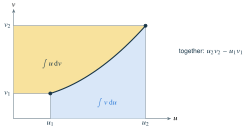
D. Why the transfer can simplify a product#
In , set , . Differentiating lowers the polynomial degree and integrating the exponential does not make it harder. The formula transfers one derivative onto :
The product rule checks the answer: . In contrast, choosing , gives a new integral containing , which is harder. A legal transformation need not be a useful one.
E. Choose a method by the resulting integral#
Simplify first. Look for a direct derivative pattern or substitution. If neither appears, ask whether one factor becomes simpler under differentiation and the other has a manageable antiderivative. Write a two-column record of and . Apply the formula with its minus sign, then inspect the new integral. Stop when it is elementary, repeat if complexity is decreasing, or solve algebraically if the original integral returns. For definite integrals, evaluate the boundary product as well as the remaining integral.
F. Worked teaching examples#
A hidden product. To integrate for , write it as . Choose , , so , . Then . A product need not have two visibly complicated factors.
Repeated parts. With , choose , . Then . The second integral, using , , equals . Therefore
Notice that multiplies both terms of the second result.
A cyclic comparison. Integrals of or often return to themselves after two applications. That is not failure: it supplies an equation for the unknown antiderivative. Keep the repeated integral named consistently and collect it on one side.
G. Independent practice#
F foundation C standard course work T transfer S optional stretch L runnable lab or project. Attempt the complete set before opening its solutions.
Evaluate .
Evaluate .
Evaluate .
Evaluate .
Evaluate by a cyclic integration-by-parts calculation.
Evaluate .
Choose and execute an efficient method for each integral: and . Explain the structural difference.
For integers , derive a reduction relation for . Use it to find , treating the base case separately.
Optional small hints
For M20.04, use . For M20.05, name the sine integral and the cosine integral . For M20.06, divide by after parts. For M20.08, the standard recurrence is intended for , not for the base case .
H. Complete solutions: Module 20#
Compare the first step where your work differs. A corrected answer is not yet an independent success.
M20.01Show solution
Remember the antiderivative’s scale factor
Choose , , so and . Then
Differentiation makes the two extra sine terms cancel.
Back to M20.01M20.02Show solution
Lower the polynomial degree twice
First, . A second application gives . Thus . Checking: the product derivative is .
Back to M20.02M20.03Show solution
Evaluate the boundary product too
The primitive is . At it is ; at it is . Hence the integral is . The positive answer agrees with on the interval.
Back to M20.03M20.04Show solution
A single inverse trigonometric factor is a product with one
Use , . Then
The remaining integral is a substitution with . The logarithm argument is positive for every real , so no additional domain split is required.
Back to M20.04M20.05Show solution
Solve the equation produced by repetition
Let and . Integrate the exponential in each parts step:
Substitution gives
Thus , so
Product differentiation verifies the coefficients and signs.
Back to M20.05M20.06Show solution
Parts followed by polynomial division
Take and . Then
Since , the remaining integral is . Consequently . The logarithmic terms cancel only after both definite evaluations are included.
Back to M20.06M20.07Show solution
Similar-looking products can encode different rules
For , the inner exponent’s derivative is , so gives . For , the polynomial factor is not the derivative of the exponent; parts reduces it to . Differentiating both answers checks that the first produces an extra through the chain rule while the second uses product-rule cancellation.
Back to M20.07M20.08Show solution
A recurrence from one parts step and an identity
For , write and choose , . The boundary term vanishes at both ends. Thus
Solving gives . With , and . For the boundary term is not zero, which is why the recurrence’s derivation must not be blindly extended to that base case.
Back to M20.08I. Retention and readiness#
Revisit M17.04 and M10.05. Explain which earlier derivative rule each integration method reverses. Advance when you can predict the new integral before committing to a parts choice and can check the final primitive by differentiation.