Module 29: Power series and endpoint testing
On this page
A. Prerequisites and observable goals#
Geometric series, ratio/root tests, alternating series, and interval notation.
Find a radius and interval of convergence, test endpoints separately, and differentiate or integrate a power series only where justified.
B. The central idea: an infinite polynomial with a domain#
A power series is a function assembled from infinitely many polynomial terms:
The coefficients are fixed numbers, is the center, and is the variable input. At each chosen , the expression becomes an ordinary numerical series. Its convergence can change with , so a power series comes with a convergence domain, not just a formula.
C. The radius theorem and legal operations#
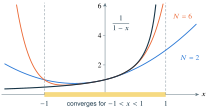
There is a radius such that the series converges absolutely for and diverges for . When , the endpoints require separate tests. Neither, one, or both may converge, absolutely or conditionally. The center always converges because all positive powers vanish there.
Inside the open convergence interval, termwise differentiation and integration are valid:
The differentiated and integrated series have the same radius of convergence, but may have different endpoint behavior. These statements are not automatic permission to differentiate at a boundary where the original numerical series happens to converge. [O2Power]
The geometric identity
is a starting point for building many power-series representations by substitution, differentiation, and integration. Always translate into the actual condition.
D. Why one radius organizes convergence#
Suppose a power series converges at a nonzero displacement . Its terms there are bounded, say . At any strictly smaller displacement,
a convergent geometric bound. Thus convergence at one distance implies absolute convergence at every smaller distance. This nested structure explains the radius. The boundary itself is not covered by a strictly smaller-ratio argument.
A similar geometric domination on any closed subinterval strictly inside the radius makes the convergence controlled enough to interchange limits with differentiation or integration. The full uniform-convergence proof is optional, but the location restriction is essential.
E. A four-stage workflow#
Identify the center. Apply the ratio or root test with treated as a parameter, and solve the strict inequality giving absolute convergence. Translate it into an open interval. Then substitute each finite endpoint into the original series and classify that numerical series separately. After differentiating or integrating, retain the radius but retest the new endpoints rather than copying the old brackets.
F. Worked examples#
A shifted center. For , the absolute ratio tends to , so . At , the series is , which converges conditionally. At , it is harmonic and diverges. The interval is ; writing only would omit endpoint information.
Building a logarithm. On , substitute into the geometric series and integrate from to :
The series converges at as well. Its value there equals , but extending the interior identity to that endpoint needs an endpoint argument (for example, a remainder estimate from the finite geometric identity), not just the observation of convergence. The stretch problem develops a related justified endpoint evaluation.
G. Independent practice#
F foundation C standard course work T transfer S optional stretch L runnable lab or project. Attempt the complete set before opening its solutions.
Find the radius and interval of convergence of , and its sum inside that interval.
Find the interval of convergence of , classifying both endpoints.
Find the radius and interval of convergence of .
Find the radius of convergence of and .
Derive a power series for centered at zero, and state its interval of convergence.
Derive a power series for on by integrating a geometric series.
The series converges on . Determine the interval of convergence of its termwise derivative, and explain why copying the original endpoints would fail.
Use the finite geometric identity for and an integrated remainder bound on to prove .
Optional small hints
For M29.03, the endpoint terms fail to tend to zero. For M29.07, differentiate the exponent as well as the coefficient. For M29.08, the remainder after powers through is .
H. Complete solutions: Module 29#
Compare the first step where your work differs. A corrected answer is not yet an independent success.
M29.01Show solution
Translate the geometric ratio into an input interval
The ratio is . Thus , giving and open interval . At either endpoint, terms have magnitude one and the series diverges. Inside, . The rational function exists at many other inputs, but this particular series does not represent it outside its interval.
Back to M29.01M29.02Show solution
Absolute convergence can persist at both endpoints
The ratio limit is , so . At , the series is , convergent; at , its absolute series is the same convergent -series. Thus the interval is , with absolute convergence at both endpoints. The radius alone did not determine the brackets.
Back to M29.02M29.03Show solution
A polynomial coefficient changes endpoint behavior
The absolute ratio tends to , giving and interior . At , terms are ; at , they are . Neither tends to zero. Therefore the interval is .
Back to M29.03M29.04Show solution
Factorials in opposite places give opposite radii
For , the absolute ratio is for every real , so . For and fixed , the ratio is , proving divergence. At , only the constant term remains. Thus the second radius is . An infinite formal polynomial need not define a function on any open neighborhood of its center.
Back to M29.04M29.05Show solution
Differentiate only inside the known radius
For , differentiate term by term:
The radius stays one. At both endpoints the terms do not approach zero, so the interval is . Reindexing explains the changed coefficient.
Back to M29.05M29.06Show solution
Integrate from a base point with known value
Using , for . Integrating from to gives
The constant is zero because both sides vanish at . Endpoint evaluation is a separate justification, supplied for in M29.08.
Back to M29.06M29.07Show solution
The radius survives, the endpoints can change
The derivative series is . Its radius remains one. At , it becomes the divergent harmonic series. At , it is , which converges conditionally. Hence its interval is . Differentiating a convergent numerical series at an endpoint is not justified merely by the original endpoint convergence.
Back to M29.07M29.08Show solution
Control the endpoint remainder explicitly
The finite identity is
Integrate over . The left side is , and the finite sum integrates to . The remaining integral has absolute value at most . Therefore the finite sums converge to . This proves the value at the boundary instead of assuming an interior identity extends there without explanation.
Back to M29.08I. Retention and readiness#
Retrieve M28.06 and M26.03. Explain why radius, interval, and endpoint classification are three related but different outputs. Advance when you can change a power series by differentiation or integration and correctly retest its endpoints.