Module 34: Vector-valued motion, arc length, and curvature
On this page
- A. Prerequisites and observable goals
- B. The central idea: a changing vector describes a trajectory
- C. Regular curves, length, and curvature
- D. Why constant speed can coexist with acceleration
- E. A calculation sequence
- F. Worked examples
- G. Independent practice
- H. Complete solutions: Module 34
- I. Retention and readiness
A. Prerequisites and observable goals#
Vectors, componentwise differentiation and integration, and parametric curves.
Compute spatial velocity and acceleration, parameterize by arc length in simple cases, and separate tangential acceleration from turning.
B. The central idea: a changing vector describes a trajectory#
A vector-valued function assigns a position to each time or parameter. Limits, derivatives, and integrals act componentwise. Velocity is a vector tangent to the trajectory; speed is a scalar. Acceleration may be nonzero even at constant speed because the velocity’s direction can turn.
C. Regular curves, length, and curvature#
For a sufficiently smooth curve with , the unit tangent is . Arc length from a starting parameter is for , so . Curvature measures turning per unit distance:
The cross-product formula applies to a twice differentiable regular spatial curve; a zero velocity requires separate examination. Where , the principal normal is . If , that formula does not supply a unique normal.
For regular motion, the tangential acceleration is , and the nonnegative normal component is . Thus wherever these directions are defined. The alternative magnitude relation is . Vector curve definitions: [O3Curves].
D. Why constant speed can coexist with acceleration#
Write . Product differentiation gives . Since , differentiation gives ; turning is perpendicular to the tangent. With , the acceleration decomposition follows. This connects a geometric turning rate to the familiar centripetal acceleration of circular motion.
On a circle of radius , a direction change corresponds to traveled distance , so curvature is . Changing traversal speed does not change the circle’s curvature, but it changes and therefore the required turning acceleration.
E. A calculation sequence#
Differentiate components, compute speed, and identify any zero-speed points before normalizing. Integrate speed for length, not the vector velocity itself. For curvature, choose the unit-tangent or cross-product expression that simplifies most. For a motion interpretation, compute both and rather than inferring speeding up from the magnitude of acceleration. If reparameterizing by length, solve on a monotone branch and substitute back into the position vector.
F. Worked examples#
A helix. For , velocity is and speed is . Acceleration is , perpendicular to velocity. Therefore , , and . One turn has length .
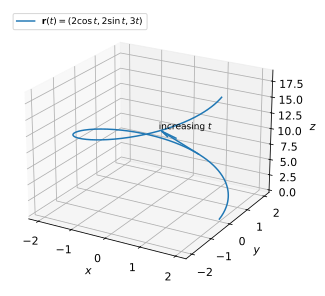
Recovering motion from acceleration. If , then integrating gives and . The integration constants are vectors determined component by component by the initial conditions.
G. Independent practice#
F foundation C standard course work T transfer S optional stretch L runnable lab or project. Attempt the complete set before opening its solutions.
For , find velocity, acceleration, and speed at .
Find the length of on .
Reparameterize the curve in M34.02 by arc length measured from .
Find the curvature of at an arbitrary real .
For the curve in M34.01, find and at , and decide whether speed is increasing.
A projectile starts at m with velocity m/s and constant acceleration m/s. Find its trajectory and time of reaching maximum height.
A particle moves around a circle of radius m at constant speed m/s. Find curvature, tangential acceleration, and normal acceleration.
For on , explain why the usual curvature formula is undefined at zero even though the image is a straight line. Find its length.
Optional small hints
For M34.04, compute before its norm. For M34.05, use a dot product for the tangential component and Pythagoras for the normal magnitude. For M34.08, speed is , including at zero.
H. Complete solutions: Module 34#
Compare the first step where your work differs. A corrected answer is not yet an independent success.
M34.01Show solution
Differentiate each coordinate
Velocity is and acceleration . At , these are and . Speed is , giving at that instant. Speed has no direction components.
Back to M34.01M34.02Show solution
Integrate a constant speed
The velocity is , whose norm is . Hence . The vertical rise alone is , less than the traveled helical length.
Back to M34.02M34.03Show solution
Arc length becomes the new input
Since from the starting point, . Substitute into the curve:
Differentiating with respect to gives a vector of norm one, which is the defining check for a unit-speed arc-length parameterization.
Back to M34.03M34.04Show solution
A regular parabola has a simple cross product
Here and . Their cross product is of norm , while speed is . Thus . Speed never vanishes, so the formula is valid for every real ; curvature is largest at the vertex.
Back to M34.04M34.05Show solution
Separate speed change from direction change
At , and , so . Since , . The positive tangential component means speed is increasing. The nonzero normal component shows the path is turning at the same time.
Back to M34.05M34.06Show solution
Integrate twice and apply vector initial data
Velocity is , and the position is . Vertical velocity vanishes at s, and vertical acceleration is negative, so maximum height occurs then. Its height is m. The horizontal speed remains m/s, so zero vertical velocity is not zero total velocity.
Back to M34.06M34.07Show solution
Constant speed removes only the tangential component
The circle has m. Since speed is constant, . Normal acceleration is m/s, directed inward. Constant speed does not mean constant velocity because direction changes continuously.
Back to M34.07M34.08Show solution
A singular parameterization can hide a simple geometric image
Velocity is , zero at . The cross-product formula therefore has a zero denominator there and cannot be evaluated directly. Away from zero the curvature is zero; the image is the straight segment from to . A regular parameterization of that image has curvature zero everywhere in its interior. The original length integral remains valid: . A formula’s regularity condition and the underlying geometry must be distinguished.
Back to M34.08I. Retention and readiness#
Retrieve M12.02 and M31.08. Explain why speed, tangential acceleration, normal acceleration, and curvature have different units and meanings. Advance when you can check the regularity needed before dividing by speed.