Module 46: The Divergence theorem and a unified view of calculus
On this page
- A. Prerequisites and observable goals
- B. The central idea: interior outflow accumulates on the boundary
- C. The theorem and its domain requirements
- D. Why a singular source changes the argument
- E. A method-selection procedure
- F. Worked examples
- Computing bridge: Conservation as a system-level check
- G. Independent practice
- H. Complete solutions: Module 46
- I. Retention and readiness
A. Prerequisites and observable goals#
Triple integrals, divergence, outward flux, and boundary orientation.
Convert closed-surface flux to a volume integral, close an open surface with explicit corrections, handle cavities and singularities, and select the appropriate boundary theorem.
B. The central idea: interior outflow accumulates on the boundary#
The Divergence theorem connects the net outward flux of a vector field through a closed surface to the integral of its divergence throughout the enclosed solid. Internal transfers cancel: flow leaving one small cell enters its neighbor. Only the exterior boundary contributes to net escape. This is the three-dimensional outflow counterpart of Green’s planar flux theorem.
C. The theorem and its domain requirements#
Let be a suitable bounded solid with piecewise smooth closed boundary , oriented outward. If has continuous first partial derivatives on an open neighborhood of the entire solid, then
The field must be regular inside the solid, not merely on its boundary. For a solid with a cavity, outward on the inner boundary points into the cavity, away from the material of the solid. Open surfaces are not closed boundaries; add the missing patches and subtract their fluxes afterward. [O3Div]
The fundamental boundary patterns are:
These share an interior-derivative/boundary-accumulation structure, but their objects, dimensions, and hypotheses differ. The analogy helps choose a theorem; it does not license exchanging curl, divergence, or gradient.
D. Why a singular source changes the argument#
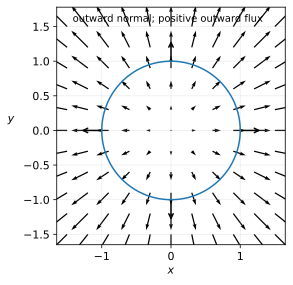
For away from the origin, direct differentiation gives divergence zero there. On a sphere of radius , the outward normal is , so , giving total flux . There is no contradiction: the enclosed origin is outside the field’s domain. The theorem cannot integrate zero divergence throughout a solid where the field is not defined everywhere.
On a spherical shell that excludes the origin, the field is smooth. The outer flux is and the inner outward-from-shell flux is , so the total is zero, agreeing with the volume integral. The missing source point and the cavity’s orientation together explain the difference between the two situations.
E. A method-selection procedure#
If asked for flux, determine whether the surface is closed. For a closed surface, compute divergence and compare the volume integral’s complexity with direct surface integration. For an open patch, determine whether adding a simple cap makes the theorem useful; track its flux with the outward orientation of the enclosed solid. Search for singularities anywhere in that solid. For circulation, consider a potential, Green, or Stokes instead; divergence is not a shortcut for every vector integral.
F. Worked examples#
An ellipsoid and a simple divergence. For , divergence is . Over an ellipsoid with semiaxes , total outward flux is , provided the entire ellipsoid boundary is included. This avoids parameterizing its surface normals.
Closing an open cap. Suppose a cap and a horizontal base disk bound a solid. Write . Only then solve for the requested cap flux. A downward base normal can make negative, so subtracting it increases the cap result. This is exactly the same sign discipline as subtracting an entire in a difference quotient, now applied to oriented contributions.
Computing bridge: Conservation as a system-level check#
The cancellation of internal fluxes is a mathematical prototype for a conservation test. A numerical transport model may track change in stored mass plus boundary outflow minus sources; an accounting service may track conserved totals across a transfer. These are different domains, not interchangeable theorems, but both benefit from explicitly naming what can enter, leave, or be created. J03 checks transaction effects; T05 checks the conservation laws appropriate to its mathematical model.
G. Independent practice#
F foundation C standard course work T transfer S optional stretch L runnable lab or project. Attempt the complete set before opening its solutions.
Find outward flux of through the full boundary of .
Find outward flux of through the unit sphere.
Find outward flux of through .
Find upward flux of through the paraboloid cap , , by adding its base disk.
Show that the total outward flux of any constant vector field through any closed surface bounding a suitable solid is zero. Explain why individual patches may still have nonzero flux.
For , compute flux through a radius- sphere centered at the origin and explain why divergence zero off the origin does not make this flux zero.
For , find total outward flux from the shell . Separately identify outer- and inner-boundary contributions.
For a radial field with and differentiable , derive . Find all such divergence-free radial fields and their fluxes through origin-centered spheres. Which extend continuously to the origin?
Optional small hints
For M46.02, integrate over the unit ball. For M46.04, the base normal is downward and its field component is . For M46.08, use and solve the resulting first-order equation for .
H. Complete solutions: Module 46#
Compare the first step where your work differs. A corrected answer is not yet an independent success.
M46.01Show solution
Closed-surface flux from constant divergence
The field is smooth throughout the box and its neighborhood. Divergence is , and volume is . Thus total outward flux is . The six faces are all included; a single face would not have this flux.
Back to M46.01M46.02Show solution
A radial divergence makes spherical coordinates efficient
Divergence is . Therefore
The field is polynomial everywhere, so no interior singularity obstructs the theorem.
Back to M46.02M46.03Show solution
Use volume rather than a complicated normal field
The ellipsoid semiaxes are , so its volume is . Since divergence is , the outward flux is . The axis lengths are read from square-root denominators, not from the denominator values themselves.
Back to M46.03M46.04Show solution
Subtract the missing disk with its signed contribution
The cap and base disk bound . Its volume is , and divergence of the field is , so closed flux is . On the base , the outward normal is downward, giving normal field component and base flux . Hence . A direct check uses upward graph vector area ; the dot product becomes , whose disk integral is also .
Back to M46.04M46.05Show solution
Zero divergence means no net enclosed source for a regular field
Every component derivative of a constant field is zero. The Divergence theorem therefore gives total outward flux . A patch facing the field can have positive flux and an opposing patch negative flux; the theorem asserts cancellation of the closed total, not zero flow at every boundary point.
Back to M46.05M46.06Show solution
Compute directly when the enclosed singularity blocks the theorem
On the sphere, , so the normal component is . Multiplying by surface area gives . The field’s divergence is zero only for . It is undefined at the enclosed origin, so the smoothness assumption on a neighborhood of the entire solid fails. A volume integral of its classical divergence over that solid is not a valid application of the theorem as stated.
Back to M46.06M46.07Show solution
Outward from a shell points inward on its cavity
The shell volume is , so total flux is times this, . The radius-two outer sphere contributes . On the radius-one inner sphere, the outward-from-shell normal is the negative radial unit vector, giving flux . Their sum is , checking both the theorem and cavity orientation.
Back to M46.07M46.08Show solution
Derive and solve the radial divergence equation
The first component is , whose derivative is . Summing the analogous derivatives gives
Setting it to zero on gives , so and . On a radius- sphere, the normal component is , giving flux . If , the magnitude is , unbounded near zero, so no continuous extension exists. Only extends continuously, as the zero field. The nonzero flux and the singularity are linked by the derived radial structure, not a violation of the Divergence theorem.
Back to M46.08I. Retention and readiness#
Revisit M15.08, M43.08, M44.08, and M45.06. Explain which boundary theorem fits an unfamiliar integral and list its domain and orientation assumptions before calculating. Complete the Calculus III assessment, then use its rubric to distinguish a setup gap from an arithmetic slip. The goal is independent method selection with justified conditions, not merely recognition of a familiar final formula.