Module 45: Curl, divergence, and Stokes’ theorem
On this page
- A. Prerequisites and observable goals
- B. The central idea: circulation around a boundary measures interior turning
- C. Operators and theorem hypotheses
- D. Why Stokes generalizes Green
- E. A theorem-selection procedure
- F. Worked examples
- G. Independent practice
- H. Complete solutions: Module 45
- I. Retention and readiness
A. Prerequisites and observable goals#
Partial derivatives, oriented line and surface integrals, Green’s theorem, and vector products.
Compute curl and divergence as different objects, connect circulation to curl flux, and apply Stokes with a compatible orientation and a nonsingular spanning surface.
B. The central idea: circulation around a boundary measures interior turning#
Green’s circulation theorem concerns a planar region. Stokes’ theorem extends the boundary-circulation idea to an oriented surface in space. The boundary curve may be easier to integrate than the surface, or the reverse. Curl packages local circulation into a vector whose normal component is the relevant turning density through a chosen surface.
C. Operators and theorem hypotheses#
For a field , its divergence is the scalar
and its curl is the vector
Divergence measures local net outflow density; curl measures local circulation density. Neither is the field’s magnitude. When second derivatives are continuous, and , by cancellation of mixed partials.
Stokes’ theorem. Let be an oriented piecewise smooth surface with compatible piecewise smooth boundary , and let have continuous first partial derivatives on an open neighborhood of . Then
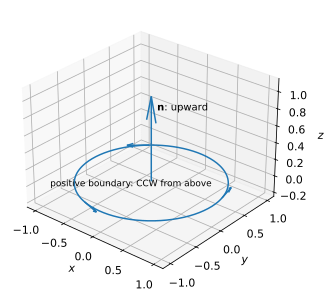
The boundary direction follows the right-hand rule relative to the normal. For an upward-oriented graph, its positively oriented boundary projects counterclockwise when viewed from above. A replacement spanning surface must satisfy the field’s regularity requirements too. [O3Stokes]
D. Why Stokes generalizes Green#
For a surface patch in the -plane with upward normal, the curl’s normal component is , exactly Green’s circulation integrand. For a curved surface, small tangent patches each have a local version of this circulation relation. Summing patches cancels their oppositely oriented interior edges, leaving only the outer boundary. This is the geometric mechanism; a full proof tracks the parameterization and derivatives carefully.
The theorem does not say curl-free fields always have zero circulation around every curve regardless of the domain. The curve must bound a suitable surface contained in a region where the field is smooth. A loop around a removed axis may have no permissible spanning disk. The field’s domain is part of the mathematical problem.
E. A theorem-selection procedure#
Identify a closed curve or a surface whose integrand is curl flux. State an orientation and check the boundary direction. Compute curl first: if it is simple, choose the easiest valid spanning surface, often a planar disk. Verify the entire chosen surface lies in a neighborhood where the field is . Integrate using the appropriate oriented vector area. If a singularity blocks that surface, either use the original path directly or find another legitimate method; do not erase the singularity by choosing a convenient picture.
F. Worked examples#
A constant curl. For , curl is . Counterclockwise circulation around a radius-three horizontal circle is the curl flux through its upward disk: times area . A clockwise traversal would give .
Computing an operator carefully. For , the curl is zero because this field is . The divergence is also zero here, but for a different reason: each component is independent of its matching differentiation coordinate. Curl zero and divergence zero are distinct conditions and need not occur together.
G. Independent practice#
F foundation C standard course work T transfer S optional stretch L runnable lab or project. Attempt the complete set before opening its solutions.
Find curl and divergence of . Interpret why they have different output types.
For , compute and verify that its curl is zero. Is its divergence necessarily zero?
Use Stokes to compute counterclockwise circulation, viewed from above, of around , .
For , find circulation around the oriented triangle visiting , , , then returning to the first vertex.
Use a flat replacement surface to compute circulation of around the boundary of above the unit disk, with upward orientation.
The field has zero curl off the -axis. Explain why its circulation around the counterclockwise unit circle in is nevertheless .
For , compute curl and then its divergence. Identify the mixed-derivative cancellation principle.
For a field on a neighborhood of the unit sphere, prove that total outward flux of its curl through the sphere is zero by applying Stokes separately to the two hemispheres.
Optional small hints
For M45.04, the oriented area vector is half . For M45.05, the boundary lies in . For M45.08, the two induced directions on the shared equator are opposite.
H. Complete solutions: Module 45#
Compare the first step where your work differs. A corrected answer is not yet an independent success.
M45.01Show solution
A vector rotation density and a scalar outflow density
Using the component formulas gives and . The rotational components contribute a vertical curl, while the expanding vertical component contributes divergence. Curl requires an axis direction; divergence is one signed scalar rate of net outflow per unit volume.
Back to M45.01M45.02Show solution
A gradient has zero curl, not automatically zero divergence
The gradient is . Its curl components are , , and , so the curl is zero. Its divergence is , generally nonzero. The gradient-curl identity does not assert that all other derivatives of a gradient vanish.
Back to M45.02M45.03Show solution
Use the upward horizontal disk
The curl is . The upward disk at induces the requested counterclockwise boundary, and the polynomial field is smooth on a neighborhood of that disk. Its area is , so circulation is . The vertical field component contributes nothing to the horizontal boundary work, consistent with this result.
Back to M45.03M45.04Show solution
The vertex order determines the normal sign
Let , , and . Then , so the oriented triangle area vector is . For , curl is . Stokes gives their dot product, . Reversing the vertex order would change the sign.
Back to M45.04M45.05Show solution
The boundary matters, but the replacement must remain valid
The boundary is the unit circle at with counterclockwise orientation from above. Use the upward flat disk at that height. The curl is , whose upward component on the disk is . Hence circulation is times disk area, . The field is polynomial on all of space, so replacing the curved cap introduces no singularity problem.
Back to M45.05M45.06Show solution
A missing axis obstructs the tempting disk argument
On the unit circle, parameterization makes the field , equal to its unit-speed tangent, so the work integrand is one and circulation is . The spanning flat disk contains the origin, where the field is undefined. Stokes cannot be applied with that disk and a zero-curl integrand. More generally, a suitable spanning surface cannot pass through the removed axis while retaining the theorem’s hypotheses; the domain restriction is the missing step in the false zero-circulation argument.
Back to M45.06M45.07Show solution
Cancellation must use the matching differentiation coordinates
The curl is . Its divergence is . In general for a field, expansion of divergence of curl pairs mixed partials with opposite signs; their equality gives zero. Here the explicit polynomial calculation is an immediate check.
Back to M45.07M45.08Show solution
Cancel the artificial interior boundary
Split the sphere into upper and lower hemispheres, both oriented outward. Stokes equates each curl flux to a line integral along its induced equator orientation. The upper hemisphere induces counterclockwise traversal from above, while the lower induces clockwise traversal. The same field on the same circle therefore contributes equal magnitudes with opposite signs. Adding gives total outward curl flux . No volume differentiability beyond the stated surface-neighborhood regularity was needed for this two-patch Stokes argument.
Back to M45.08I. Retention and readiness#
Retrieve M43.07 and M44.08. Explain where a singularity prevents using a convenient surface, and distinguish an outward field flux from a curl flux. Advance when you can determine the boundary direction from the chosen normal without relying on a memorized sign.