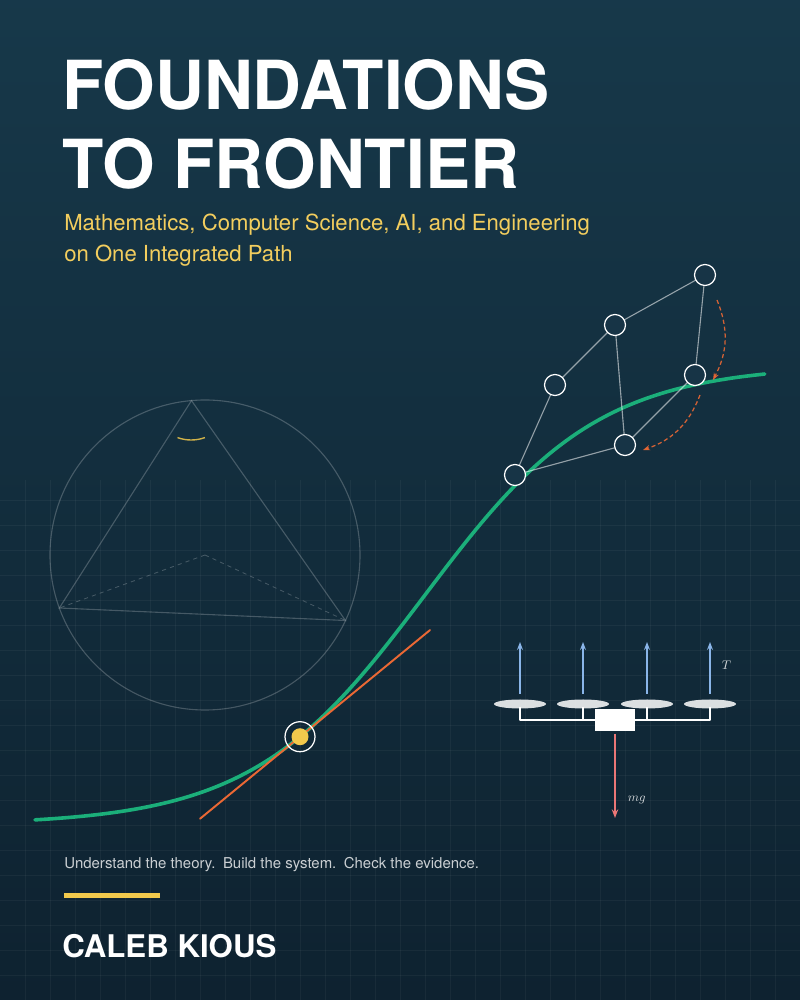
Foundationsto Frontier
Mathematics, computer science, AI and engineering on one integrated path.
Caleb Kious
Why one path
Most people meet mathematics, computer science, artificial intelligence and hardware engineering as separate subjects, in separate courses, from separate books. The connections, which are what an engineer actually uses, are left for later, and later rarely comes.
This book closes those gaps. A derivative arrives with the program that computes it, a gradient with the network it trains, and a drone with the force balance that keeps it in the air.
Read the preface, or see how to use this book for reading paths by goal.
Picture first
Wherever a picture can carry it, a chapter’s central idea comes with one.259 figures were drawn for this book.
Practice that stays
954 exercises, each with a complete solution, and hints that come in rungs so you take only the help you need.
Checked, and honest about it
Answers verified by script, lab tests tested against deliberately wrong code, and dated sources for every fact that can change. How this book was checked says what was verified and what was not.
The route
Fourteen parts. You do not need to read them all, or in order.
Learn how to learn
How the sessions work, how to use AI tools without losing the skill, and where to start.
The core
Foundations, three semesters of calculus, and algorithms and systems, taught side by side.
- Part IIFoundations10 chapters, 63 exercisesAlgebra, functions, and trigonometry, side by side with your first programs and proofs.
- Part IIICalculus I18 chapters, 185 exercisesRates, limits, derivatives, and integrals, each one computed, checked, and connected to code.
- Part IVAlgorithms and systems17 chapters, 87 exercisesFrom data structures and proofs of correctness to machines, operating systems, databases, networks, and distributed systems.
- Part VCalculus II15 chapters, 124 exercisesIntegration strategy, honest numerical error, differential equations, series, and curves in the plane.
- Part VICalculus III16 chapters, 132 exercisesVectors, surfaces, gradients, multiple integrals, and the theorems of vector calculus.
Applied and graduate work
The mathematics every engineering track leans on, five bounded projects, and the graduate core.
- Part VIIApplied mathematics and computation14 chapters, 70 exercisesLinear algebra, probability, statistics, numerical methods, and differential equations, put to work in systems, GPUs, machine learning, robotics, and aerospace.
- Part VIIIProjects5 chapters, 5 exercisesFive bounded engineering projects, each with a specification, independent tests, and stated limits.
- Part IXThe graduate core23 chapters, 127 exercisesSpecifications, semantics, algorithms with certificates, measurement, architecture, and machine learning you can derive and defend.
Frontier tracks
Each track opens with a map of its whole route and teaches its first module in full.
- Part XFrontier engineering3 chapters, 22 exercisesWhat engineers are building now, and the mathematics and code underneath it: drones that hold altitude, cars that follow a lane, and machines that run models fast.
- Part XIThe AI Lab2 chapters, 25 exercisesFrom the chain rule to a small code model you train with reinforcement learning, reward with a grader you wrote, and then open up to see what it learned.
- Part XIIThe Engineering Lab2 chapters, 26 exercisesFrom Newton’s second law to a drone you design, analyse, build, test, and fly with your own C++ attitude controller.
- Part XIIIGeometry2 chapters, 40 exercisesFrom angle chasing to olympiad circles, with the two bridges an engineer needs: geometry as the constraint language of CAD, and geometry as code.
- Part XIVThe Algorithms Lane2 chapters, 15 exercisesFrom your first loop to choosing, proving, and coding the right algorithm under a clock.
From the engine
The author builds game engines and aerospace simulations, and 25 chapters end their teaching with a short piece of that code, quoted unedited and explained, most with a small example worked by hand.
Explorers
Four chapters come with an interactive model you can push around before you do the mathematics.
- Gradient ExplorerWatch gradients flow backward through a computation graph, one node at a time.
- Hover Budget ExplorerSize a drone and see thrust, weight and current respond.
- Angle ExplorerDrag triangles, parallel lines and stars; the angle sums hold while every angle changes.
- Counting ExplorerStep through loops, prefix sums and the frequency map.
Ways to read
Here, in your browser
The whole book, with three reading themes, search, and solutions that stay folded until you ask for them. Open the contents.
With the lab code
Starters you type into, the tests that judge them, and the worked code the book prints. Browse the code.