Module 44: Surface area, scalar surface integrals, and flux
On this page
- A. Prerequisites and observable goals
- B. The central idea: a surface needs two parameters and a normal
- C. Area elements and orientation
- D. Why cross products appear again
- E. A safe surface-integral workflow
- F. Worked examples
- G. Independent practice
- H. Complete solutions: Module 44
- I. Retention and readiness
A. Prerequisites and observable goals#
Cross products, double integrals, parameterized curves, and field interpretation.
Parameterize a surface patch, compute its area element, choose an oriented vector area element, and distinguish an open surface from a closed boundary.
B. The central idea: a surface needs two parameters and a normal#
A curve uses one parameter; a surface patch uses two: . The two derivative vectors describe tangent directions. Their cross product gives a normal and an area scale. A scalar surface integral weights actual curved area. Flux additionally selects the component of a vector field passing through the oriented surface. Choosing an orientation is part of the problem, not an optional sign adjustment afterward.
C. Area elements and orientation#
For a smooth regular patch with and a parameter region that covers the surface once except permissible boundary seams,
For the orientation of ,
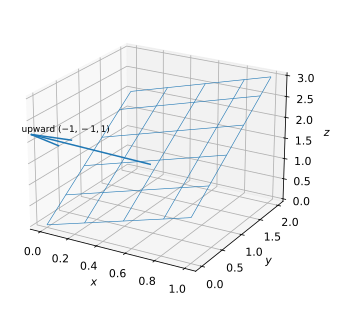
The cross product already contains the area scale. Do not multiply its dot product by its norm again. Reversing orientation negates flux but does not change scalar surface area. [O3Surface]
For a graph , upward vector area is , and scalar area is . Downward orientation reverses the vector. A closed surface encloses a solid and has a conventional outward orientation; an open patch has a boundary and must be assigned one of its normal choices explicitly.
D. Why cross products appear again#
A small parameter rectangle has tangent side vectors approximately and . Its mapped parallelogram has area . Dividing the cross product by its length yields a unit normal, so multiplying by scalar area cancels the normalization denominator and gives the vector-area formula.
The same geometric distinction appeared in line integrals: density times length used a norm, while work along a direction used a dot product. Here density times area uses a cross-product norm, and flow through an orientation uses a dot product with the cross product.
E. A safe surface-integral workflow#
Identify the surface equation, its boundary, and orientation. Choose a graph or a two-parameter description with a simple parameter domain. Differentiate both parameter directions, compute their cross product, and test its direction at an easy point. Reverse it if necessary. Substitute the field and integrate with either the norm or the oriented vector, depending on the requested quantity. For a closed surface made of several patches, account for every patch with outward normals; a missing disk can change flux even when it looks visually small.
F. Worked examples#
A cylinder’s side. The radius- cylinder is . The cross product points outward and has norm . Therefore lateral area over height is . The top and bottom disks are not included.
A sphere’s orientation. With fixed radius , use . The order points outward and has magnitude . Swapping parameter derivative order makes the normal inward. The pole singularities are coordinate degeneracies handled by patching or limits, not geometric tears in the sphere.
G. Independent practice#
F foundation C standard course work T transfer S optional stretch L runnable lab or project. Attempt the complete set before opening its solutions.
Find the area of , .
Evaluate on the graph over , .
Find upward flux of through above the triangle , .
Compute outward flux of through the radius-two sphere directly as a surface integral.
Compute outward flux of through the lateral cylinder , . What do its end disks contribute if included?
Find downward flux of through over the unit disk.
Evaluate over the upper hemisphere of the unit sphere.
For the constant field , compute upward/outward flux through the upper unit hemisphere and downward flux through its base disk. Explain the difference between the open and closed surface totals.
Optional small hints
For M44.03, use the upward vector area . For M44.06, downward vector area is . For M44.08, close the hemisphere only after including the disk with the correct outward direction for the half-ball.
H. Complete solutions: Module 44#
Compare the first step where your work differs. A corrected answer is not yet an independent success.
M44.01Show solution
The cross-product norm is constant over this planar patch
The tangent vectors are and . Their cross product is , with norm . The parameter square has area one, so surface area is . This also equals the parallelogram area spanned by the two edge vectors.
Back to M44.01M44.02Show solution
A scalar surface integral weights slanted area
For the graph, , so . Substitute : . No orientation sign is involved in this scalar integral.
Back to M44.02M44.03Show solution
The field’s vertical component dots with vector area
The upward vector area is . After substituting , its dot product with is . Thus
Multiplying by another would wrongly add a second area scale.
Back to M44.03M44.04Show solution
A radial field has constant normal component on the sphere
On radius two, the outward unit normal is , so . The sphere area is , derived by integrating over its angular domain. Hence outward flux is . This direct surface calculation will later provide a check on the Divergence theorem.
Back to M44.04M44.05Show solution
The side passes radial flow; the ends do not
Using , outward vector area is . The substituted field is the same vector, so the dot product is one. Flux is . On horizontal end disks, normals are vertical while the field has zero vertical component, so each disk contributes zero.
Back to M44.05M44.06Show solution
Choose downward before integrating
The graph’s downward vector area is . Its dot product with is . In polar coordinates,
The negative flux means the field has a net component opposite the chosen downward normal. Reversing to upward would give .
Back to M44.06M44.07Show solution
The hemisphere’s height and area factor are different functions
For the unit sphere, and . The upper hemisphere uses . Thus . This is a surface moment, not the volume moment of the upper half-ball in Module 40.
Back to M44.07M44.08Show solution
Closing a surface adds a real flux contribution
On the upper unit hemisphere, the outward normal’s vertical component is , so the flux is by the same angular integral as M44.07. The base disk’s outward normal for the half-ball is , so its flux is times disk area, . The open hemisphere flux is therefore , whereas the closed boundary total is . A theorem for closed boundaries cannot be applied to the open hemisphere without accounting for its missing disk.
Back to M44.08I. Retention and readiness#
Retrieve M42.04 and M41.07. Explain when to use a cross-product norm and when to use its oriented vector directly. Advance when you can identify every patch of a closed surface and test each normal’s direction geometrically.