Module 15: Newton’s method, indeterminate forms, and growth
On this page
- A. Prerequisites and observable goals
- B. The central idea: an approximation and a theorem are different tools
- C. Precise tools and caution signs
- D. Why Newton’s formula and the limit rule work
- E. A decision procedure
- F. Worked teaching examples
- G. Independent practice
- H. Complete solutions: Module 15
- I. Retention and readiness
A. Prerequisites and observable goals#
Tangent lines, limits, chain and quotient rules, and logarithms.
Perform and assess Newton iterations; recognize the hypotheses for L’Hôpital’s rule; and transform other indeterminate forms without illegal cancellation.
B. The central idea: an approximation and a theorem are different tools#
Newton’s method uses tangent lines to approximate a root. It is an algorithm, not a guarantee of convergence. L’Hôpital’s rule is a theorem about certain limits of quotients. It is not the quotient rule and does not say that two quotients are equal away from a limit. Growth comparisons ask which term dominates in a limiting regime; size at one finite input is not enough.
C. Precise tools and caution signs#
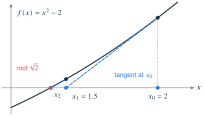
Given and an initial guess , Newton’s iteration is
provided the denominator exists and is nonzero. A tiny derivative can cause a huge jump; cycles, divergence, or leaving the function’s domain are possible. Near a simple root, sufficient smoothness and a sufficiently close initial guess can yield rapid convergence. Do not replace those conditions by “Newton always works.”
A useful version of L’Hôpital’s rule: on a one-sided punctured interval approaching a finite endpoint or infinity, assume are differentiable, , and either both or both have infinite magnitude. If has a finite or infinite limit , then . Apply separately on both sides for a two-sided limit. This is a sufficient theorem; failure of the derivative-ratio limit does not prove that the original limit fails. Check the indeterminate form again before each repetition. [O1LH]
Forms , , , , and require rewriting, not direct differentiation of both visible pieces. For variable powers with a positive base, use and .
D. Why Newton’s formula and the limit rule work#
The tangent at is . Setting gives the iteration. This uses the tangent’s root as a guess for the curve’s root, so a poor local model can produce a poor next guess.
For a simple case at a finite endpoint, the Cauchy Mean Value Theorem relates a quotient of increments to a quotient of derivatives at an intermediate point. As the endpoint is approached, that intermediate point also approaches it, transferring a derivative-ratio limit to the function quotient. The general versions require more careful hypotheses, which is why the rule is not mere symbolic cancellation of zeros.
E. A decision procedure#
For a limit, try direct substitution first and identify its form. Factor, rationalize, or use a known limit if that resolves the structure transparently. Use L’Hôpital only after recording or and derivative conditions. For a power, take a logarithm on a positive-base neighborhood, find its limit, then exponentiate. For Newton, show the function, derivative, starting value, and actual iterates; check the final residual and whether the iterate stayed in the domain. A small step is not alone a rigorous error bound.
F. Worked teaching examples#
A root iteration. To solve , use and . Then , so and . The squared residual is , not zero. An MVT derivative lower bound can convert this residual to a certified input error if the root and iterate are known to lie in a suitable interval.
An indeterminate power. For , let . Then , a quotient as . Its derivative ratio is , so . The exponent was not simply replaced by infinity.
A rule that does not apply. The limit as is , not . Differentiating numerator and denominator to obtain would be an unjustified and wrong conclusion.
G. Independent practice#
F foundation C standard course work T transfer S optional stretch L runnable lab or project. Attempt the complete set before opening its solutions.
Take two Newton steps for starting at . Keep exact fractions and evaluate the second iterate’s residual.
Show that Newton’s method for starting at cycles. Does this prove the equation has no real root?
Evaluate . State why L’Hôpital applies.
Evaluate .
Evaluate and interpret the growth comparison.
Evaluate by converting it to a quotient.
Evaluate .
A root and approximation both lie in an interval where is continuous, differentiable in its interior, and . Prove . Apply it to for the root of in .
Optional small hints
For M15.04, check the form after each derivative. For M15.06, write . For M15.08, apply the MVT between the root and the approximation, not automatically across the entire interval.
H. Complete solutions: Module 15#
Compare the first step where your work differs. A corrected answer is not yet an independent success.
M15.01Show solution
Exact iterates and a nonzero residual
Here , so . Therefore and . Its residual is . The small positive residual indicates that this positive approximation is slightly above .
Back to M15.01M15.02Show solution
A two-cycle is a failure of this starting guess
Since , . At , and , so . The same two steps repeat forever. Nevertheless and ; polynomial continuity and the IVT guarantee a root between them. An algorithm’s failure does not establish nonexistence.
Back to M15.02M15.03Show solution
Check the form, then differentiate
Both numerator and denominator tend to zero; they are differentiable and the denominator derivative is . The derivative ratio tends to , so the requested limit is . The original quotient is not equal to for general nonzero .
Back to M15.03M15.04Show solution
Repeated use requires repeated checks
The first quotient is . L’Hôpital transforms its limit into that of , still . A second use gives , again . A third gives . The denominator derivatives are nonzero on sufficiently small punctured intervals, and the final limit exists. A Taylor expansion later will independently explain the cubic leading term.
Back to M15.04M15.05Show solution
Polynomial growth versus exponential growth
The form is . Differentiating gives , still ; repeating gives . Thus : the quadratic is negligible relative to the exponential as . This is an eventual comparison, not a claim that at every real input.
Back to M15.05M15.06Show solution
Turn a product into a valid quotient
For , , of infinite-over-infinite magnitude as . The derivative ratio is . Hence the original limit is , approached through negative values. Substituting “zero times negative infinity” is not arithmetic.
Back to M15.06M15.07Show solution
Take logarithms without losing the final step
The base is positive near zero. Set . Then by a valid application. Continuity of the exponential gives . Reporting would give the logarithm’s limit, not the requested power’s limit.
Back to M15.07M15.08Show solution
A residual can become a rigorous error bound
If , the result is immediate. Otherwise the MVT gives for some point between them. Since , , proving the bound. For on , and . Consequently . This is a guaranteed bound from stated assumptions, unlike an unexplained decimal agreement.
Back to M15.08I. Retention and readiness#
Review M06.03, M03.06, and M13.06. Before every L’Hôpital calculation, say the indeterminate form aloud. Before trusting a numerical root, check the residual and the domain. Advance when you can reject a tempting but inapplicable rule as confidently as you can use it.