Module 08: The derivative and the tangent line
On this page
- A. Prerequisites and observable goals
- B. The central idea: a stable limiting rate
- C. Definitions and what they do not promise
- D. Why a derivative implies continuity
- E. An explicit routine for tangent problems
- F. The transition you need most
- Computing bridge: Two pieces of local information
- G. Independent practice
- H. Complete solutions: Module 08
- I. Retention and readiness
A. Prerequisites and observable goals#
Compute a derivative from its definition, separate function height from slope, build tangent lines, and distinguish differentiability from continuity.
B. The central idea: a stable limiting rate#
A secant line compares two points. A derivative asks whether these average slopes approach one finite number as the second point approaches the first from every allowed nearby direction. The derivative is not simply a tiny-interval quotient; it is the limit of such quotients when that limit exists.
At a fixed input , the derivative is a number. When the same process is carried out for varying inputs, is itself a function. The prime symbol is an operator indicating differentiation, not an exponent. The notation is another way to denote the derivative of with respect to ; it is motivated by rates but should not initially be treated as an ordinary quotient of two nonzero numbers.
C. Definitions and what they do not promise#
A finite derivative at an interior point implies continuity there. The converse is false. Corners, cusps, and certain vertical tangencies can occur on continuous graphs without a finite derivative. An endpoint may have a one-sided derivative, which should be identified as such rather than silently described as a two-sided derivative. Definitions and the continuity implication: [O1D].
D. Why a derivative implies continuity#
For , rewrite the output change as
If the quotient tends to a finite , the product tends to . Therefore , giving continuity. The argument uses the existence of a finite quotient limit, not merely the fact that becomes small.
The derivative also produces a local prediction:
More precisely the error divided by tends to zero. This is the meaning of being locally well approximated by a line. The line need not equal the curve away from , and it need not meet the graph only once.
E. An explicit routine for tangent problems#
Find to obtain the point. Find to obtain the slope. Place both into point-slope form before simplifying. Check that substituting gives , and that the line’s coefficient of is the slope. If the derivative limit is not finite or the two sides disagree, state that no finite derivative exists rather than forcing a line of the form .
F. The transition you need most#
For , Module 05 derived the quotient for nonzero . Now, and only now, take the limit:
At , these are different evaluations:
The point is and the slope is . Thus
The is a height at input ; the is a height at input . The incorrect would put the line through , not through .
A continuous counterexample. At zero, the quotient for is . Its right-hand limit is and its left-hand limit is . The derivative does not exist, even though Module 07 established continuity. The corner is a visual signal of the disagreeing limiting slopes, not a substitute for the calculation.
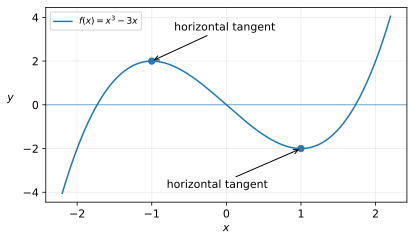
From a function graph to a derivative graph. A positive derivative means an upward-sloping tangent; a negative derivative means a downward-sloping tangent. On an interval where the derivative stays positive, the function increases; where it stays negative, it decreases (justified by the Mean Value Theorem in Module 13). The converse needs care: a strictly increasing function may have a horizontal tangent at an isolated point. A horizontal tangent corresponds to derivative zero. A function’s height and its derivative’s height are different: the graph can lie below the horizontal axis while having positive slope.
Computing bridge: Two pieces of local information#
A tangent approximation must preserve both a location and a rate. In engine terms, a moving object’s height at time is not its height at time . With and , the local prediction is , which becomes when . Substitution of checks the point independently of checking the slope. This same separation of baseline state and change appears in the integrator project J04.
G. Independent practice#
F foundation C standard course work T transfer S optional stretch L runnable lab or project. Attempt the complete set before opening its solutions.
Use the definition to differentiate . Show the entire difference quotient before simplification.
For , derive directly from , then find the tangent line at .
Use a limit to find the derivative of at a nonzero input .
Let and . Find the tangent-line equation and its prediction for . Is that prediction necessarily exact?
Use the definition to decide whether is differentiable at . State its continuity status too.
A graph is decreasing on and has a horizontal tangent at . What can be concluded about its derivative where it exists? Does this determine the graph’s heights?
Give a function with and whose tangent line at zero intersects the graph at another point. Verify your example.
Use the quotient at zero for to explain why its graph has a vertical tangent but no finite derivative at zero.
Optional small hints
For M08.04, predict a change from the known point, not a new intercept. For M08.07, add to a term vanishing at to second order and also at another input.
H. Complete solutions: Module 08#
Compare the first step where your work differs. A corrected answer is not yet an independent success.
M08.01Show solution
A general derivative from first principles
Substitute and subtract with brackets:
Expansion gives numerator . Factor and cancel for to obtain . Taking the limit yields . The cancellation and the limiting operation are distinct steps.
Back to M08.01M08.02Show solution
The point and slope reappear separately
Compute . Next . Hence
The limit is . With point the line is , or . At the result is , verifying that the slope and point were combined correctly.
Back to M08.02M08.03Show solution
A reciprocal slope
For and sufficiently small nonzero with ,
Its limit as is . A negative derivative is plausible: the reciprocal function decreases on each of its intervals and .
Back to M08.03M08.04Show solution
Local prediction, not a new exact function
The tangent line is , hence . For input change , its output change is , giving . It need not be exact because curvature can create an error. The given information determines the tangent line, not the whole function.
Back to M08.04M08.05Show solution
A translated corner
The value at is zero. Its difference quotient there is . The right limit is and the left limit , so the derivative does not exist. Yet as , so the function is continuous at .
Back to M08.05M08.06Show solution
Derivative signs do not encode absolute height
For a decreasing function, the derivative, where it exists, is nonpositive; strict decrease does not force it to be strictly negative at every individual point. The horizontal tangent gives if this tangent corresponds to a finite derivative. Adding a constant to the function shifts all heights without changing its slopes. Thus the stated behavior cannot determine function values.
Back to M08.06M08.07Show solution
Tangency does not mean only one intersection
Choose . It satisfies . Directly, , so . The tangent is . Since , the graph meets this tangent again at . Indeed, equality with the line requires , giving inputs and .
Back to M08.07M08.08Show solution
An infinite slope is not a finite derivative
At zero, the quotient is for . Because and tends to zero from both sides, this quotient tends to . Thus there is no finite derivative at zero. The limiting lines become vertical, described geometrically by . The function is nevertheless continuous there because .
Back to M08.08I. Retention and readiness#
Take mixed review R1 before rushing to derivative rules. Independently solve M05.02, M07.07, and M08.04. Explain in one sentence each what and contribute to a tangent line. Advance when you can derive a fresh quadratic’s derivative and reject an incorrect tangent line by substitution.