LM: How to learn: the session loop, error families, and AI without losing the skill
On this page
- A. Prerequisites and observable goals
- B. Why measure how you learn
- C. What the evidence says
- D. Strengths that transfer
- E. The friction map: four error families
- F. The learning loop
- G. A session and a week
- H. How your map updates
- I. Using AI without making it a crutch
- Sources for section I (checked 17 October 2026)
- Sources for sections C–H
- J. Independent practice
- K. Complete solutions: LM
- L. Retention and readiness
A. Prerequisites and observable goals#
Nothing. Read this before any other chapter, and again whenever a subject starts to feel harder than it should.
Name the four common error families and the countermeasure for each; run the learning loop in every session; keep an error log that decides what you review and when; use AI help without it becoming a crutch.
Level: For every reader. The examples and exercises LM.01–LM.05 use Calculus I derivatives (Modules 09–11); if you have not met them yet, read the chapter now and do the exercises when you have.
B. Why measure how you learn#
An engineer who wants a faster engine measures it before changing anything. Learning works the same way. This chapter is a measured model of how people learn technical subjects: what speeds them up, what trips them, and which countermeasure works for each. It rests on two kinds of evidence: controlled studies of learning, listed after section I, and the mistakes that recur in calculus and programming work, sorted into families. Your own error log turns the general model into a model of you. Like any model, revise it when your data disagrees with it.
C. What the evidence says#
The patterns below turn up again and again among learners of calculus and programming. Each one points to a change in how to study.
| What learners do | What it tells you |
|---|---|
| A strong student loses the only point on an exam by writing for . | The concepts are solid. The loss is bookkeeping, a dropped sign on an exponent, not misunderstanding; a final sweep (section E) catches it. |
| A learner is lost when is rewritten as to fit a vertex-form pattern. | Notation shortcuts introduced before the direct reasoning break the chain of understanding. Direct steps first, compact notation second. |
| A dense multi-step explanation does not land. | Several new ideas at once overload working memory. One idea, one check, then the next. |
| A unit-circle animation with a moving point does not help until the right triangle’s sides are labelled. | Pictures teach when they show the mechanism (which side is opposite, which is the hypotenuse), not when they decorate. |
| “What do you mean by leg?” and “why is it squared?” stop a geometry worksheet cold. | Undefined vocabulary stalls work completely. Define every term the first time it appears. |
| Several answers to a multi-part problem read as conflicting answers. | Label each requested quantity before solving, and work one at a time. |
| A learner keeps asking “why does it work?” and wants to try the next step alone. | Owning the reasoning beats collecting answers. On first contact, guided steps that you complete yourself teach more than a finished solution you only read. |
| Composition makes sense as Russian nesting dolls; a rate as a steering angle, a gear ratio, or a speedometer. | Mechanical and physical analogies are a fast route to a new concept. Use them, then check where the analogy breaks. |
| A programmer who debugs systematically and verifies with tests. | Strong self-monitoring transfers directly: finding the first wrong step in a derivation is debugging. |
| A developer who directs and integrates large systems written largely with AI help, but finds unfamiliar code hard to read and has solved few algorithm problems unaided. | Directing systems is a real strength. Reading others’ code and designing algorithms unaided are separate skills that need deliberate practice, so the AI Lab and the Algorithms Lane include code-reading drills, and in every lab you write the core code yourself. |
What controlled studies add. Six findings from learning research shape every chapter of this book.
- Retrieval beats rereading. Students who restudied a passage did better on a test five minutes later, but students who practised recalling it did better two days and one week later (Roediger and Karpicke, 2006). A review of ten common study techniques rated practice testing and spaced practice the most useful, and rereading and highlighting among the least (Dunlosky and colleagues, 2013).
- Spacing beats cramming. The same study time spread over several sessions is remembered longer, and the best gap between sessions grows with how long you need to remember (Cepeda and colleagues, 2006).
- Mixing beats blocking. In a mathematics study, practice that mixed problem types scored lower during practice but far higher on a test a week later than practice in blocks of one type (Rohrer and Taylor, 2007).
- Worked examples first, then fade them. Students who explained the steps of worked examples to themselves solved more problems afterwards (Chi and colleagues, 1989), and prompting students to self-explain was later shown to cause the gain (Chi and colleagues, 1994). Examples help most on first contact; as skill grows the advantage reverses, so examples should fade into problems you solve alone (Renkl and Atkinson, 2003; Kalyuga and colleagues, 2003).
- One new idea at a time, with a picture of the mechanism. New information competes for a small working memory, so stacking new ideas overloads it (Sweller, 1988). Words with relevant pictures teach better than words alone, while decorative material hurts (Mayer, 2009).
- Errors teach when feedback follows. An error followed by prompt corrective feedback is usually corrected, and confidently held errors are corrected most readily of all (Metcalfe, 2017).
D. Strengths that transfer#
Ideas stick when they become a mechanism you can see, move, and run. Most readers bring at least one strength that speeds this up. Find yours and use it on purpose:
- Spatial and mechanical intuition. Pictures of the real mechanism and physical analogies make concepts click quickly.
- Structural self-monitoring. Noticing when a variable goes missing or an expression looks lopsided is the same instinct that finds bugs.
- Tenacity. Hard multi-step problems and systematic debugging reward persistence more than rote drills do.
- A working lab. If you can program, any mathematical idea can become something you watch run. The labs in this book are built for that.
Costs appear under specific conditions, not everywhere, which is good news: each has a known trigger and a countermeasure.
E. The friction map: four error families#
Four families of error recur in calculus work, even among learners who understand the ideas. This book calls them friction families; its drill sets and hints name them, and each has a trigger and a countermeasure.
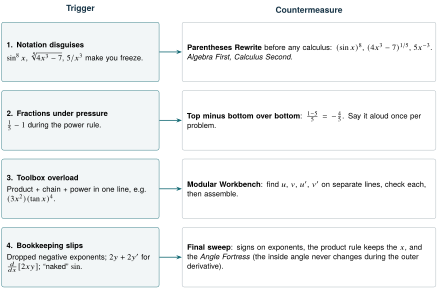
The four friction families. A fifth, density overload, belongs to how material is taught, not to the learner: this book’s explanations come one idea at a time.
The book’s names for its tools are part of the toolkit, and later chapters use them:
- the Derivative Wheel (): each derivative turns the wheel one click;
- the Magic Triangles, which pair with and with : , , , ;
- the Co- Rule: the co-function derivatives (of , , and ) are the negative ones;
- derivative on top, original on bottom: ;
- the Number Hack: in implicit differentiation, substitute the point before isolating ;
- Russian nesting dolls for composition: open the outer doll first, leave the inner dolls untouched, then multiply by the derivative of what was inside.
Outside calculus, label errors with the broader categories in “How to use this book”: notation or syntax, concepts, method choice, algebra, proof assumptions, program state, test coverage, interpretation, and performance reasoning. When one pattern keeps recurring, give it a family name and a countermeasure of its own (section H).
F. The learning loop#
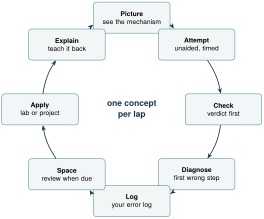
Every concept travels this loop. Skipping Diagnose and Log is how the same mistake survives to the final exam.
- Picture. Start from a diagram that shows the real mechanism: a labelled triangle, a signal flow, a plot of the physics. Every new idea in this book opens with one.
- Attempt. Work it on paper before seeing anything else. Record what you tried, even if you stall.
- Check. Correct or incorrect first. Then the shortest calculation that proves it.
- Diagnose. Find the first wrong step and name its friction family. “Wrong answer” is not a diagnosis.
- Log. One row in your error log, a spreadsheet or CSV file with these columns: date, problem ID, family, first wrong step, corrected rule, and next review date (2, 7, then 21 days later).
- Space. Open each session by redoing two or three due problems from the log without looking at the old solution.
- Apply. Use the idea in a lab or in a project of your own within a week. F01’s drone and car labs are built for this.
- Explain. Teach it back in a few sentences: a note to yourself, a post in a study forum, or a short public write-up. If you can’t explain it simply, go around the loop again.
G. A session and a week#
One 60-minute session. 5 minutes of retrieval from the error log; 10 minutes of picture and concept; 30 minutes of problems (the module’s drill, then one frontier application); 10 minutes to check, diagnose, and log; 5 minutes to write the one-sentence explanation.
One week. Four or five sessions on your current mathematics module, one 2–3 hour build block on a lab or portfolio project, one cumulative no-notes quiz of 8–10 problems drawn from the log, and one public or private write-up of something you built or proved. Algorithms practice gets its own lane of two short sessions a week. The planner in Part I, “Plan your path”, schedules it and the other tracks beside any course you are taking.
H. How your map updates#
The friction map is only as good as the log. After each session, record misses under their family. At the end of each week, tally the log by family and revise your own copy of the friction map: which triggers fired, and did the countermeasures work? A friction family that stays quiet for three weeks of mixed practice moves to “retired” and is checked only in cumulative quizzes. A new pattern that appears three times earns its own row and countermeasure. If you study with a tutor or an AI assistant, give it this procedure and section I’s rules at the start of each session.
I. Using AI without making it a crutch#
AI is part of how engineers work now, and employers expect fluency with it. It is also the easiest way to feel you learned something you didn’t, and since 2025 controlled trials have measured exactly that. (A controlled trial assigns people at random to a group that gets the treatment or to a control group that does not, so the difference between the groups measures the treatment itself.) In a trial with about 1,000 high-school students, unrestricted GPT-4 raised practice grades by 48% but left students 17% below the control group once it was taken away, while a tutor that gave hints within guardrails raised practice grades by 127% with no penalty on the exam. In Anthropic’s January 2026 trial, 52 mostly junior engineers learning a Python library with AI scored 50% on a quiz taken without it, against 67% for those who learned without AI; debugging showed the largest gap, and the learners who asked only conceptual questions, or generated code and then studied it, scored 65% or more.
Later studies agree. A test 45 days later favored traditional study over AI study, 68.5% to 57.5%. An October 2026 working paper found that an AI tutor built into a course lowered final grades by 0.37 standard deviations; a standard deviation measures how widely grades spread around the class average, so that is a drop of a little over a third of the usual spread. Tutors designed to teach can help: a September 2026 trial of one for secondary-school science found an effect size of 0.33, a gain of about a third of that spread. The pattern is consistent. AI that does the work raises the score you see while lowering the skill you keep.
So this book uses three zones, the same line AtCoder drew in its October 2026 trial rule, where the human chooses the solution and AI may only implement it:
- Red, no AI: every first attempt; every gate, phase test, and cumulative quiz; every timed build and contest; and the delayed re-checks below.
- Amber, after a logged attempt: ask for a concept explained, a hint about the next step, a review of finished work, or a variant problem. Never ask AI to debug your code or to find your error while you are learning that skill: repeated AI debugging was among the lowest-scoring ways of working in Anthropic’s trial, and debugging is the skill you need most to supervise code an AI writes. After amber help, close everything and redo the problem from a blank page; only that counts as a success in the log.
- Green, any time: chores that are not the skill being learned, such as stress-test generators, visualizers, plots, and looking up an API.
Four habits make the zones stick:
- Log AI use. Keep an AI-use log beside your error log, with one row for each amber session: the date, the task, what you asked, and what you then did yourself. AtCoder’s trial required AI logs, and the Leiden Declaration (June 2026) asks mathematicians to disclose AI use.
- Re-check later, unannounced. Four to six weeks after each gate, redo three to five problems drawn from that module’s error-log entries, with no notes and no AI. The interval is a design choice, not a tested value; the trials show that delayed results are where AI’s cost appears.
- Audit the AI. Practise on work you did not write: a worked solution or program with a planted defect from your own friction list, such as a dropped negative exponent or C++ that compiles but is wrong, where you mark the first incorrect step. CP01.04 and the gates of AI01 and EL01 are exercises of this kind; add one to each of your own drill sets. Checking an assistant’s output is now graded in interviews, and it is the same skill as finding the first wrong step in your own work.
- Follow each process’s rules exactly. When a company says no AI (Anthropic’s take-homes and live interviews, unless it says otherwise), work alone; when an interview allows AI, it is grading how you check what the assistant produces.
Sources for section I (checked 17 October 2026)#
- Bastani et al., “Generative AI without guardrails can harm learning”, PNAS (2025), www.pnas.org/doi/10.1073/pnas.2422633122.
- Anthropic, a randomized trial of AI assistance and coding-skill formation (January 2026), www.anthropic.com/research/AI-assistance-coding-skills.
- Barcaui, 45-day retention study (2025), www.sciencedirect.com/science/article/pii/S2590291125010186; Liu et al., working paper (October 2026), edworkingpapers.com/ai26-1598; Harrison et al., preprint (September 2026), arxiv.org/abs/2609.14789.
- AtCoder’s trial rule for AI use (October 2026), atcoder.jp/contests/ahc_genai_test_2026; the Leiden Declaration, leidendeclaration.ai/.
- Anthropic, guidance on candidates’ AI use (last updated 10 July 2025; checked 20 October 2026), www.anthropic.com/candidate-ai-guidance.
Sources for sections C–H#
- Cepeda, Pashler, Vul, Wixted, and Rohrer, “Distributed practice in verbal recall tasks: a review and quantitative synthesis”, Psychological Bulletin 132(3) (2006), 354–380.
- Chi, Bassok, Lewis, Reimann, and Glaser, “Self-explanations: how students study and use examples in learning to solve problems”, Cognitive Science 13(2) (1989), 145–182.
- Chi, de Leeuw, Chiu, and LaVancher, “Eliciting self-explanations improves understanding”, Cognitive Science 18(3) (1994), 439–477.
- Dunlosky, Rawson, Marsh, Nathan, and Willingham, “Improving students’ learning with effective learning techniques”, Psychological Science in the Public Interest 14(1) (2013), 4–58.
- Kalyuga, Ayres, Chandler, and Sweller, “The expertise reversal effect”, Educational Psychologist 38(1) (2003), 23–31.
- Mayer, Multimedia Learning, 2nd edition, Cambridge University Press (2009).
- Metcalfe, “Learning from errors”, Annual Review of Psychology 68 (2017), 465–489.
- Renkl and Atkinson, “Structuring the transition from example study to problem solving in cognitive skill acquisition: a cognitive load perspective”, Educational Psychologist 38(1) (2003), 15–22.
- Roediger and Karpicke, “Test-enhanced learning: taking memory tests improves long-term retention”, Psychological Science 17(3) (2006), 249–255.
- Rohrer and Taylor, “The shuffling of mathematics problems improves learning”, Instructional Science 35 (2007), 481–498.
- Sweller, “Cognitive load during problem solving: effects on learning”, Cognitive Science 12(2) (1988), 257–285.
J. Independent practice#
F foundation C standard course work T transfer S optional stretch L runnable lab or project. Attempt the complete set before opening its solutions.
Parentheses Rewrite only, with no calculus: , , , .
Rewrite, then differentiate: . Say “top minus bottom over bottom” for each new exponent.
Differentiate . Guard the Angle Fortress.
The curve passes through . Find there using the Number Hack, then find the general formula for and check that they agree.
Use the Modular Workbench: differentiate .
Optional small hints
LM.02: . LM.04: the product rule on produces two terms, and one of them keeps the .
K. Complete solutions: LM#
Compare the first step where your work differs. A corrected answer is not yet an independent success.
LM.01Show solution
Make the structure visible
Each rewrite shows the outside layer (a power) and the inside layer, which is exactly what the chain rule needs.
Back to LM.01LM.02Show solution
Three power rules, three exponent checks
. Then . The middle exponent is . So . Final sweep: all three exponents are negative, as they should be.
Back to LM.02LM.03Show solution
Outside, then inside, angle untouched
Outside: . Next doll: , with the angle still . Innermost: . Product: .
Back to LM.03LM.04Show solution
Substitute early, then confirm
Differentiate: . Number Hack at : , so . General: , giving , and at that is . The two methods agree.
Back to LM.04LM.05Show solution
L. Retention and readiness#
Revisit LM.02 and LM.04 in a week without looking at these solutions. If either fails, log it under its family and repeat the countermeasure drill for two more sessions.