Module 35: Multivariable functions, level sets, and limits
On this page
- A. Prerequisites and observable goals
- B. The central idea: every nearby direction must agree
- C. The limit definition and useful bounds
- D. Why two-dimensional limits need stronger evidence
- E. A decision procedure
- F. Worked examples
- G. Independent practice
- H. Complete solutions: Module 35
- I. Retention and readiness
A. Prerequisites and observable goals#
Domains, one-variable limits, inequalities, and spatial geometry.
Read a function with several inputs, sketch a domain or level set, disprove limits by paths, and prove limits with bounds that work in every direction.
B. The central idea: every nearby direction must agree#
A function takes an ordered pair as input and returns one scalar. Its graph is a surface in three dimensions, while its domain is a region in the input plane. A level curve lives in that input plane; it marks inputs with a common output height. Confusing the domain, graph, and level set mixes objects of different dimensions.
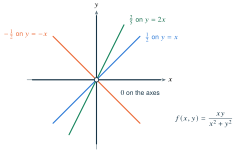
Approaching a point now permits infinitely many paths. Different path limits disprove a common limit. Agreement along two paths, ten paths, or even every straight line does not by itself prove a multivariable limit; a curved approach may reveal different behavior.
C. The limit definition and useful bounds#
For a domain point approached from within the domain,
means that for every there is such that implies . Continuity means the limit equals the point value. Standard sums, products, and compositions preserve continuity where they are defined, and a quotient is continuous where its denominator is nonzero. [O3Limits]
Let . Then , , and . Such bounds prove behavior uniformly in direction. In polar coordinates, ; a bound independent of that tends to zero as can prove a limit. Checking each fixed angle separately is only checking straight rays, not all approaches where may change with .
D. Why two-dimensional limits need stronger evidence#
For away from the origin, the axes give zero, but gives . Thus no limit exists. A graph may look smooth from one chosen viewing direction while hiding this mismatch.
A more subtle example is . Along with fixed nonzero , the expression becomes ; along it is also zero. Yet along it is . The denominator assigns different scales to the coordinates, suggesting the curved path. This is why an all-directions inequality is stronger than a collection of samples.
E. A decision procedure#
Determine the domain first. At a regular input, use continuity and direct substitution. At an indeterminate point, try simple paths to look for disagreement; inspect the powers in the denominator to select more informative curved paths. If evidence suggests a common limit, seek an inequality in , an algebraic simplification valid on the punctured domain, or a uniform polar estimate. State whether you proved a limit or merely failed to find a counterpath.
F. Worked examples#
A domain with two restrictions. For , the logarithm requires , while the denominator requires , strictly. The domain is the portion above the parabola and inside the open disk satisfying both restrictions. A boundary satisfying only one is not included.
A successful uniform bound. For away from zero,
Therefore the limit is zero along every allowable approach. Defining makes it continuous there. This proof does not assert differentiability, which is a stronger property addressed next.
Level curves as a height map. For , the level is an ellipse with semiaxes and . The level zero is one point, and negative levels are empty. Closely spaced level curves suggest rapid change, but precise rates require derivatives.
G. Independent practice#
F foundation C standard course work T transfer S optional stretch L runnable lab or project. Attempt the complete set before opening its solutions.
Find the domain of . Describe its graph and its level curves for .
Find the domain of . Are the excluded boundaries the same type of restriction?
Evaluate .
Show that does not exist.
Prove by a bound independent of direction.
For , describe the level curves and the trace of the graph in the plane .
Prove .
Let away from zero and . Prove every straight-line approach has limit zero, then prove the function is nevertheless discontinuous at zero.
Optional small hints
For M35.05, use . For M35.08, handle the vertical line separately and then use a curved path balancing the denominator terms.
H. Complete solutions: Module 35#
Compare the first step where your work differs. A corrected answer is not yet an independent success.
M35.01Show solution
Separate input region, graph, and equal-height inputs
The domain is the closed disk . The graph is the upper hemisphere , . A level satisfies for : circles for and the origin for . The output range is .
Back to M35.01M35.02Show solution
Intersect, do not combine away, the restrictions
The logarithm requires and the denominator requires . Thus the domain is . The first excludes an entire closed half-plane, while the second removes a line from the allowable half-plane. Neither condition makes the other unnecessary.
Back to M35.02M35.03Show solution
Continuity resolves a regular point
The denominator at is , so the rational function is continuous there. Direct substitution gives . Path testing would add work without addressing any singularity.
Back to M35.03M35.04Show solution
Two conflicting paths are enough for disproof
Along with , the quotient equals . Along with , it equals . Both paths approach the origin through the domain, so a common limit would have to equal two different numbers. Therefore the limit does not exist.
Back to M35.04M35.05Show solution
A radial bound covers changing directions too
For , the inequality yields
Thus the limit is . In epsilon–delta language, suffices. The estimate does not depend on any selected angle or path.
Back to M35.05M35.06Show solution
Level curves and graph traces are different cuts
The level zero is the origin; level one is the circle of radius one; level four is the circle of radius two, all in the input plane. In the vertical plane , the graph has equation , a parabola. A horizontal level slice and a vertical trace expose different aspects of the same paraboloid.
Back to M35.06M35.07Show solution
Oscillation with uniformly shrinking amplitude
For nonzero , , so the expression’s magnitude is at most . As , , hence the limit is . The sine factor itself has no limit, but its bounded oscillation is suppressed by the vanishing amplitude.
Back to M35.07M35.08Show solution
Even all straight lines can miss a curved obstruction
On with , substitution gives . On the value is zero, and on the vertical line it is zero as well. These cover all straight lines through the origin. But on with , the function is . Thus the full limit does not exist and cannot equal . This demonstrates why a directional sampling strategy is not a proof of a multivariable limit.
Back to M35.08I. Retention and readiness#
Retrieve M06.07 and M07.06. Explain the logical asymmetry: two disagreeing paths disprove a limit, but agreeing paths do not generally prove one. Advance when you can produce a uniform bound or identify precisely why your current evidence remains incomplete.