Module 05: From two values to an average rate
On this page
- A. Prerequisites and observable goals
- B. The central idea: change in output per change in input
- C. The definition, read in full
- D. A complete algebraic derivation
- E. A five-step routine that prevents sign errors
- F. Worked example with a reciprocal
- Computing bridge: A rate quotient is not a machine instruction to divide by zero
- G. Independent practice
- H. Complete solutions: Module 05
- I. Retention and readiness
A. Prerequisites and observable goals#
Build a difference quotient, explain each subtraction, simplify without setting the interval to zero, and attach appropriate rate units.
B. The central idea: change in output per change in input#
A function value says where you are; a rate says how the output changes as the input changes. If a position changes from to during a nonzero time interval, its average velocity is
The numerator is a displacement, not the final position alone. The denominator is elapsed time, not the final time alone. This quotient is the slope of the secant line through the two graph points. It may be positive, negative, or zero. Average speed instead uses total distance traveled, which need not equal the magnitude of displacement.
Replacing the second input with produces the general difference quotient. Here is the input change; it can be negative, but it must not be zero. The two inputs are and , so their difference is .
C. The definition, read in full#
The first term substitutes the entire expression into every input slot. The subtraction then removes the entire old output . Keep it in brackets until you distribute the minus sign. Canceling requires factoring it from every numerator term. A simplified quotient remains an average rate for nonzero ; taking a limit is an additional operation, not a casual deletion of .
D. A complete algebraic derivation#
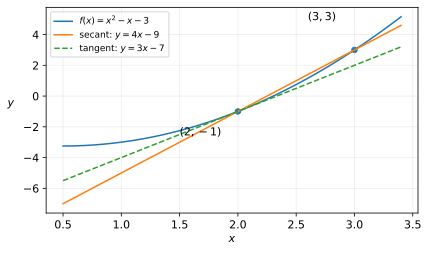
Use the single function that will later produce your tangent-line example:
At a general input, substitution gives . Now subtract the entire original expression:
Therefore for . At , this becomes . For , the secant slope is ; for , it is ; for , it is . These are exact finite-interval values. The emerging value will be a limit, developed in Module 08.
E. A five-step routine that prevents sign errors#
Write with parentheses around every replacement. Write without simplifying mentally. Expand products and distribute that final minus sign. Collect like terms, then factor out when possible. Divide only after stating . If no cancellation appears, check the substitution and signs; not every function will simplify to a polynomial, but many beginner examples do.
For a numerical average rate, use the actual two input values instead. There is no need to invent an when the interval is already given. A table only gives average rates from its entries; it does not automatically reveal the exact instantaneous rate between entries. Secant interpretation and rate definition: [O1D].
F. Worked example with a reciprocal#
Let . Require , , and . Then
The negative sign came from the subtraction . For positive nearby inputs the reciprocal decreases, so the negative average rate is geometrically sensible.
Faded step. For , the numerator expands to . Factor it before reading the completion. Completion: , so the quotient is for . It is not yet ; that requires a limit as approaches zero.
Computing bridge: A rate quotient is not a machine instruction to divide by zero#
For nonzero , the difference quotient is a mathematically exact average rate. A computer approximation with a small representable is a different object: subtracting nearby floating-point outputs can lose significant information, and can round to . A05 compares exact limits, finite differences, and automatic differentiation. First simplify and understand this module’s quotient algebraically; then use computation to investigate an approximation rather than treating a small decimal step as the definition of a derivative.
G. Independent practice#
F foundation C standard course work T transfer S optional stretch L runnable lab or project. Attempt the complete set before opening its solutions.
For , find the average rate on and the secant-line equation.
For , write and then simplify . Show the sign changes.
For , simplify the difference quotient by multiplying by a conjugate. State the restrictions.
A position table gives , , in meters. Find average velocities on and . Must the instantaneous velocity be constantly m/s?
A particle goes from position to m in two seconds, then returns to m in three more seconds, without reversing direction within either leg. Find average velocity and average speed for all five seconds.
A student simplifies as . Diagnose the exact error and correct it.
For , find the secant slope from to . What happens to its formula as nonzero approaches zero?
For , compare the forward quotient and the centered quotient . Explain why one is independent of .
Optional small hints
For M05.03, multiply by above and below. For M05.08, expand both squares before subtracting.
H. Complete solutions: Module 05#
Compare the first step where your work differs. A corrected answer is not yet an independent success.
M05.01Show solution
Two heights and a nonzero interval
Compute and . Average rate is . The line through with this slope satisfies , hence . At it gives , checking the other endpoint.
Back to M05.01M05.02Show solution
Subtraction of an entire function
First . Now
Dividing by nonzero gives . Notice that subtracting contributed .
Back to M05.02M05.03Show solution
A conjugate converts a radical difference into a factor
Require , , and . Then
The conjugate is nonzero: if both square roots were zero, then and , forcing , already excluded. The identity is therefore valid on the full stated domain.
Back to M05.03M05.04Show solution
Average rates do not determine all intermediate behavior
The rates are and m/s. But a curved position rule matches every listed value while changing its slope between them. Thus the table does not prove constant instantaneous velocity. It only fixes the two average rates.
Back to M05.04M05.05Show solution
Displacement and distance
Net displacement is m, so average velocity is . Total distance is m, so average speed is . The return portion subtracts from displacement but adds to distance. Both denominators use the full elapsed time, s.
Back to M05.05M05.06Show solution
Division must reach every term
The numerator factors as . Canceling the common nonzero factor gives , not . The student’s error was to divide the first and third terms by but leave the middle term unchanged. Equivalently, , because one factor of remains.
Back to M05.06M05.07Show solution
A cubic secant
Expand . Subtract and divide by :
As approaches zero, the last two terms approach zero, leaving . For finite nonzero the displayed quotient is an average rate, not automatically the limiting rate.
Back to M05.07M05.08Show solution
Symmetric samples cancel the error for a quadratic
The forward quotient is . The centered numerator is
Dividing by gives . Symmetry cancels the terms. This exactness is special to quadratic functions (and lower degrees), not a guarantee for every function; for the centered quotient is .
Back to M05.08I. Retention and readiness#
Rework M01.07 and M02.01 before M05.02. Explain why is nonzero during cancellation. A correct explanation says that the two input points must be distinct and division by zero is undefined; it does not say “ is basically zero.” Advance only after you can build a fresh quotient from scratch and name its units.