Module 09: Derivative rules without losing the structure
On this page
- A. Prerequisites and observable goals
- B. The central idea: reuse a proved limit calculation
- C. The rules and the domains
- D. Why the product rule has two terms
- E. A practical derivative routine
- F. Worked examples and a useful comparison
- G. Independent practice
- H. Complete solutions: Module 09
- I. Retention and readiness
A. Prerequisites and observable goals#
Derivative definitions and expansion of products.
Recognize sums, products, quotients, and powers; differentiate them accurately; and explain why product derivatives contain two contributions.
B. The central idea: reuse a proved limit calculation#
You could rebuild every difference quotient from scratch, but repeated structure makes that inefficient. Derivative rules package limit arguments that have already been justified. They do not replace the meaning of a derivative; they make that meaning usable for complicated functions.
Before choosing a rule, identify the outermost operation. The function is a product of two functions. The function is a sum. Their derivatives require different structures even though the pieces look similar. Writing and temporarily can make the structure easier to see.
C. The rules and the domains#
If are differentiable at the relevant input and is constant, then
For positive integers , for all real . The same power rule holds for negative integer powers where . For arbitrary real powers, it is safe on ; other real branches require their own domain checks. In particular, for , not at its endpoint zero. Standard rules and their limit-based foundations: [O1D].
D. Why the product rule has two terms#
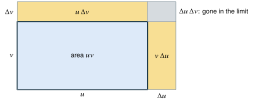
For , add and subtract inside the numerator:
Differentiability implies continuity, so . Taking limits gives . Each factor can change; both effects contribute. A rectangle with changing length and width has the same first-order logic: one thin strip comes from the length change and another from the width change.
For a reciprocal, the difference quotient produces
where . Applying the product rule to then gives the quotient rule. The minus sign is inherited from subtracting reciprocals, not an arbitrary mnemonic.
E. A practical derivative routine#
Simplify constants and obvious algebra first, but do not expand a large product automatically. Label the outer operation; compute the derivative of each component; assemble the correct rule; simplify only after the structure is correct. Preserve original domain exclusions. For a tangent question, continue by evaluating both the original function and derivative at the requested input. For a rate question, interpret the derivative’s units as output units per input unit.
F. Worked examples and a useful comparison#
Product. For ,
An independent check is to expand and differentiate term by term. Both routes agree. The two methods teach a structural equivalence; use whichever keeps later arithmetic clearer.
Quotient. For with ,
The parentheses around the second product prevent a lost sign on the constant.
Finish a rewrite. To differentiate for , first simplify to . Its derivative is on the original domain. The simplification does not suddenly create a derivative of the original undefined function at zero.
G. Independent practice#
F foundation C standard course work T transfer S optional stretch L runnable lab or project. Attempt the complete set before opening its solutions.
Differentiate , and state its domain.
Differentiate by the product rule and check by expansion.
Differentiate , simplifying the numerator.
Differentiate on its real domain of differentiability.
Find the tangent line to at .
Suppose , , , and . Find and .
A student claims . Correct the rule and verify the answer by a different algebraic route.
Find every point with a horizontal tangent on . Explain why a zero numerator of is sufficient here.
Optional small hints
For M09.06, use the given values directly rather than trying to invent formulas for and . For M09.08, the denominator never vanishes.
H. Complete solutions: Module 09#
Compare the first step where your work differs. A corrected answer is not yet an independent success.
M09.01Show solution
Powers, a constant, and a reciprocal
Rewrite . Applying the power and sum rules gives
The derivative of is zero. The positive reciprocal-square term results from multiplying the coefficient by the exponent . Both the function and derivative are defined on .
Back to M09.01M09.02Show solution
Two contributions to a product
The product rule gives
For verification, expand the original to and differentiate term by term. This produces the same result for every real input.
Back to M09.02M09.03Show solution
A quotient with no real denominator zeros
Let and . Then , . Therefore
The denominator is positive for all real , so there are no excluded real inputs.
Back to M09.03M09.04Show solution
Domain before applying a fractional power rule
The square root requires and the negative power excludes zero; thus the original real domain is . Differentiating there gives
There is no endpoint derivative to discuss at zero because the original term is itself undefined there.
Back to M09.04M09.05Show solution
Differentiate, then evaluate the two needed quantities
Quotient rule gives , for . At , the point is and the slope is . Thus
At the line gives , checking the point.
Back to M09.05M09.06Show solution
Local data are enough
The product derivative at is . The quotient derivative is
The quotient is allowed because . No global formulas for the factors are required.
Back to M09.06M09.07Show solution
A false product rule
The correct derivative is . Expanding the original gives , whose derivative is also . Multiplying the derivatives alone loses both original factor values and cannot generally describe the change of their product.
Back to M09.07M09.08Show solution
Horizontal tangent points
The derivative is
Its denominator never vanishes, so exactly when , giving . Evaluate the original function: , . The points are . Both derivatives exist there, so zeros of the numerator genuinely give horizontal tangents.
Back to M09.08I. Retention and readiness#
Revisit M08.03 to connect the reciprocal rule to a limit. Mix M09.02 with M09.03 without their module heading as a cue. Before advancing, explain why the product rule uses unchanged factors as well as derivatives, and why a simplified derivative does not repair an excluded original input.