Module 16: Antiderivatives, Riemann sums, and definite integrals
On this page
- A. Prerequisites and observable goals
- B. The central idea: add many small contributions
- C. Definitions before calculation shortcuts
- D. A sum that becomes an exact area
- E. How to recognize the requested object
- F. Worked teaching examples
- G. Independent practice
- H. Complete solutions: Module 16
- I. Retention and readiness
A. Prerequisites and observable goals#
Derivative rules, finite sums, limits, and signed rates.
Distinguish a family of antiderivatives from an integral value, construct a Riemann sum, and interpret signed accumulation with units.
B. The central idea: add many small contributions#
Differentiation extracts a local rate from a function. Accumulation goes in the other direction: many small rate-times-width contributions add up to a total. The definite integral makes this idea exact by taking a limit of sums. An antiderivative is a function whose derivative is known; the Fundamental Theorem in the next module explains why these seemingly different objects are connected.
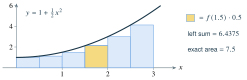
C. Definitions before calculation shortcuts#
An antiderivative of on an interval is a function with . Any two antiderivatives on the same interval differ by a constant, by the MVT. The notation describes a family of functions, not a single number. On disconnected domains, separate constants may be needed on separate intervals.
For a partition , let and choose . A Riemann sum is . If all such sums converge to one value as the largest subinterval width tends to zero, that value is the definite integral
A continuous function on a closed interval is Riemann integrable. Many discontinuous functions are also integrable, so continuity is sufficient, not necessary. For equal widths, and right endpoints are . Integral foundations: [O1Int].
The integral is signed: portions below the horizontal axis contribute negatively. Geometric area uses , splitting at sign changes when necessary. Reversing bounds changes sign, and splitting at an interior input adds accumulations. If is measured in meters per second and in seconds, the integral has meters as its units.
D. A sum that becomes an exact area#
For on , a right-endpoint sum has width and sample inputs :
Thus , agreeing with the area of a triangle of base and height . Every finite right sum overestimates the increasing function; the limit removes the discrepancy. The identity is a finite algebraic fact, while the passage is a limit.
E. How to recognize the requested object#
An indefinite integral asks for a family of functions; differentiate your answer. A definite integral asks for an accumulated number; its units and bounds matter. A numerical sum asks for a finite approximation and must not be silently replaced by the limiting answer. To build a sum, identify width, sample input, function value, and number of terms in that order. The sample input is not always just .
F. Worked teaching examples#
Undoing a derivative. For , termwise antidifferentiation gives . Checking gives . If , then ; an initial value selects one member of the family.
Signed displacement. Suppose velocity is m/s for two seconds and then m/s for three seconds. Displacement is m. Distance is m. Zero net accumulation does not mean nothing happened.
A midpoint setup to finish. For with four equal subintervals, the width is . The midpoints are . Thus the midpoint sum is . The exact integral, obtained next module, is , so the sum is an approximation.
G. Independent practice#
F foundation C standard course work T transfer S optional stretch L runnable lab or project. Attempt the complete set before opening its solutions.
Find all antiderivatives of on , and the one with .
Find an antiderivative of on . Explain why rather than is used.
Compute the left and right sums with four equal subintervals for on . Compare them with the exact geometric integral.
Build a right-endpoint Riemann sum for with equal intervals. Do not evaluate the limit.
Use to evaluate directly from right-endpoint sums.
A rate is liters/min for and liter/min for . Find net change, total variation in volume, and final volume if the initial volume is liters.
Given and , find , , and . Are these data enough to find the geometric area under ?
On , let except . Explain using Riemann sums why despite the discontinuity.
Optional small hints
For M16.05, separate powers of before taking the limit. For M16.08, only subintervals containing zero can contribute, and at most two such intervals occur in a partition.
H. Complete solutions: Module 16#
Compare the first step where your work differs. A corrected answer is not yet an independent success.
M16.01Show solution
Integrate, then use the initial value
The power rule gives . At , , so . The selected function is . Differentiating verifies the integrand; substituting verifies the initial condition.
Back to M16.01M16.02Show solution
The power rule’s excluded exponent
Because for , an antiderivative is . The usual rule excludes , where its denominator is zero. On a negative interval, the logarithmic primitive would be instead.
Back to M16.02M16.03Show solution
Finite sums and their exact target
The width is . Left sample heights are , so . Right heights are , so . The trapezoid under the line has area . Increasing behavior explains .
Back to M16.03M16.04Show solution
Retain the interval’s offset
Here and the th right input is . Therefore
The starting input belongs inside the square root. The external is a width, not part of the function input.
Back to M16.04M16.05Show solution
Evaluate an integral from its defining sums
The width is and sample input is . Hence
Continuity guarantees that this right-sum limit is the integral, not a special result that depends on the chosen sample convention.
Back to M16.05M16.06Show solution
Accumulate the rate over each time interval
Net change is liters. Total variation adds magnitudes, liters. Final volume is initial volume plus net change, liters. The integral gives a change, not the final amount without the initial value.
Back to M16.06M16.07Show solution
Use linearity and interval additivity
Since , the latter integral is . Reversing bounds gives , and multiplying the integrand by gives . The signed data alone do not determine : positive and negative contributions inside the smaller intervals may cancel in many different ways.
Back to M16.07M16.08Show solution
A single exceptional height has no width
Every Riemann-sum term is zero unless its sample input is zero. At most two subintervals can have zero as an endpoint or interior point. If the mesh is , their total contribution is nonnegative and at most . As the mesh tends to zero, every Riemann sum is squeezed to zero. Thus the integral is . This proves integrability directly and shows why continuity is not a necessary condition.
Back to M16.08I. Retention and readiness#
Revisit M05.05 and M12.01. Explain why an integral of a rate has amount units, why belongs to an indefinite answer, and why a point’s height alone supplies no area. Advance when you can construct a sum on an interval that does not begin at zero.