Module 11: Implicit, inverse, and logarithmic differentiation
On this page
- A. Prerequisites and observable goals
- B. The central idea: the dependent variable also changes
- C. Conditions that make the methods legitimate
- D. Derivations that expose the branches
- E. How to recognize the right method
- F. Worked examples
- G. Independent practice
- H. Complete solutions: Module 11
- I. Retention and readiness
A. Prerequisites and observable goals#
The chain rule, inverse functions, and logarithm domains.
Differentiate equations that define a curve implicitly, find inverse derivatives without solving explicitly, and handle variable powers using logarithms.
B. The central idea: the dependent variable also changes#
An equation such as describes a relationship, not a single global function . Near a suitable point, however, it may determine one branch of as a differentiable function of . When differentiating that equation, each appearance of must be treated as the changing quantity . Thus , not simply .
Inverse differentiation asks for the rate of the reverse input-output relationship. Logarithmic differentiation changes a difficult product or variable exponent into a simpler sum or product before applying the derivative. Both methods are applications of established rules, not new kinds of derivative.
C. Conditions that make the methods legitimate#
For a differentiable relation on a local differentiable branch, differentiation gives
Here means differentiate the expression in while temporarily holding fixed, and means differentiate in while holding fixed. This notation is a preview of Module 36; for now you can simply differentiate term by term and collect . If its denominator is zero, do not conclude a finite slope. Examine the curve and numerator; there may be a vertical tangent or a more complicated singularity.
If has a differentiable local inverse near and , then
A common sufficient setting is a continuously differentiable function near with nonzero derivative there. The input on the right is , not . For principal inverse trigonometric functions,
Here has range , range , and range . Inverse notation means , not . Inverse derivative conditions: [O1Inv].
D. Derivations that expose the branches#
From , the chain rule gives . Division by the nonzero first factor produces the reciprocal rule.
For , we have . Differentiate: . On the interior of the principal range, , so . The positive square root is justified by the branch. Without that range information, the sign would not be determined.
For with , take logs: . Differentiation gives , hence . The usual fixed-power rule alone does not apply because the exponent changes too.
E. How to recognize the right method#
If both and appear in an equation and solving for is awkward, differentiate implicitly. Use product rules for terms such as and chain factors for powers of . Collect every term before solving. If given data about a function but asked for an inverse derivative, identify which original input produces the requested inverse input. For a variable exponent, first write the function as with , or take logs on a positive branch.
F. Worked examples#
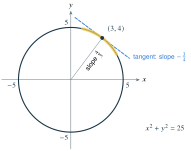
Implicit slope. On , differentiate to get
Collecting gives . At , which lies on the curve, . The tangent is . Checking the point before differentiating prevents computing a “tangent” at a location not on the curve.
Logarithmic differentiation of many factors. For with , write
Then , so multiply back by the original . The derivative of is , not , because depends on .
G. Independent practice#
F foundation C standard course work T transfer S optional stretch L runnable lab or project. Attempt the complete set before opening its solutions.
Find the tangent line to at .
For , find and evaluate it at .
Let and . Find without solving explicitly for .
Differentiate .
Differentiate and state the domain of the function and the open interval where this derivative formula is finite.
Differentiate for and find its horizontal-tangent input.
Differentiate on its real domain. Compare with differentiating the expression inside the logarithm.
The function is one-to-one on . Why does that alone not imply its inverse has a finite derivative at ? Verify using a limit.
Optional small hints
For M11.03, first solve by inspection. For M11.07, logarithm laws simplify before differentiating. For M11.08, use the inverse rather than a division by zero.
H. Complete solutions: Module 11#
Compare the first step where your work differs. A corrected answer is not yet an independent success.
M11.01Show solution
Circle tangent
Differentiate to get , so when . At the slope is . Hence
The radius from the origin has slope , whose product with the tangent slope is , independently checking perpendicularity.
Back to M11.01M11.02Show solution
A product containing the dependent variable
The derivative of is ; that of is . Thus , and
At the original equation gives , and the denominator is , so .
Back to M11.02M11.03Show solution
Undo the rate at the matching input
Since , . The original derivative is , so . Therefore . The derivative is positive everywhere, supporting one-to-one behavior; evaluating instead would use the wrong original input.
Back to M11.03M11.04Show solution
An inverse trig function with a linear inner input
The outer derivative contributes and the inner derivative contributes . Thus , valid for all real . The denominator is always positive.
Back to M11.04M11.05Show solution
Separate the function’s endpoints from derivative endpoints
The arcsine input must satisfy , equivalent to . Thus the function’s domain is . On , the chain rule gives
The denominator vanishes at , so the formula is not a finite derivative there. This does not make the original endpoint values undefined.
Back to M11.05M11.06Show solution
A variable base and exponent
For positive , . Taking logs and differentiating gives , so . The positive factor cannot be zero. A horizontal tangent therefore requires , giving .
Back to M11.06M11.07Show solution
The logarithm changes the requested function
The real domain requires . Expand the log:
Its derivative is . This is the logarithmic derivative of the inner function , not itself. To obtain , multiply the displayed answer by .
Back to M11.07M11.08Show solution
One-to-one does not guarantee nonzero local rate
The inverse is . Since , the nonzero-derivative hypothesis of the inverse derivative rule fails. Directly,
Thus has no finite derivative at zero. The conclusion follows from a limit, not from treating as an ordinary derivative value.
Back to M11.08I. Retention and readiness#
Revisit M03.04 and M08.08. Explain why differentiating with respect to needs . Advance when you can use both a given implicit point and inverse-function data without solving an unnecessary cubic equation.