Module 32: Polar coordinates, polar calculus, and conics
On this page
- A. Prerequisites and observable goals
- B. The central idea: locate a point by direction and signed distance
- C. Calculus formulas and their geometric conditions
- D. Why polar area has a half and a square
- E. A tracing-first procedure
- F. Worked examples
- G. Independent practice
- H. Complete solutions: Module 32
- I. Retention and readiness
A. Prerequisites and observable goals#
Radians, trigonometric identities, parametric differentiation, and definite integrals.
Interpret negative radius and equivalent coordinates, compute polar slopes and areas, choose intervals that trace a region once, and recognize focus-directrix conic forms.
B. The central idea: locate a point by direction and signed distance#
Polar coordinates represent a point by with , . A negative places the point in the direction opposite . The representation is not unique: and agree, and agrees as well. At the origin every angle represents the same point. These redundancies make tracing intervals important in integration.
C. Calculus formulas and their geometric conditions#
For , differentiation of its Cartesian parameterization gives
when the denominator is nonzero. Arc length on a smooth tracing is
A polar sector bounded by a radial graph and rays, with the intended region swept once, has area
For two nonnegative radial boundaries on the same rays, use . Before using this for intersections or negative radii, confirm that the angular interval really describes the intended region without duplicate tracing. Polar calculus: [O2Polar].
A conic with a focus at the origin may have form or , with and eccentricity . For nondegenerate standard branches, gives an ellipse, a parabola, and a hyperbola; gives a circle. Here is a scale parameter, not generally the semimajor axis. The denominator’s zeros and signs restrict the branch represented.
D. Why polar area has a half and a square#
A circular sector of radius and angle radians has area . As the angular partition becomes fine, varying-radius sectors give the integral. This is not circumference times width: area accumulates entire radial wedges. The factor and radians both arise from the sector formula.
For length, squaring the Cartesian derivatives gives ; the cross terms cancel. This derives the formula directly from the parametric arc-length rule rather than guessing it from the area expression.
E. A tracing-first procedure#
Sketch key angles, zeros of , maximum distances, and any negative-radius intervals. Convert to Cartesian form when that simplifies a circle or conic. For area, find where the intended loop begins and ends and whether it is traced once. For intersections, remember that equal at equal angles is useful but does not by itself detect every shared point represented with different polar coordinates; check the origin and the geometry. For slopes, evaluate both and at the angle before simplifying.
F. Worked examples#
A circle disguised as a polar equation. For , multiply by : becomes , or . The interval has and traces the circle once. Integrating area over would count the disk twice.
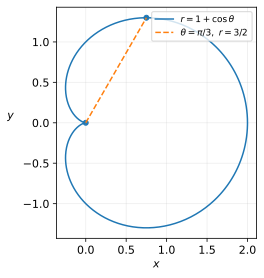
A cardioid area. For on , the curve is traced once with nonnegative radius. Its area is
The negative-valued cosine does not make the radius negative here; the added one matters.
G. Independent practice#
F foundation C standard course work T transfer S optional stretch L runnable lab or project. Attempt the complete set before opening its solutions.
Convert to Cartesian coordinates and give an equivalent polar pair with positive radius.
Identify the curve and give an interval with nonnegative radius that traces it once.
Find the area enclosed by using a once-traced interval.
Find the area of one petal of centered on the positive -axis.
Find the tangent slope of at .
Find the length of the circle parameterized by , , and explain how the answer changes on .
Classify the conic . Convert it into Cartesian standard form and identify its center and semiaxes.
Find the area inside but outside . Derive the angular interval and radial bounds before integrating.
Optional small hints
For M32.04, the petal’s endpoint rays occur where around zero. For M32.07, use and preserve the nonnegative-distance relation when squaring. For M32.08, the outer radius must be at least one.
H. Complete solutions: Module 32#
Compare the first step where your work differs. A corrected answer is not yet an independent success.
M32.01Show solution
A negative radius reverses the direction
Compute and . The Cartesian point is . An equivalent positive-radius representation is , obtained by adding to the angle while reversing the radius sign.
Back to M32.01M32.02Show solution
Multiply by radius to expose a Cartesian circle
The equation gives , or . Thus , a radius-three circle centered at . On the radius is nonnegative and the curve is traced once, beginning and ending at the origin.
Back to M32.02M32.03Show solution
The natural half-turn already traces the full circle
Use . Then . The Cartesian circle has center and radius one, confirming its disk area. A full parameter interval would trace it twice and double the area integral.
Back to M32.03M32.04Show solution
Integrate one loop rather than the entire rose
The petal around angle zero extends from to , where its radius vanishes. Its area is
The radius is nonnegative on this interval and sweeps just the specified petal.
Back to M32.04M32.05Show solution
Differentiate the Cartesian parameterization
At , and . Thus and . The slope is . The point is , so the tangent line would be . The radius itself is not the slope.
Back to M32.05M32.06Show solution
Length counts the actual tracing
Here , so , the usual circumference. On , the integral is because the circle is traversed twice. The geometric image has not changed, but the parameterized journey has.
Back to M32.06M32.07Show solution
An eccentricity below one suggests an ellipse
The eccentricity is , so the curve is an ellipse. Multiplying gives , hence . Squaring and completing squares yields
The center is with horizontal semiaxis and vertical semiaxis . Its range is , so ; no extraneous branch was introduced by squaring. One focus is indeed the origin because .
Back to M32.07M32.08Show solution
The angular restriction comes from radial feasibility
The region on a ray requires , so and . Therefore
These nonnegative radii sweep the intended lens portion once. The answer is less than the area of the outer circle, a useful geometric check.
Back to M32.08I. Retention and readiness#
Retrieve M31.05, M18.08, and M04.01. Explain why a full interval is not always one tracing. Complete the Calculus II assessment next, recording separately mistakes in method choice, endpoint conditions, and computation.