Module 42: Vector fields, scalar line integrals, work, and circulation
On this page
- A. Prerequisites and observable goals
- B. The central idea: integrate along a path, not across an interval of space
- C. Two line integrals with different orientation behavior
- D. Why work uses a dot product
- E. A parameterization procedure
- F. Worked examples
- G. Independent practice
- H. Complete solutions: Module 42
- I. Retention and readiness
A. Prerequisites and observable goals#
Vector curves, dot products, arc length, and single-variable integration.
Distinguish scalar fields from vector fields, choose between and , compute work or wire mass, and track orientation.
B. The central idea: integrate along a path, not across an interval of space#
A scalar field assigns one number to each point, such as temperature or density. A vector field assigns a vector, such as force or fluid velocity. A path samples the field along a curve. Scalar line integrals weight length; vector line integrals weight directed displacement. They answer different questions even when both involve the same curve.
C. Two line integrals with different orientation behavior#
For a piecewise smooth parameterized curve , ,
while
The first is unchanged by reversing a once-traced curve; the second changes sign. A nonnegative linear density makes the first a wire mass. A force field makes the second work, because only the force component along displacement contributes. Notation denotes the same vector work integral for . [O3Line]
For a closed path, the work-type integral is also called circulation in a velocity-field context. In a counterclockwise oriented simple closed plane curve, the outward normal is to the right of travel. The planar outward flux is
This measures crossing of the boundary, not motion along it. The next module relates circulation and flux to area integrals.
D. Why work uses a dot product#
A small displacement receives work approximately : a force perpendicular to the motion does no work, while a force opposed to motion contributes negatively. Summing and limiting gives the integral. Wire mass instead uses positive segment lengths, so it contains , not a signed coordinate derivative.
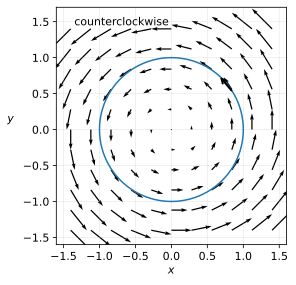
A rotating field is tangent to circles centered at the origin: it has circulation but zero normal flux through those circles. A radial field has positive outward flux but zero circular work. This distinction previews curl versus divergence.
E. A parameterization procedure#
State the curve and orientation, choose a parameter interval tracing it as intended, and differentiate the parameterization. Substitute every coordinate in the field. Then choose the final factor: speed for , tangent vector for , or an oriented normal for flux. Compute and check units and signs. Repeated tracing counts repeatedly, so a geometric picture alone does not fix the integral without its parameter information.
F. Worked examples#
Work along a segment. For from to , use , . Then and , giving work .
Flux versus circulation. On the counterclockwise unit circle, , , and outward normal . For the radial field , the work integrand is zero while flux integrand is one. Total circulation is zero; outward flux is .
G. Independent practice#
F foundation C standard course work T transfer S optional stretch L runnable lab or project. Attempt the complete set before opening its solutions.
Evaluate along the segment from to .
Evaluate along the first-quadrant unit-circle arc from to .
Find work by along the segment from to .
For , find circulation counterclockwise around the circle of radius two and its outward flux through that circle.
For , compare work from to along the straight segment and along the broken path first to and then to .
Evaluate for , .
A wire is , , with linear density equal to its coordinate in consistent units. Find its mass.
Explain by a substitution why a one-to-one smooth orientation-preserving reparameterization leaves both line-integral values unchanged, while orientation reversal changes only the work integral’s sign.
Optional small hints
For M42.01, the segment speed on is five. For M42.05, work is ; a vertical segment has . For M42.08, contrast the factor with .
H. Complete solutions: Module 42#
Compare the first step where your work differs. A corrected answer is not yet an independent success.
M42.01Show solution
A scalar field weights positive arc length
Use , . Then and speed is . Hence . Reversing the segment would not change this scalar line integral.
Back to M42.01M42.02Show solution
Unit-circle speed equals one for its angle parameter
Use for . Speed is one, so the integral is . The parameter interval, not a full circle, matches the specified arc.
Back to M42.02M42.03Show solution
Substitute the field and dot with velocity
With , and . The work integrand is , so work is . Integrating the field’s magnitude instead would calculate a different quantity.
Back to M42.03M42.04Show solution
A tangential field circulates without crossing the circle
Parameterize , . Then , so and circulation is . The outward unit normal is and its dot product with the field is zero, so outward flux is .
Back to M42.04M42.05Show solution
Two paths reveal path dependence
Along , work is . On the first broken segment, , so ; on the second, is constant, so . The broken-path work is . Because the same endpoints give different values, the field’s work is path-dependent; an endpoint-only rule cannot apply to this field globally.
Back to M42.05M42.06Show solution
Orthogonal horizontal motion cancels in the dot product
The substituted field is and velocity is . Their dot product is . Thus the work is . The horizontal circular motion contributes no radial-field work; the vertical motion does.
Back to M42.06M42.07Show solution
Density must be multiplied by speed
Density along the path is , and speed is . Thus mass is
The substitution contributes the factor . Positivity of the density and length factor makes the mass positive.
Back to M42.07M42.08Show solution
The chain rule explains reparameterization invariance
Let be a smooth one-to-one monotone reparameterization. The new velocity is . For work, the integrand acquires the signed factor , exactly the ordinary substitution differential; reversing endpoint order reverses the integral. For a scalar line integral, the speed acquires , so orientation reversal changes the bounds and the sign of together, leaving the positive length weighting unchanged. This argument assumes the same curve is traced once; a multiple-covering map is not the same reparameterization and can multiply the integral.
Back to M42.08I. Retention and readiness#
Retrieve M31.05 and M34.02. Say whether the problem is asking for density times length, force along motion, circulation, or flux across a boundary. Advance when you can predict orientation behavior before performing the integral.