Module 01: Algebra is the language of calculus
On this page
- A. Prerequisites and observable goals
- B. The central idea: preserve the value and the domain
- C. Rules, definitions, and restrictions
- D. Why factoring permits a limit later
- E. A reliable decision procedure
- F. Worked examples with visible algebra
- G. Independent practice
- H. Complete solutions: Module 01
- I. Retention and readiness
A. Prerequisites and observable goals#
Signed numbers, basic multiplication, and willingness to write parentheses.
Add and divide fractions, expand and factor expressions, solve equations with restrictions, and explain why a cancellation is legal.
B. The central idea: preserve the value and the domain#
An expression names a quantity, such as . An equation asserts that two quantities are equal, such as . Simplifying an expression and solving an equation are different tasks. An identity holds for every input in its stated domain; an equation may hold for only a few inputs. Calculus repeatedly changes the form of an expression without changing its value at the inputs under discussion. Losing a sign or an excluded input can change the problem before any calculus happens.
The main question is not “What can I cross out?” It is “What operation preserves equality here?” Fractions are quotients. A sum in a numerator is a single object until you deliberately distribute division over its terms.
C. Rules, definitions, and restrictions#
For , common denominators give
The reciprocal rule follows because multiplying by undoes multiplying by . Multiplying numerator and denominator by the same nonzero number multiplies a fraction by .
Distribute into every term: and . The square is a product , hence . The middle term represents two separate products, and .
Factoring reverses distribution. Useful identities are
The real square root is nonnegative: . In general . In a real expression, a denominator must be nonzero and a square-root input must be nonnegative. These restrictions survive later simplification.
D. Why factoring permits a limit later#
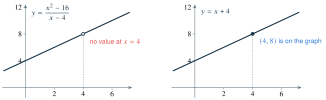
Consider . Factoring gives
The two formulas agree everywhere the original is defined. The simplified formula also has a value at , but that does not assign a value to the original quotient. This distinction will let us study values near a hole in Module 06. Algebra creates a useful nearby formula; a limit will describe what its values approach.
To solve an equation, reversible operations preserve its entire solution set. Squaring is not always reversible: implies , but also admits . Thus squaring can introduce candidates that must be checked. Multiplying an inequality by a negative quantity reverses its direction; multiplying by an expression of unknown sign requires cases.
E. A reliable decision procedure#
Identify the outermost operation. In a fraction, record denominator restrictions before manipulating. If asked to simplify, factor or use a common denominator. If asked to solve, isolate or factor to make a product zero. A product is zero when at least one factor is zero; this rule does not apply to a sum. For a rational inequality, mark zeros and excluded points on a number line and test the sign in each interval. Check proposed solutions in the original equation, not only in the transformed one.
F. Worked examples with visible algebra#
Example 1: simplify a complex fraction. For ,
The common denominator is ; the numerator subtraction includes the whole . We canceled a factor , not either of the terms inside .
Example 2: solve a radical equation. Solve . The left side is nonnegative, so any solution must satisfy . Squaring gives , or . The candidates are and . The second violates and also fails the original equation. At , . Thus the solution set is .
Finish a step. In , predict all three signs before reading on. Distribution gives . The minus sign multiplies the entire expression by .
G. Independent practice#
F foundation C standard course work T transfer S optional stretch L runnable lab or project. Attempt the complete set before opening its solutions.
Compute and . Give reduced fractions.
Expand and collect .
Simplify , retaining every restriction from the original expression.
Solve .
Solve using a sign chart.
A student writes for every real . Correct the statement and give a counterexample to the student’s version.
Simplify , and explain exactly which quantities must be nonzero.
Solve and explain why testing candidates is essential.
Optional small hints
For M01.05, zeros and forbidden points split the line into three intervals. For M01.07, combine the two inner fractions before dividing by . For M01.08, the square-root output cannot be negative.
H. Complete solutions: Module 01#
Compare the first step where your work differs. A corrected answer is not yet an independent success.
M01.01Show solution
Two operations on fractions
For subtraction, use denominator : and . Thus the difference is . For division, multiply by the reciprocal of the nonzero divisor:
The difference is smaller than ; the quotient is greater than because . These magnitude checks would catch a swapped reciprocal.
Back to M01.01M01.02Show solution
Expansion includes the middle term
First . Multiply the entire trinomial by and distribute separately:
At , the original is , matching the constant term. This single check supports the algebra but is not a proof of the identity; the distributive steps establish it.
Back to M01.02M01.03Show solution
Simplification with a missing input
The numerator is and the denominator is . Thus the original excludes . At every other input, canceling the nonzero factor gives
Although the reduced formula is defined at , the original expression is not. It is incorrect to erase the restriction .
Back to M01.03M01.04Show solution
A rational equation
Require . Multiplying by yields . Distribute: , so . The original sides are then and . The allowed, verified solution is .
Back to M01.04M01.05Show solution
A rational inequality
The numerator changes sign at ; the denominator is zero at . On both are negative, giving a positive quotient. On the numerator is negative and denominator positive, giving a negative quotient. On both are positive. Include because equality is permitted, but never include . The solution is .
Back to M01.05M01.06Show solution
The square root chooses nonnegative output
The correct identity is . This equals for and for . At , the left side is while the student’s right side is . Squaring and taking the principal square root loses a sign; absolute value restores it correctly.
Back to M01.06M01.07Show solution
A nested quotient
The original requires , , and . Combining fractions first gives
The numerator is , not . Cancellation uses . All three original restrictions remain part of the identity.
Back to M01.07M01.08Show solution
Candidates are not yet solutions
Because , require . Squaring yields , so . Candidates are . Checking: at , ; at , . Only solves the equation. The false candidate entered because squaring does not distinguish opposite signs.
Back to M01.08I. Retention and readiness#
Revisit M01.03 and M01.07 the next day without their solutions. Say aloud why a factor must be nonzero before cancellation. Readiness means you can distinguish an expression from an equation, preserve the excluded inputs, and solve a fresh sign-chart problem without guessing. A mistaken sign in M01.02 calls for distribution practice, not a new calculus formula.