Module 10: The chain rule and elementary derivatives
On this page
- A. Prerequisites and observable goals
- B. The central idea: rates multiply along a dependency chain
- C. The rule and a compact derivative dictionary
- D. Why the method works
- E. Read from outside inward, then multiply outward
- F. Worked examples with explicit layers
- Computing bridge: Chain rule as a dependency calculation
- G. Independent practice
- H. Complete solutions: Module 10
- I. Retention and readiness
A. Prerequisites and observable goals#
Composition, derivative rules, radians, exponentials, and logarithms.
Differentiate nested functions without missing inner factors, use elementary derivative formulas with their domains, and distinguish a product from a composition.
B. The central idea: rates multiply along a dependency chain#
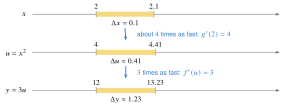
Suppose and . A small input change first changes at rate , then changes at rate per unit change in . The total rate with respect to multiplies these effects. The evaluation point of the outer derivative is the inner output, not automatically .
C. The rule and a compact derivative dictionary#
If is differentiable at and is differentiable at , then
For a differentiable inner function , useful consequences are
Here , and the trigonometric quotient functions require their usual nonzero denominators. For arbitrary real , use unless an appropriate real branch is separately justified. The formula for itself requires ; extends the derivative formula to nonzero negative inputs on their own intervals. These formulas are exact, not small-angle approximations. Chain-rule conditions and inverse-function derivatives: [O1Ch], [O1Inv].
D. Why the method works#
Optional proof from local linear changes. Let , let be the change in , and let be the resulting change in . Differentiability means that we can write the exact decompositions
where the error factors and as their inputs approach zero. Set so the second identity also covers . For , substitution gives
Differentiability of implies when , so the limit is . This proof never divides by , which could be zero. The informal “cancel ” mnemonic alone does not establish the theorem.
For sine, use the addition formula in its difference quotient:
The two basic radian limits make this approach . For exponentials, reduces the derivative to . The normalization of the base makes that final limit equal to one. Other bases add the factor .
E. Read from outside inward, then multiply outward#
For , the outer operation is a square root, then addition, then an exponential, then multiplication of the input by . Differentiate each layer at its current input and multiply the chain factors. For , the outer operation is multiplication of two functions, so start with the product rule. A problem may need both rules: differentiate the product, then apply the chain rule within its terms.
A useful self-check is to count nonlinear nesting layers. If gives only , the derivative of the inner was lost. If a derivative of contains , the original inner expression was incorrectly replaced instead of preserved.
F. Worked examples with explicit layers#
Power of a trigonometric function. Write . The outside square differentiates to twice its input; sine contributes cosine; contributes :
The notation means this square, not .
Product plus chain. For ,
The exponential changes too, so treating it as a constant would lose the second term.
Finish the layer. For , the outer derivative is . Multiply by to finish: . The log input is positive for every real , so this derivative is valid everywhere.
Computing bridge: Chain rule as a dependency calculation#
For and , a small change travels through two stages: and . Their product gives . A computational graph records these dependencies explicitly. T03 later applies the same rule to a loss function with many parameters. The mathematical chain rule is the foundation; a library computing gradients does not remove the need to understand the graph or the differentiability assumptions.
G. Independent practice#
F foundation C standard course work T transfer S optional stretch L runnable lab or project. Attempt the complete set before opening its solutions.
Differentiate .
Differentiate .
Differentiate and state its real domain.
Differentiate and state the excluded inputs.
Differentiate .
Differentiate , and find the inputs where its derivative is zero.
Let , where , , , and . Find and explain which given value is irrelevant.
Find the tangent line to at . Show every chain factor before simplification.
Optional small hints
For M10.04, is a square of a secant, not the derivative of tangent. For M10.08, compute the curve’s height separately from its derivative.
H. Complete solutions: Module 10#
Compare the first step where your work differs. A corrected answer is not yet an independent success.
M10.01Show solution
A polynomial inside a fourth power
Set . The outer derivative is and . Thus
Both original and derivative are polynomials, defined for all real inputs.
Back to M10.01M10.02Show solution
An exponential of a sine
The outer exponential reproduces itself evaluated at its current input: . The inner derivative is . Multiplication gives . The exponential factor never vanishes, so the sign of the slope follows the sign of .
Back to M10.02M10.03Show solution
A log of a positive inner function
Because for all real , the domain is . The outer derivative is and the inner derivative is , so . In particular, the slope at zero is zero, consistent with the original being an even function with a minimum there.
Back to M10.03M10.04Show solution
Three chain factors
Writing exposes the layers:
Both the original and derivative exclude , that is for integers .
Back to M10.04M10.05Show solution
Product outside, chain inside
Use the product rule, then the derivative of :
The second term is negative because the inner derivative of is . The domain is all real inputs.
Back to M10.05M10.06Show solution
Derivative of a quotient, then solve its zero equation
The real domain is . Quotient rule gives
Since , its zeros solve , hence . This identifies a horizontal tangent; classifying an extremum requires the sign analysis developed in Module 14.
Back to M10.06M10.07Show solution
Evaluate the outer derivative at the inner output
The chain rule gives . The value is irrelevant because the input arriving at is , not . This problem tests the location of evaluation, not just multiplication of available numbers.
Back to M10.07M10.08Show solution
A tangent through a nested function
The height is . The derivative before simplification is
At zero the slope is . Therefore
The radical input is strictly positive everywhere. The tangent at zero has the correct height and positive slope.
Back to M10.08I. Retention and readiness#
Return to M03.01 and M09.06, then solve M10.07 from memory of the rule rather than the numbers. Advance when you can identify the outermost operation in a fresh expression and explain the evaluation point of every chain factor. Repair composition before memorizing more derivative tables.