Module 24: Improper integrals and probability density
On this page
- A. Prerequisites and observable goals
- B. The central idea: accumulation can extend beyond finite, bounded data
- C. Definitions and comparison tools
- D. Why the exponent threshold is one
- E. A procedure for improper problems
- F. Worked examples
- G. Independent practice
- H. Complete solutions: Module 24
- I. Retention and readiness
A. Prerequisites and observable goals#
Limits, antiderivatives, positivity, and comparison of functions.
Define improper integrals by separate limits, decide convergence, distinguish convergence from value, and normalize a continuous probability density.
B. The central idea: accumulation can extend beyond finite, bounded data#
The Riemann integral on a compact interval was built for bounded functions. Infinite intervals or unbounded integrands require limits of ordinary integrals. A small tail may accumulate to a finite total or an infinite one. The integrand tending to zero is not enough: tends to zero but its tail integral diverges.
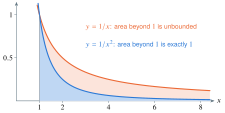
C. Definitions and comparison tools#
For continuous on every finite subinterval of ,
if the limit is finite. At an unbounded endpoint , use . At an interior singularity, split into two independent improper integrals and require both to converge. On , split at a finite point and require each tail separately. A finite symmetric limit can be a Cauchy principal value without being an ordinary improper integral.
For nonnegative functions, if eventually and converges, then converges; if diverges, then diverges. Finite initial pieces do not change tail convergence. For -integrals,
Different endpoint regimes produce opposite inequalities. [O2Improper]
A probability density must be nonnegative and have total integral one over its support. The probability of an interval is the integral of the density there, not a point height. When , the mean is . A normalized density need not have a finite mean. If has length units, a density has reciprocal-length units.
D. Why the exponent threshold is one#
For ,
If , the exponent is negative and , leaving . If , it grows without bound. At , the primitive is , which also diverges. At zero the same power expression is examined as its lower input approaches zero, reversing the exponent condition. The convergence test comes from a limit, not simply the sign of .
E. A procedure for improper problems#
Mark every infinite bound and singular point before integrating. Split wherever necessary. Replace one problematic endpoint at a time with a finite variable and calculate an ordinary integral. Take each limit independently. For a convergence-only question, comparison may be quicker than finding a primitive. For a density, verify nonnegativity, then normalization, then any requested probability or moment; do not assume a moment exists just because normalization succeeds.
F. Worked examples#
An exponential tail. For , , so this function is a density on . Integration by parts gives
The vanishing product follows from exponential dominance, not from assigning a value to .
A misleading symmetry. The symmetric truncated integral of from to and from to is zero. Nevertheless its two near-zero pieces diverge independently. Symmetry can coordinate cancellations but cannot change the definition of an ordinary improper integral.
G. Independent practice#
F foundation C standard course work T transfer S optional stretch L runnable lab or project. Attempt the complete set before opening its solutions.
Evaluate , displaying the limiting step.
Determine convergence of and ; evaluate the convergent one.
Evaluate .
Does converge? Explain why a single formal endpoint substitution into is invalid.
Prove convergence of by comparison, without evaluating it.
For on , zero elsewhere, choose to make a density. Find and .
A density has for , zero elsewhere. Find and determine whether its mean is finite.
For which real does converge? Evaluate it when it converges.
Optional small hints
For M24.04, split at zero first. For M24.07, normalization and the mean have different integrands. For M24.08, use and transform both the differential and the lower bound.
H. Complete solutions: Module 24#
Compare the first step where your work differs. A corrected answer is not yet an independent success.
M24.01Show solution
Take the upper limit after finite evaluation
For , . Letting gives . Infinity was not substituted as an ordinary real endpoint.
Back to M24.01M24.02Show solution
A finite interval can still have an improper endpoint
For the first integral, . For the second, . Thus only the first converges. Both heights are unbounded near zero, but their accumulation rates differ.
Back to M24.02M24.03Show solution
Parts before the infinite-endpoint limit
On , parts yields . Exponential dominance makes the last term vanish, so the integral is . Positivity rules out a negative result and supports the limiting computation.
Back to M24.03M24.04Show solution
Do not integrate through a singularity
The right piece is . Thus the full integral already diverges; the left piece also diverges positively. Evaluating crosses a point where neither the integrand nor its primitive is defined, violating the FTC conditions. A negative result for a positive integrand would also signal an error.
Back to M24.04M24.05Show solution
An upper comparison proves finiteness, not a sum value
For , , so . The comparison integral is , hence the requested integral converges and lies between and . This does not show that its value equals the comparison value.
Back to M24.05M24.06Show solution
Normalize before computing probabilities
Nonnegativity requires . The total mass is , so . Then . The mean is . The mean is within the support and shifted toward the denser right side.
Back to M24.06M24.07Show solution
A valid distribution can have an infinite mean
Since , normalization gives . But the mean integral is , which diverges. The nonnegative random variable therefore has infinite expectation, not a finite mean inferred from the existence of the density.
Back to M24.07M24.08Show solution
A logarithmic substitution exposes a standard threshold
Set , so , and the lower bound is . The integral becomes . By the derived power threshold, it converges exactly when and then equals . The logarithm changes the tail classification even though every member has a factor .
Back to M24.08I. Retention and readiness#
Revisit M15.05, M22.08, and M19.07. Explain why convergence, numerical value, and existence of a moment are separate questions. Advance when you can list every independent limiting endpoint before performing any antiderivative calculation.