Module 40: Triple integrals and cylindrical and spherical coordinates
On this page
- A. Prerequisites and observable goals
- B. The central idea: integrate contributions throughout a solid
- C. Coordinate conventions that must be explicit
- D. Why the spherical factor contains two powers and a sine
- E. Build the solid before computing
- F. Worked examples
- G. Independent practice
- H. Complete solutions: Module 40
- I. Retention and readiness
A. Prerequisites and observable goals#
Double integrals, spatial regions, polar coordinates, and density-weighted moments.
Describe a solid with nested bounds, choose cylindrical or spherical coordinates, and compute volume, mass, or moments with the correct volume element.
B. The central idea: integrate contributions throughout a solid#
A triple integral adds tiny-volume contributions. Integrating gives volume; integrating a mass density gives mass. The solid and the integrand jointly determine the most useful coordinates. Cylindrical coordinates suit rotational symmetry around an axis; spherical coordinates suit distances and angles from a point.
C. Coordinate conventions that must be explicit#
Cartesian volume is in an appropriately nested order. Cylindrical coordinates use
The symbol is distance from the -axis, not distance from the origin.
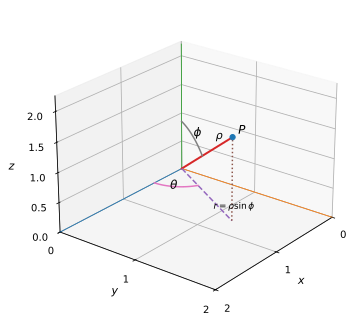
Our spherical convention uses for distance from the origin, for azimuth in the -plane, and for angle down from the positive -axis:
Some texts interchange angle names; the formulas and geometric definitions, not the letters alone, determine correctness. The factors and account for volume scaling. Coordinate and integral conventions: [O3Triple].
For density , and , with analogous . The moment of inertia about the -axis is : distance from the axis is squared, not distance from the origin.
D. Why the spherical factor contains two powers and a sine#
A small spherical cell has approximate side lengths , , and . Their product gives . Near the poles, a fixed azimuth change sweeps a smaller distance, explaining the sine. This geometric argument is supported by the Jacobian determinant in the next module.
A cone and a sphere simplify in these coordinates for different reasons. The cone becomes , or away from the origin. The sphere becomes . Their intersection can therefore produce constant angular and radial bounds.
E. Build the solid before computing#
Describe its projections and bounding surfaces. Choose an outer variable range and an inner interval that depends only on variables not yet integrated. For cylindrical coordinates, decide whether or is best innermost. For spherical coordinates, draw the polar angle from the positive -axis and convert every inequality. Include the volume factor, then inspect whether symmetry makes odd moments zero. Never use symmetry across a plane that the solid or density does not actually possess.
F. Worked examples#
A ball volume. A radius- ball uses , , . Thus
Recovering a known volume is a useful check on the Jacobian and angular ranges.
A region under a paraboloid. For , the base disk has . Cylindrical bounds are , , . Volume is . The upper height must be nonnegative, which determines the radial boundary.
G. Independent practice#
F foundation C standard course work T transfer S optional stretch L runnable lab or project. Attempt the complete set before opening its solutions.
Evaluate .
Find the volume of the tetrahedron , using Cartesian iterated integration.
Evaluate over the cylinder , .
Evaluate in spherical coordinates.
Find the centroid of the uniform upper half of the unit ball.
Find the volume inside the radius-two sphere and above the cone .
For the solid , , , density is . Find mass and .
Reverse the nested description , , to an order with outermost and innermost. Evaluate the volume in the new order.
Optional small hints
For M40.05, symmetry gives two coordinates, not the vertical one. For M40.06, above the cone means . For M40.08, rewrite the original inequalities as one chain .
H. Complete solutions: Module 40#
Compare the first step where your work differs. A corrected answer is not yet an independent success.
M40.01Show solution
Separate the three symmetric contributions
Over the unit cube, . The and contributions are the same by symmetry, so the total is . This equals the cube volume times the affine function’s value at its center.
Back to M40.01M40.02Show solution
The inner endpoint comes from the remaining plane height
Use , , and . Integrating in gives , then in gives . The outer integral is . All nested upper bounds are nonnegative on their stated outer ranges.
Back to M40.02M40.03Show solution
A constant horizontal cross-section separates the variables
Cylindrical coordinates give . The cylinder’s volume is and its mean height is , giving the same first volume moment.
Back to M40.03M40.04Show solution
The radial integrand multiplies the radial volume factor
The integrand becomes and the volume element contributes another . Therefore
This is not a surface integral over the sphere: every radius from zero to two is included.
Back to M40.04M40.05Show solution
Use symmetry for two moments and integrate the third
Symmetry gives . The hemisphere volume is . Its moment in spherical coordinates is
Thus . The centroid lies above the flat base and below the sphere’s top, as required.
Back to M40.05M40.06Show solution
Translate the cone into a polar-angle bound
Inside the sphere means . Above the cone means , hence in the upper half-space, giving . The azimuth covers . Therefore . The origin’s angle ambiguity has no effect on the volume integral.
Back to M40.06M40.07Show solution
A growing cross-section and growing density both weight the top
At height , the cross-section has area . Mass is . The moment adds another factor , giving . Thus . The centroid’s high position reflects both the widening solid and the increasing density.
Back to M40.07M40.08Show solution
Keep the same ordered inequalities
The original solid is . With outermost, use , , and . Thus
The order change is a new description of one solid, not a permutation of the old limits attached to new variable names.
Back to M40.08I. Retention and readiness#
Retrieve M39.08 and M19.07. Explain whether means axial distance or means distance from the origin. Advance when your bounds reconstruct the intended cone, sphere, or cylinder and your units distinguish volume from mass or moment.