Module 18: Volumes from slices, washers, and shells
On this page
- A. Prerequisites and observable goals
- B. The central idea: volume is accumulated cross-sectional area
- C. The geometric formulas and what their symbols mean
- D. Why the washer and shell methods agree
- E. A setup-first decision procedure
- F. Worked examples
- G. Independent practice
- H. Complete solutions: Module 18
- I. Retention and readiness
A. Prerequisites and observable goals#
Definite integrals, area between curves, and geometric area formulas.
Build a volume integral from a typical cross-section or shell, measure distances from the correct rotation axis, and compare alternative setups.
B. The central idea: volume is accumulated cross-sectional area#
A solid can be described by thin pieces. A slice of thickness and cross-sectional area has approximate volume . In the limit, . Disks, washers, and shells are convenient geometric ways to identify that contribution; they are not interchangeable formulas to select by appearance alone.
C. The geometric formulas and what their symbols mean#
For cross-sections perpendicular to the -axis, . Rotating such a slice about a horizontal axis can produce a disk of radius or a washer with outer radius and inner radius :
The radii are distances to the rotation axis, not automatically the two function values. For an axis , a point at height has distance from it. The expression is not the washer area divided by .
A thin shell has approximate volume circumference times height times thickness. With shells parallel to a vertical rotation axis,
Use a partition that counts each portion of the solid once. If the region crosses an axis, blindly integrating shells on both sides may double-count overlapping volume. Drawing the rotated geometry or splitting carefully prevents this. Volume methods: [O2Vol].
D. Why the washer and shell methods agree#
A washer is the difference of two full disks, so subtraction occurs after squaring each radius. A shell can be viewed as a narrow rectangular strip rolled around an axis: its circumference is approximately , and its height is the strip’s length along the axis. Its precise annular volume differs from the approximate formula by terms that vanish in the limiting sum. Both methods add the same solid, organized differently.
A region between and for is useful for comparison. About the -axis, vertical shells have radius and height . Horizontal washers use the inverse boundary descriptions and . The integrals look different because the slicing variables differ.
E. A setup-first decision procedure#
Draw the planar region and rotation axis. Choose a slice direction, then decide what that slice becomes: a disk/washer if perpendicular to the axis, a shell if parallel. Label the integration variable and its bounds. Express each radius as a distance from the axis and each height as an endpoint difference. Simplify only after the geometry is correct. The units should be area times length or circumference times height times thickness: in either case, cubic units.
F. Worked examples#
Two methods, one volume. Rotate , , about the -axis. Shells give
Horizontal washers have outer radius and inner radius , giving . The agreement checks both bounds and the inversion of the curves.
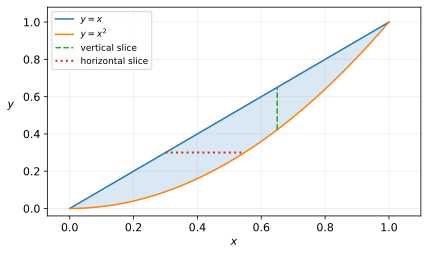
A solid that is not a rotation. If a base lies between and perpendicular cross-sections are squares, then their side length is , not . Thus and . No is involved: these slices are squares, not disks.
G. Independent practice#
F foundation C standard course work T transfer S optional stretch L runnable lab or project. Attempt the complete set before opening its solutions.
Rotate the region under on above the -axis around the -axis. Find the volume.
Rotate the region between and about the -axis. Find the volume.
Rotate the region under on about the -axis using shells.
Rotate the region between and , , about the line . Use washers.
Rotate the region between and , , about . Use shells.
A solid has base , . Its cross-sections perpendicular to the -axis are equilateral triangles whose sides lie in the base. Find its volume.
A student rotates the region between and on about the -axis and uses . Explain and correct the error.
For the solid in M18.03, set up and evaluate a washer integral using . Explain why its inner radius is not zero except at the bottom.
Optional small hints
For M18.04, both radii include the distance to . For M18.06, an equilateral triangle of side has area . For M18.08, solve for the left boundary at a fixed height.
H. Complete solutions: Module 18#
Compare the first step where your work differs. A corrected answer is not yet an independent success.
M18.01Show solution
A disk radius determined by height
The disk radius is , its area is , and the axial bounds are . Thus cubic units. The region rotates into a cone of radius and height , whose formula gives the same result.
Back to M18.01M18.02Show solution
Outer squared minus inner squared
The intersections satisfy , so . At each such input the outer radius is and inner radius is . Therefore
The inner squared radius is , not .
Back to M18.02M18.03Show solution
A vertical strip produces a cylindrical shell
For , radius is , height is , and thickness is . Hence . The shell formula includes a circumference, not a disk area.
Back to M18.03M18.04Show solution
Measure both radii from the shifted axis
On , the outer radius is and inner radius is . Their squared difference is . Therefore
Using radii would calculate rotation about the wrong axis.
Back to M18.04M18.05Show solution
The region stays fixed while the axis changes
The shell radius is the horizontal distance , while height remains . Multiply: . Thus
The positive answer is larger than rotation about , consistent with the larger circumference of every shell.
Back to M18.05M18.06Show solution
A noncircular cross-section
At input , the base segment has length . The triangular area is . Hence cubic units. Squaring the side produces even though the base boundary was .
Back to M18.06M18.07Show solution
A ring is not a small full disk
The proposed formula squares the thickness of the ring. A washer is the area of a radius- disk minus the area of a radius- disk, so its area is . The correct volume is . Geometrically this is an outer cylinder minus an inner cylinder, not a cylinder of radius .
Back to M18.07M18.08Show solution
Invert the boundary for horizontal slices
At a height , the original region runs from to . Rotation about the -axis creates a washer with outer radius and inner radius . Thus
Above the bottom, the region does not reach the axis, which explains the hole in each horizontal slice. Agreement with shells checks the geometry, not just arithmetic.
Back to M18.08I. Retention and readiness#
Retrieve M17.06 and M04.06. Explain which length becomes a radius, which becomes a height, and why the direction of a slice matters. Advance when you can set up the same solid by two methods and identify when one avoids solving an inverse relation.