Module 27: Positive series: comparison, integral, ratio, and root tests
On this page
- A. Prerequisites and observable goals
- B. The central idea: bound partial sums or compare their tails
- C. Test statements that include their hypotheses
- D. Why the ratio test becomes a geometric comparison
- E. A method-selection guide
- F. Worked examples
- G. Independent practice
- H. Complete solutions: Module 27
- I. Retention and readiness
A. Prerequisites and observable goals#
Sequence limits, positive improper integrals, algebraic estimates, and geometric series.
Select a convergence test based on term structure, verify its hypotheses, and distinguish a decisive result from an inconclusive one.
B. The central idea: bound partial sums or compare their tails#
For nonnegative terms, partial sums increase. A finite upper bound forces them to converge; a known divergent lower accumulation forces divergence. Most positive-series tests formalize one of these comparisons. They usually classify convergence without giving an exact value for the sum.
C. Test statements that include their hypotheses#
Direct comparison. If eventually, convergence of implies convergence of , and divergence of implies divergence of . The reverse directions are not valid.
Limit comparison. For eventually positive , if with , then the two series either both converge or both diverge. A limit of zero or infinity is not the two-way version, though a suitable one-way comparison may still follow.
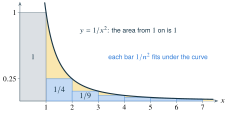
Integral test. If is positive, continuous, and decreasing on a tail, with , then and have the same convergence classification. For a convergent series with remainder ,
Thus converges exactly for . The integral and the series generally have different values.
Ratio and root tests. For (with eventually nonzero terms), or , gives absolute convergence; , including , gives divergence. is inconclusive. These displayed versions assume the limit exists. [O2Tests]
D. Why the ratio test becomes a geometric comparison#
If the limiting ratio is less than one, choose strictly between that limit and one. Eventually , so repeated multiplication bounds the tail by a geometric sequence. The resulting geometric series converges. If the ratio is eventually larger than a number greater than one, terms cannot approach zero. At a limiting ratio of one, neither comparison follows; both harmonic and convergent -series have this ratio limit.
For the integral test, decreasing heights place rectangles on opposite sides of the graph. The integral from bounds the tail from above, while the integral from bounds it from below. Indexing is essential: the tail starts with , not .
E. A method-selection guide#
Start with the term test. For rational expressions in , compare leading powers and justify the resulting asymptotic comparison. For logarithmic denominators, an integral substitution may reveal the threshold. Factorials and exponentials often suit ratios; expressions raised to the th power often suit roots. Alternating signs may require the next module. When a test is inconclusive, switch structure rather than declaring convergence or divergence from an ambiguous number.
F. Worked examples#
A rational comparison. For , compare with . The ratio , a finite positive limit, so the series converges. No exact sum has been found.
A factorial ratio. For , . Thus it converges absolutely. The factorial simplifies under a one-index shift, explaining why the ratio test is efficient.
A tail estimate. For , the error after terms lies between and . This proves convergence and estimates the remaining accumulation without assuming a formula for the full sum.
G. Independent practice#
F foundation C standard course work T transfer S optional stretch L runnable lab or project. Attempt the complete set before opening its solutions.
Classify and .
Test by limit comparison.
Test by direct comparison.
Test and bound its tail after summing through index (that is, the terms ).
Test .
Test using the root test.
A ratio test gives for . Is the series divergent? Explain and finish the classification.
Choose a sufficient number of initial terms of so that the omitted positive tail is at most . Give both an upper and a lower tail bound for this .
Optional small hints
For M27.02, the leading powers suggest , not . For M27.04, verify decreasing behavior and use . For M27.08, integrate from to infinity.
H. Complete solutions: Module 27#
Compare the first step where your work differs. A corrected answer is not yet an independent success.
M27.01Show solution
Use the power threshold in the series regime
Both are -series. The first has and converges; the second has and diverges. Each term sequence tends to zero, illustrating why the exponent test supplies information that the term test cannot.
Back to M27.01M27.02Show solution
Compare the correct leading power
Take . Then . Both sequences are positive, so limit comparison with the divergent harmonic series proves . A cubic denominator alone does not make a rational-term series convergent; the numerator’s degree matters too.
Back to M27.02M27.03Show solution
Use an upper bound by a convergent series
For , , so . The comparison series converges; therefore the given series converges. A smaller denominator would reverse the inequality and require reconsidering the direction of the argument.
Back to M27.03M27.04Show solution
Check the integral-test assumptions and the tail indexing
For , is positive and continuous, and . Substitution gives . The integral is finite, proving convergence. After terms through , the remainder is and satisfies
Logarithmic decay can make this convergence slow even though it is genuine.
Back to M27.04M27.05Show solution
A factorial can eventually dominate an exponential
The ratio is . Therefore the series diverges; indeed its terms eventually grow and fail to tend to zero. The finite initial decreases do not determine the infinite tail.
Back to M27.05M27.06Show solution
The nth root removes the outer nth power
Since the terms are positive, . The root test proves convergence. This is more direct than computing the ratio of two complicated th powers.
Back to M27.06M27.07Show solution
An inconclusive test is not a classification
The ratio tends to one. The ratio test therefore says nothing about convergence. The -series test with proves convergence. For comparison, the divergent harmonic series has the same limiting ratio, so no outcome can be inferred from alone.
Back to M27.07M27.08Show solution
Certify the error with a tail inequality
The integral upper bound is . Requiring gives , so suffices. The two-sided bound is
This is a certified count from the integral estimate, not a claim that no smaller count could meet the target by a sharper argument.
Back to M27.08I. Retention and readiness#
Retrieve M24.08 and M26.06. For each new series, say both the chosen test and its decisive inequality or limit. Advance when you can recognize an inconclusive ratio/root result and switch to comparison or an integral test without guessing.