F00: The frontier map: what engineers build now, and your route in
On this page
- A. Prerequisites and observable goals
- B. What engineers are building right now
- Tesla: Autopilot, FSD, and Optimus
- SpaceX: flight software, GNC, Starlink, and SpaceXAI
- Drones: PX4, ArduPilot, Skydio, Anduril, Zipline, Shield AI
- Frontier AI labs: Anthropic, OpenAI, SpaceXAI
- C. The skill stack behind every posting
- D. Where every skill lives in this book
- E. Starting points
- F. Four flagship projects
- G. Building public evidence
- H. How long the route takes
- Sources for this chapter (checked 24 September 2026)
A. Prerequisites and observable goals#
Nothing. Part I, on how to learn from this book and plan your path, helps you act on this chapter.
Describe the current work at Tesla, SpaceX, drone companies, and frontier AI labs from primary sources; find where each required skill is taught in this book; choose a first route that fits your background and flagship projects that produce public evidence; estimate how long the route takes at a weekly pace you can keep.
Level: Orientation and planning. Industry facts were checked on 24 September 2026 against the sources at the end of this chapter; the facts whose sources are listed under “Checked 17 October 2026”, including everything marked “since June 2026”, were checked or revised on that date. They change quickly, so recheck before you rely on one, and recheck on events (an earnings call, a launch, a release) rather than on a calendar.
B. What engineers are building right now#
Four families of teams define the frontier this part maps. Across all of them, the daily work is either real-time C++ (or Rust) systems or performance engineering around neural networks.
Tesla: Autopilot, FSD, and Optimus#
- One network from pixels to controls. Tesla’s AI leadership describes FSD as a single end-to-end network where “the gradients flow all the way from controls to sensor inputs.” It is trained on curated fleet video and evaluated in a neural world simulator that is shared with Optimus. FSD v12 replaced roughly 300,000 lines of hand-written C++ planning code, and v14 folded navigation into the network.
- C++ moved, not away. Hand-written C++ now lives mainly in the runtime, the infrastructure, and the code that deploys networks onto the car’s inference computer (AI4 today, AI5 taped out in April 2026).
- Postings ask for: modern C++ (14/17/20) and Python, PyTorch, CUDA kernels, lowering networks onto edge hardware, and profiling for throughput, latency, and determinism. Optimus foundations roles add embedded Linux, SIMD, and multithreading. Tesla accepts “proof of exceptional skills” in place of a degree, and its AI page asks applicants: What exceptional work have you done?
- Since June 2026 (company statements reported from its April and July earnings calls; recheck after the 21 October call). In April Tesla described FSD v15 as a complete overhaul of the architecture, with a model reported to be about ten times larger, aimed at customers around the end of 2026 or early 2027; in July it said Robotaxi already runs v15. A distilled “V14-Lite” brings AI4-level driving to older AI3 cars. Unsupervised Robotaxi service runs in several Texas and Florida metros, and paid Cybercab rides began in Austin on 4 September 2026. Optimus V3 had not been publicly shown as of September, and Tesla hopes AI5 reaches volume in 2027. The pattern to notice: a large “teacher” model distilled into a small one that runs on the vehicle.
SpaceX: flight software, GNC, Starlink, and SpaceXAI#
- Real-time C++ on Linux. Flight computers run Linux with real-time patches or bare microcontrollers, with autonomy code in C++. Dragon and Starlink postings ask for C/C++, Linux, state machines, and highly reliable real-time software.
- Game-engine experience counts. A September 2026 Starlink C++ posting lists game-engine development, real-time rendering, physics simulation, and UDP/TCP networking as preferred experience.
- GNC (guidance, navigation, and control) roles want 6-DOF dynamics simulation, Monte Carlo analysis, attitude and orbit determination, and trajectory optimization, which is where this book’s calculus parts lead.
- xAI is now part of SpaceX (February 2026). Since June 2026 SpaceX has also listed on Nasdaq (SPCX, 12 June), bought the AI coding company Cursor (closed 14 August), begun developing “Starmind” orbital-compute satellites with NVIDIA, and renamed its AI division from SpaceXAI to SpaceXSI (October). One company now spans rockets, satellites, and frontier AI.
- Starship since June 2026. Version 3 flew for the first time in May; Flight 13 (24 July) relit an engine in space; Flight 14 (28 September) reached orbit and deployed 26 Starlink V3 satellites, although one of the ship’s six engines failed on ascent and the planned 10-hour mission was cut to about 3 hours; Flight 15 aims to catch the ship itself. These flights are ready-made guidance and propulsion problems for F10, the route’s rocket and spacecraft GNC chapter (section D).
- Degree. Most full-time software postings accept two or more years of professional software experience in place of a degree; internships require current enrollment in a degree program. All require US-person status under export-control rules (ITAR).
Drones: PX4, ArduPilot, Skydio, Anduril, Zipline, Shield AI#
- The open flight stacks. PX4 v1.17 shipped in May 2026 and is still the stable release; pin it, because v1.18’s release candidates (from September) change how MAVLink message signing is set up and rename the RC-override and EKF2 sensor parameters. PX4 is built from modules that talk over uORB publish/subscribe messaging, estimates state with EKF2, speaks MAVLink (version 2 by default since v1.17) to ground stations, and bridges to ROS 2. ArduPilot Copter 4.7 (July 2026; 4.7.2 by October) uses EKF3 and renamed many parameters to SI units. Both run in software-in-the-loop simulation with Gazebo on a PC.
- What drone companies hire for: C++ (and increasingly Rust), computer vision, state estimation, motion planning, and controls (Skydio, Anduril); flight-critical state machines, fault detection, simulation and hardware-in-the-loop testing, and log replay (Zipline). Anduril’s 2027 flight-software internship (updated October 2026) asks almost exactly for what the Engineering Lab builds: PX4 or ArduPilot, software- and hardware-in-the-loop simulation, IMU and GNSS sensors, UART, CAN, I2C, and SPI buses, and log analysis in Python or MATLAB.
- Piloting. The FAA Part 107 Remote Pilot Certificate requires being 16 or older and passing a 60-question knowledge test at an approved centre (about $175, 70% to pass), with free online recurrent training every 24 months. Skydio encourages new hires to earn it within 60 days. Recreational flying needs the free TRUST certificate. The FAA’s rule for routine flight beyond visual line of sight (Part 108) has been under White House review since July 2026 and is not yet law. State laws add their own limits: from 1 November 2026, Oklahoma law (SB 1441) makes it an offense to fly intentionally or knowingly below 400 feet over fenced or posted critical infrastructure without written consent, with no exemption for hobby flights.
Frontier AI labs: Anthropic, OpenAI, SpaceXAI#
- Inference engineering. Anthropic’s Inference Engine role asks for “a working mental model of LLM inference: how prefill and decode land on an accelerator’s compute, memory, and interconnect,” strong Rust or C++, and experience building allocators, caches, schedulers, or high-bandwidth transports. OpenAI’s inference roles work “from application behavior to kernels, accelerators, networking.”
- GPU kernels: CUDA, Triton, CUTLASS, FlashAttention, NCCL, FP8, and Nsight profiling.
- Reinforcement learning and agents: profiling RL pipelines, RL environments, agent harnesses and sandboxes, and evaluations.
- Robotics: OpenAI is hiring control-systems engineers for real-time control and state estimation in C++ or Rust.
- Background: Anthropic says about half its technical staff had no prior ML experience and “plenty of brilliant colleagues never went to college.” Lead an application with independent research, a thoughtful blog post, or open-source work. Anthropic does not currently offer internships.
- What the models became, June to October 2026. Open frontier models converged on very large sparse mixtures of experts, attention that mixes linear and sparse layers, Muon-family optimizers, and training in 4- and 8-bit formats (Kimi K3; Qwen’s next architecture preview). Competition systems now win by generating, testing, and repairing against a verifier: NVIDIA’s open system scored 535.4 of 600 at IOI 2026 in an unofficial run, above the best human. And evaluations broke where their tests were weak: OpenAI stopped reporting SWE-bench Verified in February 2026, and a June audit found that 28.5% of its sampled tasks accept a wrong patch. Verifiers, evaluations, and honest statistics are now frontier skills, not chores.
C. The skill stack behind every posting#
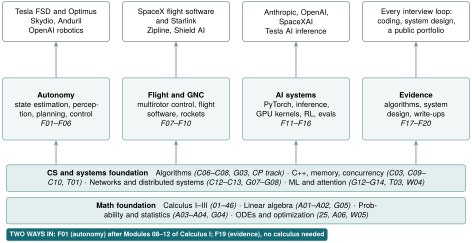
The frontier as a building: two foundations, four pillars, and the roles each pillar holds up. Italic labels name the chapters behind each part. The foundations are all taught in this book; of the pillar chapters, this part teaches F01 and F19 in full, and section D shows where the skills of the others are taught.
The postings keep returning to the same core: modern C++ everywhere, Python for anything ML, Rust as a growing alternative, Linux and real-time behaviour, concurrency, profiling-driven optimization, and determinism and replay testing. On the math side the recurring subjects are linear algebra, probability, optimization, differential equations, estimation, and control. Calculus II and III are necessary but not sufficient; linear algebra and probability should start early.
D. Where every skill lives in this book#
| Skill | Taught in this book | Frontier chapter on the route |
|---|---|---|
| Calculus I–III | Modules 01–46 (Parts II, III, V, VI) | Used throughout; F01 needs Modules 08–12 |
| Linear algebra | A01–A02, G05, W06 | F02 rotations, F04 EKF, F12 transformers |
| Probability and statistics | A03–A04, G04 | F03 Kalman filter, F16 evals |
| ODEs, stability, optimization | 25, A06, W05 | F01 control, F07 multirotor, F10 GNC |
| Algorithms and data structures | C06–C08, G03, the Algorithms Lane (Part XIV) | F17 interview lane |
| C++, memory, concurrency | C03, C09–C10, T01, G06 | F08 flight software, F13 inference engine |
| Networks and distributed systems | C12–C13, G07–G08 | F15 training at scale, F18 system design |
| Machine learning and attention | G12–G14, T03, W04 | F11–F16 |
| GPU computing | T02 | F14 CUDA and Triton kernels |
| Embedded, control, estimation | T04 | F01, F03, F04, F07, F08 |
| Aerospace computing | T05 | F10 GNC and rocket dynamics |
| Computer vision | Not covered in this book | F05 perception |
| Planning | J02 grid pathfinding | F06 planning and learned driving |
The Frontier route. This part teaches two of its chapters in full: F01 (feedback control) and F19 (performance engineering). The rest of the route is a map of what each chapter covers:
- Autonomy: F02 rotations and frames (2D to quaternions); F03 the Kalman filter from scratch; F04 EKF and sensor fusion (IMU, GPS, barometer); F05 camera geometry, CNNs, and bird’s-eye-view perception; F06 planning, imitation learning, and world models.
- Flight: F07 multirotor dynamics and cascaded control; F08 flight-software engineering (uORB, MAVLink, SITL, failsafes, real-time Linux); F09 piloting and Part 107 preparation; F10 rocket and spacecraft GNC (6-DOF simulation, Monte Carlo, the rocket equation).
- AI systems: F11 Python and PyTorch for a C++ engineer; F12 transformers from scratch; F13 LLM inference engineering (prefill and decode, KV cache, batching, quantization); F14 GPU kernels in CUDA and Triton; F15 distributed training and RL infrastructure; F16 evals, agents, and interpretability tooling.
- Evidence: F17 the algorithms interview lane; F18 system design for real-time and ML systems; F19 performance engineering on a parallel machine (bounds, VLIW packing, SIMD, batched tree traversal; taught in this part, with a guide to Anthropic’s public performance take-home); F20 writing and publishing technical evidence.
Three of the book’s tracks carry most of this route, and their route chapters place each piece. The Engineering Lab (EL00, Part XII) covers F02 (EL18), F03 and F04 (EL16 and EL22), F07 (EL19–EL20), F08 (EL23–EL24), and F09 (EL06 and EL26); F01’s PID is the prerequisite for its EL20. The AI Lab (AI00, Part XI) covers F11 and F12 in its Module 2 and begins F15 and F16 in Modules 4 and 6; its Phase 2 then covers F14 (Module 8), F13 (Module 9, which is also flagship Project 1 below), and the rest of F15 and F16 (Modules 10–12). The Algorithms Lane (CP00, Part XIV) leads into F17. F05, F06, F10, F18, and F20 are not taught in this book. The table above points to the foundations the book does teach for each (computer vision is the one skill it leaves out), and for F20, W08 and the chapter that closes Part IX, on turning study into engineering evidence, cover much of the ground.
E. Starting points#
Readers arrive with different parts of what the postings ask for. Find the description nearest yours: each names what you probably bring, the gaps the postings expose, and a first route through this book. Part I’s diagnostics place you more precisely.
A student (in high school, college, or university). You bring recent mathematics and time to practise. The postings expose what courses rarely give: shipped software, measured results, and the systems column (C++, memory, concurrency, Linux). Keep the calculus parts moving with the Algorithms Lane (Part XIV) beside them, take F01 as soon as Modules 08–12 are done, and grow one flagship project for a year rather than starting four.
A software engineer. You bring shipped code, debugging, and production habits, and game-engine, real-time, and networking work is named in postings (the Starlink posting in section B). The usual gaps are estimation and control mathematics (Kalman filters, dynamics), linear algebra and probability, and ML-systems depth (PyTorch, inference internals, CUDA). F19 needs no calculus and gives you a measured result quickly. Then pair the applied mathematics of Part VII (A01–A04) with the AI Lab (Part XI) or the Engineering Lab (Part XII), refreshing calculus from Parts III, V, and VI as each module needs it.
A hardware engineer (mechanical, electrical, or aerospace). You bring physics, dynamics, and test discipline, which GNC and drone postings ask for (section B). The usual gaps are production software (C++ or Rust, Linux, testing, version control), the algorithms that coding screens test, and the Python and ML stack. Start with the computing units of Parts II and IV (C01–C10) and the Algorithms Lane, take F01 to turn control theory you know into tested code, then lead with the Engineering Lab, where your judgment about hardware counts most.
For every background. Some roles gate on a finished degree or on two or more years of documented professional experience (section B), and export-control and clearance rules limit others (the box at the end of section G). The rest weigh evidence, which is what sections F and G are about.
F. Four flagship projects#
Each project produces public evidence (code, measurements, a video, and a write-up) that maps onto specific postings.
If you already have a substantial project of your own, such as a game, a simulator, or an app with real users, keep it as your anchor. Years of shipped work are strong evidence for real-time and systems roles; let the flagship projects add the columns it lacks.
G. Building public evidence#
Public evidence is work a stranger can inspect and rerun: code with tests, a number with the command that produced it, a short video of the system working with the numbers on screen, and a write-up that says what failed as well as what worked. Every flagship project, and every chapter’s portfolio step, is built to produce it. Keep a log as you work (change, measurement, result) and the write-up mostly writes itself. The dated facts below show what organizations have asked for and where such evidence has been read.
- Evidence that fits in three bullets. In May 2026 Elon Musk asked engineers, “even if you have zero prior experience in AI,” to email about three bullet points of evidence of exceptional ability to
ai_eng@spacex.com, adding that making “a very complex thing do useful work” is a major plus. Tesla has run the same process for its AI chip team. Nothing published since May confirms anyone still reads that address, and the division has since been renamed; confirm before sending. Whatever you build, keep its three bullets current: what it does, the number that proves it, and the hardest problem it solved. - Anthropic’s public performance take-home. Anthropic open-sourced its original performance-engineering take-home; F19, section L, describes it as of October 2026. The public repository is a showcase: a solution under 1,487 cycles invites an email, while the live test is a different set of instruction-count puzzles. Either way, a measured, reproducible result on it is public evidence.
- Fellowships and residencies. The Anthropic Fellows program says “you don’t need a PhD, prior ML experience, or published papers,” funds about four months of empirical safety research, and reports that more than 35% of its fellows later joined Anthropic; applications for its January cohort closed on 18 October 2026, and later cohorts were not yet dated. Anthropic’s Claude Corps (June 2026) places people with under two years of full-time experience at nonprofits for a year. MATS takes research fellows in cohorts (its Winter 2027 round closed in September). Google’s Student Researcher program requires current enrollment. The OpenAI Residency does not accept enrolled students.
- Open work that was noticed. Keller Jordan reportedly joined OpenAI without a PhD or papers after his NanoGPT speedrun and a blog post on the Muon optimizer (secondary sources). Short videos of working systems with numbers on screen, open code, and an honest write-up travel far on X. Structured programs that publish under a mentor are the best-documented route: MATS reports that 75% of its alumni now work in alignment, transparency, or security.
- Teaching as evidence. Tutorials, notes, or a course others can use, with labs whose tests anyone can rerun, are public evidence of the rarest kind: claims a stranger can check.
- Competitions and events. The GPU MODE kernel leaderboard is always open; Tesla recruited at its CVPR 2026 booth.
H. How long the route takes#
Each track that carries part of the Frontier route states its own hours. At the paces below, the route looks like this:
| Where | Frontier chapters | Hours, and time at a stated pace |
|---|---|---|
| This part (Part X) | F01 and F19, in full | A few weeks each at one three-hour build block a week; the portfolio steps add more |
| AI Lab (AI00, Part XI) | F11–F16 (Modules 2, 4, and 6, then Phase 2) | Phase 1 (Modules 1–6): 238 hours, about 30 weeks at 8 hours a week. Phase 2: about 600 hours more, about 75 weeks at the same pace |
| Engineering Lab (EL00, Part XII) | F02–F04 and F07–F09 | 29 modules, about 660 hours: about 73 weeks (17 months) at 9 hours a week |
| Algorithms Lane (CP00, Part XIV) | Leads into F17 | The core lane, 153 hours: about 60 weeks at two 75-minute sessions a week |
| Not in this book | F05, F06, F10, F18, F20 | Section D lists what each covers |
Run side by side at those paces, the three tracks ask for nearly 20 hours a week (8 + 9 + 2.5), more than most people sustain beside a course or a job. “Plan your path” in Part I fits every track into one weekly budget, shows what 6, 10, 15, or 20 hours a week buy, and helps you choose which track leads. Use it rather than giving each Frontier chapter months of its own.
Take each chapter when its prerequisites are done; they are listed at the top of every chapter. F01 needs Modules 08–12 of Calculus I, and F19 needs no calculus. Re-plan monthly against your error log (LM explains how to keep one) and your project milestones.
A first step. If you are starting this part now, read section B’s sources for the field you want. Then begin F01’s lab if you have finished Module 12, or F19’s recon step (section L), which needs no calculus.
Sources for this chapter (checked 24 September 2026)#
Tesla: www.teslarati.com/tesla-vp-explains-why-end-to-end-ai-future-self-driving/; www.humanoidsdaily.com/feed/tesla-ai-chief-details-unified-world-simulator-for-fsd-and-optimus; www.marklines.com/en/report/vsi027_202407; electrek.co/2025/10/07/tesla-fsd-v14-release-notes/; electrek.co/2026/04/15/tesla-ai5-chip-taped-out-musk-ai6-dojo3/; tesla.veteran-hiring.com/job-detail/software-engineer-generalist-ai-inference-221961; tesla.veteran-hiring.com/job-detail/software-engineer-foundations-tesla-bot-222617; tesla.com/en_IE/autopilotAI; www.tesla.com/event/tesla-x-cvpr-2026.
SpaceX: freehire.me/jobs/software-engineer-c-starlink-spacex-2je3jdbb; job-boards.greenhouse.io/spacex/jobs/8601802002; job-boards.greenhouse.io/spacex/jobs/8559003002; job-boards.greenhouse.io/spacex/jobs/8395053002; x.ai/news/xai-joins-spacex; www.entrepreneur.com/business-news/elon-musk-is-now-reading-all-spacex-job-applications.
Drones: px4.io/px4-autopilot-release-v1-17-what-you-need-to-know/; docs.px4.io/main/en/concept/architecture; discuss.ardupilot.org/t/copter-4-7-0-released/144650; ardupilot.org/dev/docs/gsoc-ideas-list.html; www.skydio.com/jobs/a48fe41b-030b-4f11-bf25-df7446151854; job-boards.greenhouse.io/andurilindustries/jobs/4673932007; www.faa.gov/uas/commercial_operators/become_a_drone_pilot; extension.umd.edu/resource/guide-faa-part-107-certification-and-drone-registration-fs-2026-0803; www.faa.gov/uas/recreational_flyers.
AI labs: www.anthropic.com/careers; job-boards.greenhouse.io/anthropic/jobs/5418323008; job-boards.greenhouse.io/anthropic/jobs/4926227008; github.com/anthropics/original_performance_takehome; alignment.anthropic.com/2025/anthropic-fellows-program-2026/; www.anthropic.com/candidate-ai-guidance; jobs.ashbyhq.com/openai/85fceac9-fb8a-4d71-a524-a8e5f1e9b01b; jobs.ashbyhq.com/openai/60573bf4-13ad-4933-aba7-729f428e9f69; openai.com/residency/; eu.36kr.com/en/p/3698501921320835; github.com/gpu-mode/kernelbot.
Checked 17 October 2026. Tesla: www.notateslaapp.com/news/4035/tesla-confirms-fsd-v15-will-run-on-hw4-shares-release-date; notateslaapp.com/news/4481/summary-of-teslas-2026-q2-earnings-call-cybercab-fsd-ai4-and-more; en.wikipedia.org/wiki/Tesla_Cybercab; en.wikipedia.org/wiki/Optimus_(robot). SpaceX: www.iposcoop.com/?p=38639; en.wikipedia.org/wiki/XAI_(company); interestingengineering.com/ai-robotics/spacex-nvidia-starmind-ai1-compute-payload; gpb.org/news/2026/09/28/spacexs-starship-launches-on-first-orbital-mission-texas; interestingengineering.com/space/spacex-starship-flight-13; job-boards.greenhouse.io/spacex/jobs/8621757002. Drones: docs.px4.io/main/en/releases/1.18.html; firmware.ardupilot.org/Copter/; boards.greenhouse.io/andurilindustries/jobs/5239083007; www.reginfo.gov/public/do/XMLViewFileAction?f=EO_RULES_UNDER_REVIEW.xml; www.oklegislature.gov/cf_pdf/2025-26%20ENR/SB/SB1441%20ENR.PDF. AI labs and models: www.anthropic.com/news/claude-corps; www.matsprogram.org/; deepmind.google/about/student-researcher-program/; www.kimi.ai/blog/kimi-k3; www.lmsys.org/blog/2026-08-26-qwen-flash-next/; huggingface.co/blog/nvidia/nemotron-ioi-and-imo-2026; openai.com/index/why-we-no-longer-evaluate-swe-bench-verified/; arxiv.org/abs/2606.16062.