Module 39: Double integrals, changing order, and polar area elements
On this page
A. Prerequisites and observable goals#
Single-variable integration, planar regions, polar coordinates, and density.
Describe a region with correct variable bounds, evaluate iterated integrals, reverse order when useful, and include the polar area factor.
B. The central idea: accumulate over an input region#
A double integral sums height times tiny area over a planar region. For nonnegative , it is the volume under a graph; for density, it is mass; for a general signed function, it is signed accumulation. The area element belongs to the input plane. It is not the curved surface area of the graph, which is a later topic.
C. Iterated integrals and coordinates#
For a continuous function on a rectangle, Fubini’s theorem permits either iterated order. On a vertically simple region ,
The inner variable changes first; the other is held constant. Horizontally simple regions use bounds depending on . A region may need splitting when changing order. For more general improper integrals, absolute integrability or other applicable theorems must be checked; swapping an order across singularities is not universally valid. [O3Double]
In polar coordinates, , and
Thus on a suitable once-covered region. The factor changes area, not the function value. A nonnegative density gives mass , with centroid coordinates , . The average of over positive finite area is .
D. Why the polar factor is necessary#
A small polar cell has radial thickness and arc-length width approximately , so its area is approximately . Equal changes in angle sweep larger cells at larger radii. Ignoring would weight the disk’s center and edge incorrectly. The Jacobian module derives the factor algebraically.
Changing integration order does not mean mechanically swapping differentials and leaving the bounds unchanged. It means describing the same set of input points by a different family of slices. The region is the invariant object; the inequalities must be rebuilt from its geometry.
E. A region-first workflow#
Draw or describe the region with inequalities. Decide which slice direction makes the integrand and bounds easier. Integrate the inner variable while treating the outer one as constant, then integrate the resulting expression over its full outer interval. For order reversal, project the region onto the new outer axis and solve its boundary equations for the new inner variable. For a circular or radial region, test polar coordinates and explicitly include the area factor before integrating.
F. Worked examples#
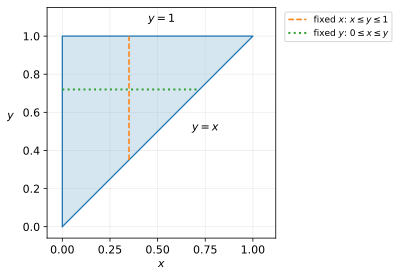
Reverse order to make an integral elementary. Consider . The region is . Reversing gives
The original inner antiderivative is not elementary, but integration across horizontal widths introduces the factor needed for substitution.
A disk integral. Over , the integrand becomes . Therefore . The combines the transformed height with the area factor .
G. Independent practice#
F foundation C standard course work T transfer S optional stretch L runnable lab or project. Attempt the complete set before opening its solutions.
Evaluate .
Evaluate where .
Reverse the order and evaluate . Explain why the new order makes substitution useful.
Evaluate using polar coordinates.
Find the area of the annular sector , , using a double integral.
On the triangle , density is . Find mass and both centroid coordinates.
Find the average value of on .
The region is described vertically by , . Give an iterated integral for its area in each order and explain why one description needs a split.
Optional small hints
For M39.02, a vertical slice has . For M39.06, moments require multiplying by the coordinate as well as density. For M39.08, the roof changes formula at .
H. Complete solutions: Module 39#
Compare the first step where your work differs. A corrected answer is not yet an independent success.
M39.01Show solution
Hold the outer variable constant in the inner integral
Integrating in gives . Then . The rectangular area is ; an average height of is consistent with the affine integrand’s center value.
Back to M39.01M39.02Show solution
Translate a triangular inequality into bounds
Use and . Then
The integrand is nonnegative, so the final sign fits the geometry.
Back to M39.02M39.03Show solution
Use slice width to create a substitution factor
The original inequalities are and . Equivalently and . At fixed , the integrand is constant in , so
Now gives , with bounds and . Hence . The horizontal slice contributes an additional factor , exactly the factor that makes the derivative of available. Merely changing the differentials without changing the bounds would not describe this region.
Back to M39.03M39.04Show solution
Transform both the integrand and area element
The unit disk corresponds to , . Thus . Omitting the area factor would produce a different and unjustified radial weighting.
Back to M39.04M39.05Show solution
Area is an integral of one with the correct area element
The area is . Independently, this is one-sixth of an annulus of area , giving the same value.
Back to M39.05M39.06Show solution
Density-weighted area and moments
Using , , . The numerator for is . The numerator for is . Therefore and in consistent mass units. Relative to the uniform triangle’s centroid, mass shifts toward larger .
Back to M39.06M39.07Show solution
Divide the accumulation by input area
The double integral is . The rectangle’s area is , so the average is . The average of a nonconstant quadratic is not necessarily its value at the rectangle’s center.
Back to M39.07M39.08Show solution
A piecewise roof becomes one horizontal description
Vertical slices require . Horizontal slices use and , so . The split arises because the upper vertical boundary changes from one line to the other at , not because Fubini’s theorem changes the region.
Back to M39.08I. Retention and readiness#
Retrieve M17.05 and M32.08. Explain why the inner bounds may depend on the outer variable but not on the variable currently being integrated after its endpoint evaluation. Advance when you can draw the region implied by someone else’s bounds and detect an omitted polar factor.