Module 43: Conservative fields and Green’s theorem
On this page
- A. Prerequisites and observable goals
- B. The central idea: some line integrals depend only on endpoints
- C. Potential, domain, and boundary theorems
- D. Why local contributions cancel inside a region
- E. Choose between a potential and a region integral
- F. Worked examples
- Computing bridge: Potential energy and the domain of the model
- G. Independent practice
- H. Complete solutions: Module 43
- I. Retention and readiness
A. Prerequisites and observable goals#
Line integrals, gradients, mixed partials, and double integrals.
Find a potential when it exists, use endpoint evaluation for conservative work, and apply Green’s circulation or flux form with domain and orientation conditions.
B. The central idea: some line integrals depend only on endpoints#
A conservative vector field is a gradient, , for a scalar potential on its domain. Along a path, the chain rule makes a derivative of , so the work becomes a difference of potential values. Other fields retain path information; Green’s theorem can turn a closed planar path integral into an area integral describing interior rotation or outflow.
C. Potential, domain, and boundary theorems#
For a differentiable potential and a piecewise smooth path from to ,
On an open connected domain with sufficient smoothness, being conservative is equivalent to path independence and to zero integral around every closed path. For a planar field , a necessary condition is . On a simply connected open domain it is also sufficient. A domain with a hole requires additional care: equality of cross partials alone is not enough. [O3Conservative]
For a positively oriented (counterclockwise) piecewise smooth simple closed boundary enclosing a suitable planar region , and on an open neighborhood of , Green’s theorem states
Its outward flux form is
For a region with holes, orient the outer boundary counterclockwise and each inner boundary clockwise, keeping the region on the left as you traverse. The theorem applies when the field is smooth on the region and a neighborhood, not necessarily inside excluded holes. [O3Green]
D. Why local contributions cancel inside a region#
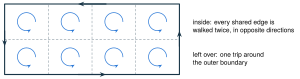
Partition a region into small cells. Circulation around adjacent cells cancels on shared edges because those edges are traversed in opposite directions. Only the outer boundary remains. The small-cell circulation per area approaches . In flux form, outward flow across one cell’s shared side is inward flow to its neighbor; again the internal contributions cancel. This cancellation explains the orientation convention and foreshadows the three-dimensional boundary theorems.
For a potential, the ordinary chain rule gives . Integrating proves the endpoint theorem directly. A zero derivative test on a punctured domain cannot create a single-valued potential if a closed loop has nonzero work around the hole.
E. Choose between a potential and a region integral#
For any path, first check whether finding a potential is easy. Integrate one component and include an unknown function of the other coordinates, then differentiate to match the remaining components. For a closed planar path, consider Green when the enclosed region is simpler than the boundary parameterization. Verify the field has no singularities on the required region. For holes, include every boundary component with its correct direction rather than filling a forbidden hole silently.
F. Worked examples#
Building a potential. For , integrate in to get . Matching gives . Thus work from to is , independent of path within .
A hole counterexample. On , the field satisfies but has circulation around the counterclockwise unit circle. It is not globally conservative there. Green cannot be applied to the full enclosed disk because the field is undefined at its center.
Area from a boundary. Choosing makes , so for positive orientation, . The symmetric form is . Reversing orientation changes the signed result, not the geometric area.
Computing bridge: Potential energy and the domain of the model#
A force derived from a potential can give path-independent work on the stated domain. In T05, the central force excludes the origin, and the simulation must reject a singular state rather than divide by zero. Checking a derivative identity at ordinary points does not remove a hole in a field’s domain. The practical connection is to record model restrictions alongside invariants such as energy, and not use a conservation argument where its assumptions fail.
G. Independent practice#
F foundation C standard course work T transfer S optional stretch L runnable lab or project. Attempt the complete set before opening its solutions.
Find a potential for on .
Use a potential to compute the work of the field in M43.01 from to along any piecewise smooth path.
Determine whether is conservative on and find a potential if so.
Determine whether is conservative on . Explain why equality at some individual points is insufficient.
Use Green’s theorem to find circulation of counterclockwise around .
Find the outward flux of across the boundary of using Green’s flux form.
For the punctured-plane field in the worked example, find circulation on the positively oriented boundary of the annulus . Explain why Green applies to the annulus but not its filled-in outer disk.
Find around the counterclockwise triangle with vertices . Check the result by direct integration on its edges.
Optional small hints
For M43.01, the arbitrary term after integrating in is a function of . For M43.07, the inner circle is clockwise. For M43.08, Green’s integrand is .
H. Complete solutions: Module 43#
Compare the first step where your work differs. A corrected answer is not yet an independent success.
M43.01Show solution
Match the component not used in the first integration
Integrating gives . Then must equal , so and . A potential is , verified by taking its gradient.
Back to M43.01M43.02Show solution
Endpoint evaluation replaces the entire path calculation
The potential from M43.01 has and . Therefore work is . The field is a smooth gradient on all of , so the endpoint theorem applies to any of the stated paths, not only a straight line.
Back to M43.02M43.03Show solution
Check a sufficient condition and construct the potential
Here and throughout the simply connected domain , suggesting a conservative field. Integrate to get . Matching gives . Thus directly establishes conservativeness.
Back to M43.03M43.04Show solution
A local mismatch rules out a global gradient
The cross partials are and , unequal wherever . Hence the smooth field cannot be conservative on . Equality along the line does not establish the needed identity on an open domain. A potential would have matching mixed partials throughout its smooth domain.
Back to M43.04M43.05Show solution
Constant planar curl reduces the calculation to area
The field is smooth everywhere and the ellipse has counterclockwise orientation. Its Green integrand is . The ellipse area is , so circulation is . Orientation reversal would negate this result.
Back to M43.05M43.06Show solution
Outward flux is an area integral of planar divergence
Here . The rectangle area is , so outward flux is . The boundary is taken counterclockwise when using ; this convention makes the associated normal outward.
Back to M43.06M43.07Show solution
The inner boundary cancels the circulation around the hole
On a radius- circle traversed counterclockwise, substitution gives work , independent of . The annulus’s outer circle therefore contributes and its clockwise inner circle contributes , for total . The cross-partial difference is zero throughout a neighborhood of the closed annulus, so Green applies and agrees. Filling the hole would include the singular origin, violating the theorem’s smoothness condition.
Back to M43.07M43.08Show solution
An area calculation checked by the boundary itself
Green gives
For a direct check, the bottom edge has and contributes zero. The sloping edge from to is , , so its contribution is . The vertical return edge has and contributes zero. Both methods agree with the specified orientation.
Back to M43.08I. Retention and readiness#
Retrieve M36.02 and M42.05. Explain why curl-free behavior on a domain with a hole is not by itself a global potential. Advance when you can choose between potential evaluation, direct parameterization, and Green, while stating which region must be free of singularities.