Module 41: Jacobians and general changes of variables
On this page
- A. Prerequisites and observable goals
- B. The central idea: coordinate changes distort small areas
- C. The change-of-variables theorem
- D. Why a determinant measures local area
- E. A complete substitution checklist
- F. Worked examples
- Computing bridge: Changing a probability representation
- G. Independent practice
- H. Complete solutions: Module 41
- I. Retention and readiness
A. Prerequisites and observable goals#
Double and triple integrals, partial derivatives, vector area, and coordinate geometry.
Compute a Jacobian, transform both a region and an integrand, use absolute volume scaling, and recognize when a coordinate map double-counts a region.
B. The central idea: coordinate changes distort small areas#
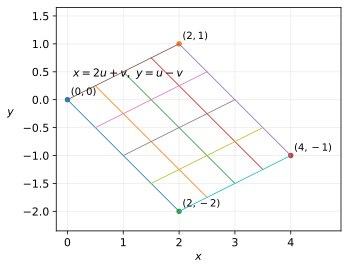
A substitution changes not only the names inside the function but also the size of the tiny pieces being added. A map transforms a small input rectangle into an approximately parallelogram-shaped output cell. The Jacobian determinant measures its signed area scale; its absolute value measures geometric area scale. This generalizes the extra factors seen in one-dimensional substitution and polar coordinates.
C. The change-of-variables theorem#
For a sufficiently smooth one-to-one coordinate map between suitable regions, with nonzero Jacobian in the interiors and appropriate integrability,
where
Standard coordinate maps may have exceptional boundary points or seams, such as the polar origin; these can be handled by splitting or limiting arguments when they do not alter the integral. In three dimensions the corresponding factor is the absolute determinant of the derivative matrix. [O3Jac]
The determinant of the forward map is the reciprocal of that of the inverse map at corresponding regular points. Do not accidentally use as though it were . Absolute values belong to area and volume integrals. Oriented line and surface integrals later carry signs differently.
D. Why a determinant measures local area#
The images of tiny coordinate sides are approximately and . Their parallelogram area is the absolute planar determinant of those vectors, giving . In three dimensions, the scalar triple product of the three derivative columns supplies the volume scale.
For polar coordinates, the derivative matrix is
whose determinant is . This derives the polar factor rather than adding it from memory. Cylindrical coordinates retain this factor because the vertical coordinate is unchanged.
E. A complete substitution checklist#
Choose new coordinates that straighten the region or simplify the integrand. Solve for the original coordinates when needed. Transform every boundary and specify a one-to-one branch. Compute the forward Jacobian and its absolute value on that branch. Substitute the function and the area or volume factor together, evaluate, and check the resulting geometry. For a linear map, compare with a parallelogram area or transformed vertices; for nonlinear maps, check a few boundary points without mistaking those checks for a proof of global injectivity.
F. Worked examples#
A rotated and stretched rectangle. Let , , with , . Inverting gives , , whose determinant is . The mapped region has area . The negative determinant reverses orientation, not area. Also .
An ellipse becomes a disk. For , the ellipse becomes . The constant area scale is . Further changing to polar coordinates produces the combined factor , not just and not just .
Computing bridge: Changing a probability representation#
A density is probability per unit of coordinate volume. Under a one-to-one differentiable transformation, preserving probability requires the appropriate absolute Jacobian, just as preserving mass does. Forgetting it changes the amount assigned to a region, not merely its notation. A03 defines densities and conditional probabilities; this module supplies the geometric reason that a transformed density must account for stretching. Coordinate seams and multiple coverage still need separate treatment.
G. Independent practice#
F foundation C standard course work T transfer S optional stretch L runnable lab or project. Attempt the complete set before opening its solutions.
For on , , find the Jacobian and image area. Evaluate .
Use a change of variables to find the area of .
Evaluate over the ellipse in M41.02.
The map sends , to a region . Describe , find its area, and evaluate .
In the first quadrant, is bounded by and . Evaluate using .
Compute the cylindrical-coordinate Jacobian from to directly as a determinant.
Why does applying over , double-count the unit square? Show this with an area integral and repair the parameter domain.
Prove by squaring finite symmetric integrals, comparing a square with inscribed and circumscribed disks, and using polar coordinates. Avoid assuming an elementary antiderivative.
Optional small hints
For M41.05, the positive inverse is . For M41.07, absolute values prevent cancellation but do not prevent duplicate coverage. For M41.08, a square lies between disks of radii and .
H. Complete solutions: Module 41#
Compare the first step where your work differs. A corrected answer is not yet an independent success.
M41.01Show solution
A signed determinant becomes positive area scale
The determinant is . The input rectangle has area , so the image has area . Since ,
The affine map is one-to-one because its determinant is nonzero.
Back to M41.01M41.02Show solution
Stretch the unit disk by two axis factors
Set with , . The area factor is . Thus . This agrees with for semiaxes .
Back to M41.02M41.03Show solution
Transform the integrand as well as the region
Under the same map, . Hence
The factor is still needed even though the ellipse has already become a unit disk in the bounds.
Back to M41.03M41.04Show solution
A nonlinear map with a simple positive inverse
Since and , the image is , . The Jacobian is , positive throughout. Area is . For the other integral, , so . Horizontal slice width provides the same area and moment checks.
Back to M41.04M41.05Show solution
Invert the coordinates on the stated first-quadrant branch
The inverse formulas are and , with , . Differentiating gives determinant . The integrand becomes , so it cancels the denominator in the area factor:
The first-quadrant assumption makes the inverse single-valued and avoids confusing opposite-sign branches.
Back to M41.05M41.06Show solution
A block determinant retains the planar polar factor
The derivative matrix is
Expanding along the last row gives . On , the absolute value is the same. The degeneracy at the axis is handled by the usual coordinate seam/limit treatment, not by claiming the map is regular there.
Back to M41.06M41.07Show solution
Multiplicity is a separate issue from determinant sign
The Jacobian is , so an absolute-area calculation over the full proposed rectangle gives . Yet the image is the unit square of area one: almost every image point has two preimages . Restricting to makes the map one-to-one off its boundary and gives . Taking an absolute determinant does not repair double coverage by itself.
Back to M41.07M41.08Show solution
Bounded-domain calculations justify the infinite result
Let . By finite-domain Fubini, is the integral of over . Positivity and disk inclusion give
Polar integration evaluates the disk of radius as . Thus . Both bounds tend to , and , so . Since the integrand is even and nonnegative, each half-line integral is half this finite limit; the ordinary improper integral therefore exists and equals . The argument did not presume an unjustified exchange over an unbounded domain.
Back to M41.08I. Retention and readiness#
Retrieve M40.04 and M39.05. Explain why a Jacobian has a direction (forward or inverse) and a sign, and why an ordinary area integral uses its magnitude. Advance when you can verify a coordinate map’s region coverage as well as its determinant.