G06: Scalable architecture and measured performance
On this page
- Prerequisites and observable goals
- The central question: which resource bounds this workload?
- Three related bounds
- Why loop order changes locality
- Parallelism without ownership confusion
- A benchmark is an experiment with an acceptance test
- Production judgment beyond a fast kernel
- Independent practice
- Smallest useful hints
- Complete solutions: G06
- Benchmark driver and exact timing boundary
- Readiness and continuation
Prerequisites and observable goals#
foundation C03, C09–C10, C14, T01–T02; matrix multiplication and G04’s paired-measurement reasoning.
Build a cost model, improve memory reuse without changing the specification, and defend a measured result with workload and correctness evidence.
The central question: which resource bounds this workload?#
A program uses instruction throughput, memory bandwidth, cache capacity, synchronization, allocation, and I/O. Improving a nonlimiting resource may not improve latency. Start with the specified output and input distribution, then count data movement and arithmetic. Treat a cost model as a prediction to test, not as a replacement for measurement.
For dense with of shape and of shape , the conventional algorithm computes
There are multiplications and additions when each dot product is accumulated from its first product, often summarized as approximately floating operations. A fused multiply-add may count as two arithmetic operations in a performance convention while using one instruction; state the convention. The arithmetic expression does not tell you how often a cache line is transferred.
Three related bounds#
For fixed total work with serial fraction and perfectly scaling remainder, ideal speedup with workers is
This is Amdahl’s model. It ignores overhead, contention, and workload changes. For a computation DAG, total work and longest dependency-chain work (span) give . Even unlimited processors cannot execute dependent operations simultaneously.
For a chosen memory level, define arithmetic intensity as floating operations divided by bytes moved through that level. If compute throughput is bounded by and bandwidth by , then a simple roofline-style bound is
The units check: . This is an upper envelope, not a promise that a kernel achieves it. Cache misses, dependencies, issue limits, and instruction mix can reduce achieved throughput further. Choose the memory level explicitly: DRAM traffic and L1 traffic are different quantities.
Why loop order changes locality#
Assume row-major contiguous arrays. In the order, consecutive reads from are contiguous but reads from stride by an entire row. In order, hold one value while sweeping contiguous entries of and . The formulas describe the same real-number result, but floating-point rounding and vectorization choices must still be checked.
Blocking processes tiles so parts of , , and can be reused before eviction. A rough working-set estimate for three tiles of doubles is bytes. For , that is 13,824 bytes, ignoring metadata, associativity, prefetching, other active data, and exact loop structure. A cache of that nominal size does not guarantee the tiles fit effectively. Benchmark multiple justified candidates; do not select the tile solely because one capacity division looks neat.
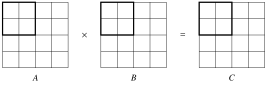
This is a schematic tile picture, not a diagram of actual cache contents. The selected block accumulates contributions from successive matching inner-dimension blocks of and . Edge blocks can be smaller; treating every dimension as a multiple of the tile size is a correctness bug.
Parallelism without ownership confusion#
For parallel matrix output, assign disjoint output tiles to workers and let each worker accumulate the complete inner sum for its tile. Sharing a single output element across workers requires a reduction or synchronization; an unsynchronized += is not made safe by using doubles. Partitioning by the inner dimension produces partial matrices that need a defined merge. Partitioning by output rows simplifies ownership but may interact differently with scheduling and locality.
False sharing occurs when workers update distinct data that share a coherence unit, usually a cache line. The objects can be logically independent yet still cause hardware ownership traffic. Padding is not an automatic fix: it consumes memory and can harm locality. Confirm with measurements and the actual hardware’s line size and access pattern before asserting a diagnosis.
SIMD executes an operation across lanes; threads schedule independent instruction streams; GPU kernels expose another parallel execution and memory model. These are related tools, not interchangeable meanings of “parallel.” A small host-to-device transfer plus launch overhead can exceed the time saved by a GPU kernel. No GPU execution is claimed by this CPU lab.
A benchmark is an experiment with an acceptance test#
The companion benchmarks the two C++ implementations at , tile 24, with a seeded input, a warm-up pair, and seven measured pairs whose method order alternates. Both functions include input validation and output allocation in the timed region. Correctness comparison happens after each timed call. The reference result is computed before the measurement loop; a checksum is consumed so the output is not simply ignored.
This is one local environment and workload, not a claim about a consumer GPU such as an RTX 5090, about Apple hardware, or about all matrices. Do not divide one printed timing by another and call that a universal acceleration factor. Examine paired ratios/differences and spread, record build settings, and repeat on your target. The CSV is included with the actual environment record. Unchanged operation count does not contradict a measured improvement from reduced memory traffic.
Production judgment beyond a fast kernel#
A production library must also consider overflow in sizes, invalid dimensions, allocation failure, thread lifecycle, ABI stability, numerical tolerances, cancellation policy, portability, and performance across many shapes. The lab validates small bounded dimensions so shape products remain representable, but it is not a replacement for a tuned BLAS library. A correct educational implementation can be useful precisely because it reveals the mechanics before a library is introduced.
Independent practice#
F foundation C standard course work T transfer S optional stretch L runnable lab or project. Attempt the complete set before opening its solutions.
For serial fraction .15, compute ideal eight-worker speedup and the unlimited-worker ceiling. Explain one omitted overhead.
A kernel has intensity .25 floating operations/byte, a 100 GB/s bandwidth ceiling, and a 1 TFLOP/s compute ceiling, using decimal units. Find the roofline bound and name the limiting resource in this model.
A DAG has work 120 ms and span 30 ms on the reference single-worker cost model. Give lower bounds for two and eight workers. Explain why increasing workers beyond four cannot beat the span bound.
For three square tiles of doubles, estimate tile storage at sides 24 and 32. Explain why a nominal 32 KiB cache does not alone prove either tile size optimal.
A parallel matrix implementation assigns workers distinct ranges but lets all perform C[i*n+j] += .... Diagnose the ownership error and give two correct alternative designs with their tradeoffs.
Implement the blocked matrix function in cpp/starters/matrix.hpp; keep the provided specification and bounds. Test odd sizes, tile sizes larger than dimensions, identity matrices, invalid shapes, and finite input handling. Run the supplied benchmark only after correctness checks, then report environment, workload, repetitions, timing boundary, and limitations. No hardware-specific speed target is an acceptance criterion.
Smallest useful hints#
For .02, convert all rate prefixes before comparing. For .05, identifying a unique writer for each output is often easier than trying to lock every addition. For .06, cap each block end with the actual dimension.
Complete solutions: G06#
Compare the first step where your work differs. A corrected answer is not yet an independent success.
G06.01Show solution
An ideal ceiling
The modeled new time is , so speedup is . The infinite-worker ceiling is . Thread scheduling, synchronization, and memory contention are omitted. A larger problem size may change the serial fraction, so this fixed-workload calculation should not be silently extrapolated to weak scaling.
Back to G06.01G06.02Show solution
Match the units
Bandwidth times intensity is operations/s, or 25 GFLOP/s. The compute ceiling is 1,000 GFLOP/s. The smaller is 25, making this workload bandwidth-bound in the simple model. Increasing theoretical compute throughput alone does not raise that minimum. Achieved throughput may be lower for other reasons.
Back to G06.02G06.03Show solution
Dependency work does not divide freely
For two workers, ms. For eight, ms. At four workers the work bound equals span; beyond four, span remains 30. These are lower bounds, not an achieved schedule; communication and idle periods can make actual time greater.
Back to G06.03G06.04Show solution
A capacity estimate is only a starting point
At 24, bytes. At 32, the estimate is bytes. A 32 KiB cache is 32,768 bytes, but conflict misses, cache associativity, other active data, vectorization, and the chosen loop order affect usable capacity and speed. The capacity comparison motivates experiments; it does not settle them.
Back to G06.04G06.05Show solution
Partition the output or reduce private partials
Different ranges contribute to the same output element, so simultaneous non-atomic updates can lose values and in C++ create data races. One repair assigns each worker disjoint output rows/tiles and the full range: no merge is needed but balancing depends on shapes. Another gives workers private partial output matrices and merges them after joining: ownership is clear but memory and reduction work increase, and floating-point order changes. Locks or atomic additions are possible but often introduce high contention and require their own numeric/performance analysis.
Back to G06.05G06.06Show solution
Complete matrix reference
The complete specification checks and both implementations follow. The tests compare 108 dimension/tile combinations, test identity, and reject invalid cases. The benchmark and its complete buildable driver are in the archive; its timing boundary is described above rather than hidden behind a favorable result.
#pragma once
#include <algorithm>
#include <cmath>
#include <cstddef>
#include <stdexcept>
#include <vector>
namespace graduate {
inline void validate(const std::vector<double>& a,
                     const std::vector<double>& b,
                     std::size_t m, std::size_t k, std::size_t n) {
    if (m==0 || k==0 || n==0 || m>512 || k>512 || n>512)
        throw std::invalid_argument("dimensions must be in 1..512");
    if (a.size()!=m*k || b.size()!=k*n)
        throw std::invalid_argument("shape mismatch");
    for (double x:a) if (!std::isfinite(x))
        throw std::invalid_argument("nonfinite A");
    for (double x:b) if (!std::isfinite(x))
        throw std::invalid_argument("nonfinite B");
}
inline void check_result(const std::vector<double>& c) {
    for (double x:c) if (!std::isfinite(x))
        throw std::overflow_error("nonfinite result");
}
inline std::vector<double> naive(const std::vector<double>& a,
                                 const std::vector<double>& b,
                                 std::size_t m,std::size_t k,std::size_t n) {
    validate(a,b,m,k,n);
    std::vector<double> c(m*n,0.);
    for (std::size_t i=0;i<m;++i)
        for (std::size_t j=0;j<n;++j)
            for (std::size_t p=0;p<k;++p)
                c[i*n+j]+=a[i*k+p]*b[p*n+j];
    check_result(c);
    return c;
}
inline std::vector<double> blocked(const std::vector<double>& a,
                                   const std::vector<double>& b,
                                   std::size_t m,std::size_t k,std::size_t n,
                                   std::size_t tile=24) {
    validate(a,b,m,k,n);
    if (tile==0 || tile>1024)
        throw std::invalid_argument("tile must be in 1..1024");
    std::vector<double> c(m*n,0.);
    for (std::size_t ii=0;ii<m;ii+=tile)
        for (std::size_t pp=0;pp<k;pp+=tile)
            for (std::size_t jj=0;jj<n;jj+=tile)
                for (std::size_t i=ii;i<std::min(ii+tile,m);++i)
                    for (std::size_t p=pp;p<std::min(pp+tile,k);++p) {
                        const double value=a[i*k+p];
                        for (std::size_t j=jj;j<std::min(jj+tile,n);++j)
                            c[i*n+j]+=value*b[p*n+j];
                    }
    check_result(c);
    return c;
}
} // namespace graduateBenchmark driver and exact timing boundary#
#include <matrix.hpp>
#include <chrono>
#include <iomanip>
#include <iostream>
#include <random>
int main() {
    constexpr std::size_t n=192,tile=24;
    std::mt19937 rng(21);
    std::uniform_real_distribution<double> sample(-1.,1.);
    std::vector<double> a(n*n),b(n*n);
    for(auto& x:a) x=sample(rng);
    for(auto& x:b) x=sample(rng);
    const auto reference=graduate::naive(a,b,n,n,n);
    auto run=[&](bool blocked) {
        const auto start=std::chrono::steady_clock::now();
        const auto c=blocked ? graduate::blocked(a,b,n,n,n,tile)
                             : graduate::naive(a,b,n,n,n);
        const auto end=std::chrono::steady_clock::now();
        double checksum=0.;
        for(std::size_t i=0;i<c.size();++i) {
            if(std::abs(c[i]-reference[i])>1e-10*(1+std::abs(reference[i])))
                throw std::runtime_error("result mismatch");
            checksum+=c[i];
        }
        return std::pair{std::chrono::duration<double,std::milli>(end-start).count(),checksum};
    };
    (void)run(false); (void)run(true);
    std::cout<<"pair,first,naive_ms,blocked_ms,checksum\n"<<std::setprecision(12);
    for(int i=0;i<7;++i) {
        std::pair<double,double> old,newer;
        if(i%2==0) {old=run(false);newer=run(true);}
        else {newer=run(true);old=run(false);}
        std::cout<<i<<','<<(i%2==0?"naive":"blocked")<<','<<old.first<<','
                 <<newer.first<<','<<newer.second<<'\n';
    }
}
Readiness and continuation#
Advance when you can predict which loop strided access harms, explain the output ownership of a parallel version, and defend why a benchmark compares equivalent tasks. Further work includes hardware counters, vectorization reports, NUMA, GPU kernels, asynchronous pipelines, and target-specific libraries. The current compiler documentation was consulted for warnings/sanitizer controls, but sanitizer success is not proof of race freedom or all memory safety. [G-GCC]