Module 06: Limits: nearby behavior, not point substitution
On this page
- A. Prerequisites and observable goals
- B. The central idea: separate “near” from “at”
- C. Limit laws and forms that require work
- D. Why canceling near a hole is legitimate
- E. Choose the method before calculating
- F. Worked examples
- G. Independent practice
- H. Complete solutions: Module 06
- I. Retention and readiness
A. Prerequisites and observable goals#
Difference quotients, factorization, radicals, and unit-circle trigonometry.
Compute limits by appropriate methods, distinguish one-sided behavior, interpret tables and graphs cautiously, and identify infinite behavior and asymptotes.
B. The central idea: separate “near” from “at”#
The notation describes the output values for inputs arbitrarily close to , excluding itself. It does not assert , nor even that exists. A function can have a hole, a reassigned value, or no definition at the approached point while nearby values approach a well-defined number.
A left-hand limit uses inputs ; a right-hand limit uses inputs . A two-sided finite limit exists exactly when the two one-sided limits exist and equal the same finite number. A table can suggest an approach, and a graph can communicate the pattern, but neither a finite table nor a coarse screen proves the behavior for all sufficiently close inputs. Precise definitions and limit laws: [O1L].
C. Limit laws and forms that require work#
If and as , then sums, products, and constant multiples have the expected limits. The quotient limit is only when . Polynomial limits may be found by substitution, and rational functions may be evaluated by substitution wherever their denominator is nonzero.
The radian limits and are basic trigonometric limits. The first can be established by comparing sector and triangle areas, giving for small positive , then using symmetry for negative . The squeeze theorem says that if near and both outside functions tend to , then also tends to .
The statement describes unbounded growth, not convergence to a real number. A vertical asymptote occurs when at least one one-sided function value tends to or . A horizontal asymptote describes a finite limit as or . A graph may cross a horizontal asymptote.
D. Why canceling near a hole is legitimate#
For , . Limits ignore the value at the approached input, so both expressions have the same limit as , namely . This is not cancellation at zero: every nearby input considered in the quotient has . The limit is then taken for the equivalent nearby expression.
At infinity, divide a rational function’s numerator and denominator by the highest relevant power of . For example,
For radicals, matters: tends to at but at .
E. Choose the method before calculating#
Try substitution where the usual continuity rules apply. If it produces , inspect for factors, a conjugate, or a standard trigonometric form. If the denominator approaches zero but the numerator does not, examine signs on each side. For absolute values or piecewise formulas, split into sides. At infinity, compare growth or divide by powers. If an oscillatory factor is bounded and multiplied by something approaching zero, try squeezing. Do not use L’Hôpital’s rule before its hypotheses and derivative machinery have been taught in Module 15.
F. Worked examples#
A radical. For ,
The conjugate converts the numerator to , which is a cancellable nonzero factor near .
A trigonometric rescaling. Write
As , the second factor tends to , so the limit is . The variable inside sine must match the denominator of the standard limit.
One-sided sign. As , tends to ; from the left it tends to . There is no common two-sided finite limit. By contrast tends to from both sides.
G. Independent practice#
F foundation C standard course work T transfer S optional stretch L runnable lab or project. Attempt the complete set before opening its solutions.
Evaluate . Explain why direct substitution is insufficient.
Evaluate .
Evaluate , with radian inputs.
Find both one-sided limits of at and decide whether the two-sided limit exists.
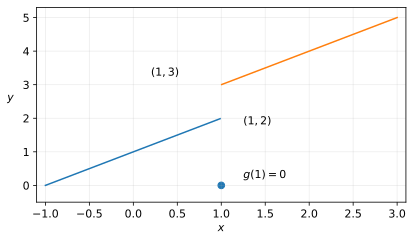
For the function in the figure, report , , , and the two-sided limit.
Find the limits of as and as .
Use inequalities to prove , without trying to assign .
Find the vertical and horizontal asymptotes of and the signs of its infinite one-sided limits at . Can it equal its horizontal-asymptote height?
Optional small hints
For M06.02, rationalize. For M06.06, factor out of the radical but replace by . For M06.08, rewrite .
H. Complete solutions: Module 06#
Compare the first step where your work differs. A corrected answer is not yet an independent success.
M06.01Show solution
A removable hole
Substitution gives , so the quotient law is not available. Factor . For the quotient equals , whose limit at is . The original still has no value at ; the limit describes its nearby values.
Back to M06.01M06.02Show solution
Rationalization
Multiply by . The numerator becomes , yielding for nearby nonzero . This continuous expression tends to . All nearby inputs can be chosen greater than , preserving the radical’s domain.
Back to M06.02M06.03Show solution
Match the standard limit
Rewrite the expression as . With , , and the bracket approaches . Thus the limit is . The radian hypothesis matters because the small-angle ratio would have a different scale in degrees.
Back to M06.03M06.04Show solution
Different branches give different limits
For , , so the quotient is . For , it is . Hence the left limit is and the right limit . They disagree, so the two-sided limit does not exist. Defining the function at would not fix that disagreement.
Back to M06.04M06.05Show solution
A filled dot is not a limit
The filled dot gives . The left branch tends to and the right branch tends to . Therefore the two-sided limit does not exist. Neither open-circle height is the actual point value, and neither alone determines a two-sided limit.
Back to M06.05M06.06Show solution
The absolute value controls the sign
For ,
At , , so the limit is . At , , so it is . The radical itself is nonnegative on both sides; the denominator changes the quotient’s sign.
Back to M06.06M06.07Show solution
Oscillation trapped between vanishing bounds
For every , . Since , multiplying preserves the inequalities:
Both bounds approach zero, so the squeeze theorem proves the middle expression tends to . No limit of by itself was required.
Back to M06.07M06.08Show solution
Separate vertical from end behavior
Long division gives . Thus is a vertical asymptote: from the left the fractional term tends to , and from the right to . As , the fraction tends to zero, so is the horizontal asymptote. Solving would require , impossible for any finite allowed . This particular curve never reaches its horizontal asymptote; that is not a general prohibition for all curves.
Back to M06.08I. Retention and readiness#
Revisit M01.03, M04.03, and M05.03. Explain what tells you: the current form is inconclusive, not that the answer is zero. Advance when you can choose among factoring, conjugates, one-sided cases, and squeezing in a mixed set. Review R1 follows Module 08.