GEO01: Angle chasing and your first proofs
On this page
- Prerequisites and observable goals
- 0. The diagnostic (about 35 minutes, closed book)
- 1. Quick summary
- 2. Deep explanation
- 2.1. The rules of the game: what a proof may use
- 2.2. Angles at a point, and vertical angles
- 2.3. Parallel lines and a transversal
- 2.4. The triangle angle sum
- 2.5. The exterior angle theorem
- 2.6. Isosceles triangles
- 2.7. Polygons
- 2.8. Angle chasing: the method
- 2.9. Writing it up
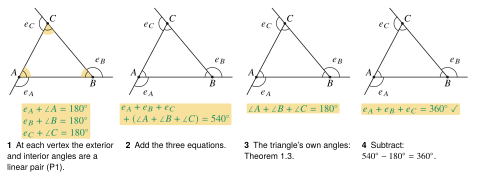
- 2.10. You cannot measure a diagram
- 2.11. Beginner mistakes: a field guide
- 3. Worked examples
- 3.1. Worked example 1: the bent arrow
- 3.2. Worked example 2: an isosceles chain
- 3.3. Worked example 3: a proof, and a non-proof
- 3.4. Worked example 4: the five points of a star
- 3.5. Worked example 5: which regular polygons tile a floor?
- 4. Practice
- 4.1. Drill
- 4.2. Problems
- 4.3. Challenges
- 5. Toolbox cards
- 6. The mastery gate
- 6.1. Next steps
- 7. Development log entry
- 8. Stretch (optional)
- Hint ladders
- Complete solutions: GEO01
- Retention and readiness
Prerequisites and observable goals#
Arithmetic with fractions and solving linear equations (Modules 01–02). No geometry is assumed: the diagnostic in section 0 finds what you already know, and every word is defined the first time it appears. C04’s section on building a proof is useful background, not a requirement.
Name angles correctly and use the vocabulary of lines, rays, and angles; prove that vertical angles are equal; use a transversal of parallel lines in both directions (parallel lines give equal angles, and equal angles prove lines parallel); prove the triangle angle sum and the exterior angle theorem from the parallel postulate; prove the isosceles base-angle theorem from SAS; find the angle sums of any polygon; chase angles through a figure step by step with a reason for every step; write a proof a stranger can check, and spot circular reasoning and diagram-trusting in someone else’s; estimate an angle from an exact figure before proving it, and explain why a figure is never a proof.
Level: Geometry, Module 1 of 28. About 10 hours over two weeks, in five sessions. You need paper, a pencil, a ruler, and a protractor. The protractor is for your guesses only, never for a proof.
0. The diagnostic (about 35 minutes, closed book)#
This module opens by finding out what you already know, so that nothing here wastes your time and nothing is skipped that you need. Work the twelve questions on paper, alone, with no notes, no calculator, and no AI. Write “not sure” rather than guess wildly: an honest blank tells you more than a lucky answer. Time yourself, then mark your answers against the key that opens this chapter’s complete solutions, and write down your score in each group. The routing table after the questions says how to use this module, and what each group’s score means for the modules after it.
This is the track’s first module, so there is nothing to review yet: the diagnostic doubles as this module’s spaced review. From GEO02 on, each module opens with two or three questions drawn from your error log.
Two straight lines cross. One of the four angles they make is . Find the other three.
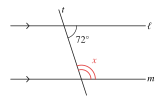
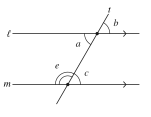
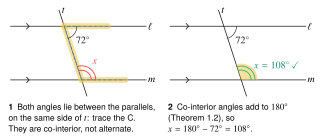
Lines and are parallel, and a third line crosses both. Find the angle marked .
Two lines are crossed by a third line. Two alternate interior angles (the “Z” pair, between the two lines on opposite sides of the third) measure and . Are the two lines parallel? Answer in one sentence that gives your reason.
The angles of a triangle measure , , and . Find .
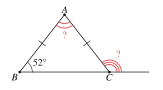
In triangle , the sides and are equal, and . Find , and the angle between side and the extension of side past .
Two triangles match in three parts. S stands for a side and A for an angle, and the order says which parts sit next to each other: SAS means two sides and the angle between them. For which of SSS, SAS, SSA, AAA, and ASA must the two triangles be exact copies of each other (the same size and the same shape)?
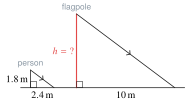
A person 1.8 m tall casts a shadow 2.4 m long. At the same moment a flagpole casts a shadow 10 m long. How tall is the flagpole?
A right triangle’s two shorter sides are 9 and 12. How long is the third side? Which side is the hypotenuse, and which are the legs?
(a) Find the area of a triangle with base 10 and height 7. (b) Find the area of the triangle with corners , , and .
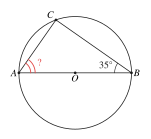
Points , , and lie on a circle, and passes through the circle’s centre. If , find .
Two lines cross, making angles , , , in order around the crossing point. Prove that . Give a reason for every step.
A student writes: “In the figure, is the midpoint of , so .” Nothing in the problem’s words mentions being a midpoint. What is wrong with the argument?

Scoring and routing#
Each question scores 1 (D06 only if all five are right; D11 only if every step has a reason). Add the scores in each group.
| Group | Questions | What the score changes |
|---|---|---|
| A. Angles and parallels | D01–D03 (3) | This module’s lane (below) |
| B. Triangle angles | D04–D05 (2) | This module’s lane |
| F. Proof | D11–D12 (2) | This module’s lane |
| C. Congruence and similarity | D06–D07 (2) | Below 2: give GEO02 and GEO03 extra time for their worked examples and drill |
| D. Pythagoras and area | D08–D09 (2) | Below 2: work through GEO04 and GEO05 from their first definitions |
| E. Circles | D10 (1) | Phase 2 teaches circles from scratch either way; with a 1, you can move faster through GEO06 |
Fast lane, if A , B , and F : read sections 2.1 and 2.8–2.11 in full; skim 2.2–2.7 through their hero figures and toolbox cards, but do every proof and every “Say it back” in them; do drill GEO01.06 only, then all the problems, all the challenges, and the gate. Full lane, otherwise: everything, in order. Whatever your lane, the mastery gate in section 6 is the same.
1. Quick summary#
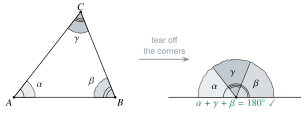
Five ideas carry this module.
- A figure is evidence, not proof. Every claim needs a reason that comes from the givens, a definition, a postulate, or a theorem already proved. What a figure seems to show (a midpoint, a right angle, a pair of parallel lines) counts for nothing unless the words say it.
- Angles at a point add up. Angles along a straight line add to , angles all the way around a point add to , and so vertical angles are equal.
- Parallel lines carry angles. When a line crosses two parallel lines, it makes the same angles at both crossings. This one assumption, the parallel postulate, is what makes plane geometry flat, and every result below rests on it.
- A triangle’s angles add to , and an exterior angle equals the two interior angles away from it. These are the most-used moves in all of angle chasing.
- Angle chasing is bookkeeping. Name one unknown, pass facts through the figure one mark at a time with a reason for each, close the loop with an equation, then write it up as a chain of “because” steps.
What you will be able to do. By the end you can find any angle in a figure built from lines, triangles, and polygons, and prove your answer in a write-up a grader would accept. The Angle Explorer, on the companion website at bezhig.com/book/explorers/geo01-angles.html, lets you drag the corners of triangles, parallel-line figures, and stars and watch the angle sums stay fixed while every individual angle changes. Use it after section 2.4, and again before the challenges.
| Session | Work | Where |
|---|---|---|
| 1 | Diagnostic, marked with its key; quick summary; what a proof may use; angles at a point | 0; 1; 2.1–2.2; GEO01.01–02 |
| 2 | Parallel lines; the triangle angle sum; the exterior angle; worked example 1 | 2.3–2.5; 3.1; GEO01.03–06 |
| 3 | Isosceles triangles; worked example 2 | 2.6; 3.2; GEO01.07–09, 13–14, 17 |
| 4 | Polygons; the method and the write-up; traps and mistakes; worked examples 3–5 | 2.7–2.11; 3.3–3.5; GEO01.10–12, 15–16, 18–20 |
| 5 | Challenges; toolbox cards; mastery gate; development log; stretch if you want it | 4.3; 5; 6; 7; 8 |
2. Deep explanation#
2.1. The rules of the game: what a proof may use#
Geometry has a small vocabulary. Learn each word once, exactly, because proofs lean on the exact meaning.
- A point marks a location and has no size. A line is perfectly straight and runs forever in both directions. A segment is the part of a line between the points and , which are its endpoints; its length is written too. A ray starts at , passes through , and runs on forever.
- An angle is two rays with the same starting point, called its vertex. The angle between rays and is written . The middle letter is always the vertex: sits at , and sits at . This is geometry’s notation disguise, and misreading it is the most common first error. When only one angle sits at a vertex, is short for it.
- Angles are measured in degrees: one full turn is . An angle is acute if it is less than , right if it equals , obtuse if it is between and , and straight if it equals (its two rays point in opposite directions and form a line). An angle more than is reflex; unless a problem says so, means the angle that is at most .
- Two angles are supplementary if they add to and complementary if they add to . A ray bisects an angle if it splits it into two equal angles; the ray is the angle’s bisector.
A proof is a chain of statements in which every statement is justified by one of four things: a given (something the problem states), a definition, a postulate, or a theorem proved earlier. A postulate is a rule accepted without proof, the starting point everyone agrees on. A theorem is a statement proved from postulates and earlier theorems. Nothing else counts: not what the figure looks like, not a measurement, not “it’s obvious.”
The because test. After every line of a proof you must be able to say “because …” and finish the sentence with a given, a definition, a postulate, or a theorem by name. If you cannot, the line is not yet part of a proof.
This module starts from four postulates. You meet each one where it is first used.
We also use, without comment, the ordinary facts about position: which side of a line a point lies on, and which of two rays lies inside an angle. Euclid read these from the figure, and so do we, but only when the words of the problem guarantee them. A fuller list of postulates, David Hilbert’s from 1899, proves them too; olympiad write-ups sometimes need that care, and GEO27 returns to it.
One word from logic you will need in section 2.3. The converse of “if , then ” is “if , then .” A statement and its converse are different claims: “if two angles are vertical angles, they are equal” is true (section 2.2), but its converse, “if two angles are equal, they are vertical angles,” is false, because two angles in different places can be equal. When both directions hold, we say “ if and only if .” C04 treats converses and proof in general.
2.2. Angles at a point, and vertical angles#
Two angles are adjacent if they share a vertex and one ray and do not overlap. If the two rays they do not share point in opposite directions, the pair makes a straight angle, and P1 gives the first fact of angle chasing:
When two lines cross, they make four angles. The two angles that sit opposite each other, sharing only the vertex, are vertical angles. The figure below shows why they must be equal: each of them makes a straight angle with the same neighbour.
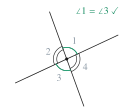
Proof. Number the angles , , , in order around the crossing, so that and are vertical.
| Statement | Reason | |
|---|---|---|
| 1. | linear pair (P1) | |
| 2. | linear pair (P1) | |
| 3. | steps 1 and 2, algebra |
The same argument with and shows .
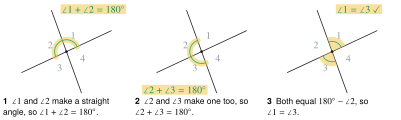
A small example, with every step. Two lines cross. One angle measures and the angle next to it measures . They are a linear pair, so
So the two angles are and . By Theorem 1.1 the other two angles are also and . Check: , a full turn.
2.3. Parallel lines and a transversal#
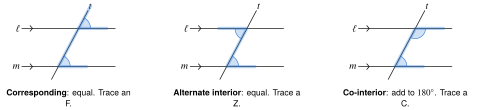
Two lines in the same plane are parallel if they never meet, however far they are extended. We write and mark parallel lines in figures with matching arrows. A transversal is a line that crosses two other lines at two different points. It makes four angles at each crossing, eight in all, and three kinds of pairs get names:
Here is the one assumption that makes this geometry flat.
Why assume it rather than prove it? Because it cannot be proved from P1 and the other basic facts: for two thousand years mathematicians tried, and in the 1800s they found consistent geometries in which it fails. On the surface of a sphere, for instance, any two “straight” paths (great circles) meet. Stretch S1 shows what then happens to triangles. In flat geometry, the geometry of engineering drawings, CAD, and this track, we accept it.
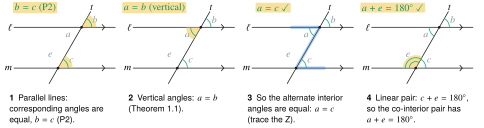
Everything else about parallels follows from P2.
Proof. Let be the upper line and the lower one, and name four angles as in the strip below: above and right of the transversal, below and left of it, and and above , to the right and left of it. Then and are corresponding angles, and are alternate interior angles, and and are co-interior angles.
- (a)(b).
- If , then (P2). Also , because they are vertical angles (Theorem 1.1). So .
- (b)(a).
- If , then (vertical angles again), so the corresponding angles and are equal, and P2 says .
- (b)(c).
- The angles and form a linear pair, so (P1). Hence exactly when .
The other alternate pair and the other co-interior pair work the same way on the other side of the transversal.
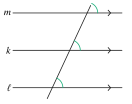
One more consequence, which worked example 1 needs:
Proof. Suppose and were different lines that met at a point . Then would not lie on (both and miss ), and and would be two different lines through parallel to . That contradicts the “exactly one” in P2. So and never meet: they are parallel.
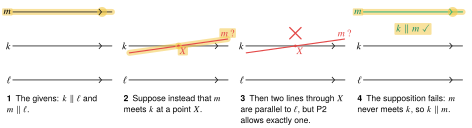
This is a proof by contradiction: assume the opposite of what you want, and show that it breaks something already accepted.
Theorem 1.2 works in both directions, and you will use both. Forwards: the lines are given parallel, so angles are equal. Backwards: you have shown two angles are equal, so the lines are parallel. The second direction is the only way to prove lines parallel in this module.
2.4. The triangle angle sum#
A triangle is three points not on one line, its vertices, joined by three segments, its sides. Its interior angles are , , and , written , , and for short. The tearing picture in section 1 suggests they always add to . Here is why, as a proof.
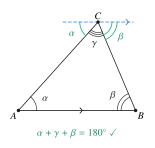
Proof. Write , , .
| Statement | Reason | |
|---|---|---|
| 1. | Draw the line through parallel to ; call its two halves (on ’s side) and (on ’s side). | P2: the parallel exists |
| 2. | alternate interior angles, transversal (Theorem 1.2) | |
| 3. | alternate interior angles, transversal (Theorem 1.2) | |
| 4. | the three angles fill the straight angle (P1) | |
| 5. | substitute steps 2 and 3 into step 4 |
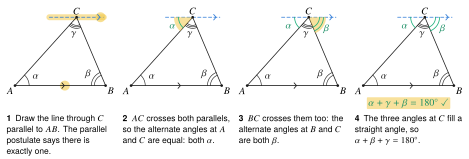
Three consequences follow at once, and you will use them without comment from now on:
- A triangle has at most one right or obtuse angle (two of them would already add to or more).
- In a right triangle, the two other angles add to : they are complementary.
- If two angles of one triangle equal two angles of another, the third angles are equal too.
A small example, with every step. A triangle’s angles are , , and . By Theorem 1.3, , so and . The angles are , , and . Check: .
2.5. The exterior angle theorem#
Extend side of triangle past to a point . The angle , between side and the extension, is an exterior angle of the triangle at . It forms a linear pair with the interior angle . The other two interior angles, and , are its remote interior angles: the ones not touching it.
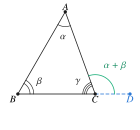
Proof.
| Statement | Reason | |
|---|---|---|
| 1. | linear pair (P1) | |
| 2. | triangle angle sum (Theorem 1.3) | |
| 3. | both sums equal : subtract from each |
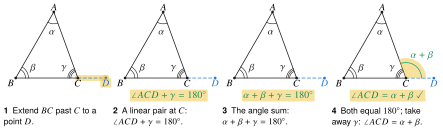
The exterior angle theorem is the angle chaser’s shortcut: it gives an angle in one step that would otherwise take a triangle sum and a linear pair. One consequence: an exterior angle is larger than either remote interior angle.
2.6. Isosceles triangles#
A triangle is isosceles if at least two of its sides are equal, equilateral if all three are, and scalene if no two are. In an isosceles triangle the two equal sides are called its legs, the third side its base, the angle between the legs its apex angle, and the two angles at the ends of the base its base angles. (Careful: “leg” has a second meaning. In a right triangle, the legs are the two sides that form the right angle, and the side opposite the right angle is the hypotenuse. The context tells you which is meant.)
To prove anything about equal sides, we need a rule that connects sides to angles. Two triangles are congruent if one can be moved onto the other exactly, by sliding, turning, or flipping it over: then every side and every angle of one equals the matching side and angle of the other. We write , listing matching vertices in the same order.
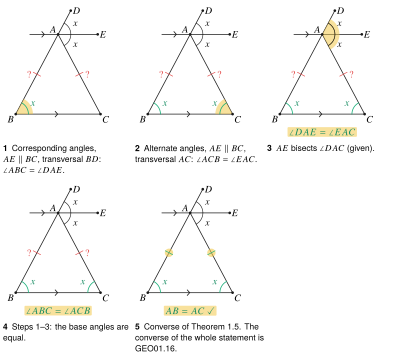
GEO02 takes SAS as its starting postulate and proves ASA from it without using anything in this section, so borrowing both here is not circular. (GEO02 will use Theorem 1.5 to prove a third rule, SSS; that direction of dependence is fine, because Theorem 1.5 rests on SAS alone.)
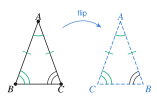
Proof (an ancient argument usually credited to Pappus of Alexandria). Compare triangle with the same triangle read in a different order, , as if it had been flipped over.
| Statement | Reason | |
|---|---|---|
| 1. | and | given |
| 2. | the same angle, read both ways | |
| 3. | SAS (P3): two sides and the angle between them | |
| 4. | matching angles of congruent triangles: the second vertex of each list |
For the converse, compare with again: (given), , and , so by ASA (P4), and the matching sides give .
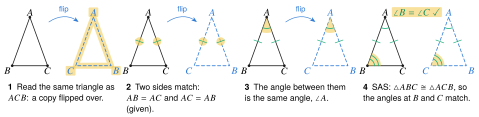
Two more facts follow. An equilateral triangle has all three angles equal (apply Theorem 1.5 twice), and so each is . And in an isosceles triangle with apex angle , each base angle is .
2.7. Polygons#
A polygon is a closed chain of segments, its sides, joined end to end at its vertices, with no two sides crossing. A polygon with sides is an -gon: a triangle has 3, a quadrilateral 4, a pentagon 5, a hexagon 6, a heptagon 7, an octagon 8. A diagonal joins two vertices that are not neighbours. A polygon is convex if each interior angle is less than ; then every diagonal lies inside it. A polygon is regular if all its sides are equal and all its angles are equal. At each vertex, extending one side makes an exterior angle, which forms a linear pair with the interior angle there.
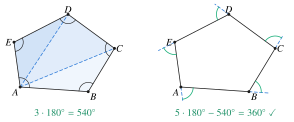
Proof. (a) Pick one vertex and draw the diagonals from it to every vertex except itself and its two neighbours: diagonals. They cut the polygon into triangles. Because the polygon is convex, the diagonals lie inside it and split the angles at the chosen vertex (P1), so the triangles’ angles together make up exactly the polygon’s angles. Each triangle contributes (Theorem 1.3), so the total is . (b) At each of the vertices, interior plus exterior is (linear pair), so all pairs total . Subtract the interior total from (a): .
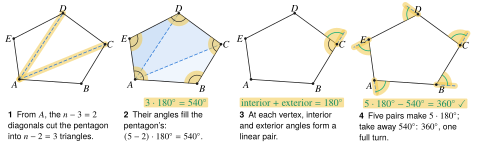
Part (b) has a picture you can act out: walk around the polygon’s edge. At each corner you turn through the exterior angle, and after one lap you face the way you started, having turned exactly once around. A car driving once around a convex block turns through in total, however the block is shaped, so a robot that adds up its heading changes around a closed loop has a built-in check: the total must come to one full turn. (For a non-convex polygon, part (a) still holds with a different way of cutting it into triangles, and part (b) holds if a turn the other way counts as negative. Stretch S2 explores both.)
A small example, with every step. A regular pentagon has interior angle sum , so each of its five equal angles is . Each exterior angle is . Check: , a linear pair.
2.8. Angle chasing: the method#
Angle chasing is how you find an unknown angle, or prove two angles equal, by passing known angles through a figure one fact at a time. It is bookkeeping, and it rewards the same discipline as the Modular Workbench in calculus: set out the parts on separate lines, check each one, then assemble.
- Copy the figure large, by hand, and mark every given: tick marks, arcs, parallel arrows, right-angle squares, and known measures.
- Guess. Estimate the target from the figure and write the estimate down. In this track the figures are drawn exactly unless they say “not to scale,” so a careful estimate should land within a few degrees. The guess is not evidence; it is a check on your proof and a way to train your eye.
- Name one unknown. Call the target , or call an angle that many others depend on.
- Push facts outward, one per line. For each new angle, write its value and its reason: “ (exterior angle of triangle ).” This is the Workbench: one angle, one reason, one line.
- Close the loop. When some angle can be found two ways, or a triangle’s three angles are all known in terms of , write the equation and solve it.
- Check. Put the value back: does every triangle add to , every straight line to ? How far was your guess?
- Write the proof (section 2.9).
There are two styles of chase, and good solvers use both. A synthetic chase uses the theorems as moves and names each one. An algebraic chase gives letters to several angles and writes one equation per fact (each triangle, each straight line, each isosceles triangle, each parallel pair), then solves the system. The algebraic chase always works when the figure’s angles are determined by the givens; it is how a computer would do it (stretch S3). The synthetic chase is shorter when you see the right move, and it explains why. Worked examples 1 and 2 solve the same problem both ways.
2.9. Writing it up#
A proof is written for a reader who was not in the room: a grader, an interviewer, or you in three weeks. Every proof in this track has the same shape.
Proofs come in two layouts. A two-column proof, like the ones above, puts statements on the left and reasons on the right; it is the best way to learn, because a missing reason is a visible hole. A paragraph proof says the same thing in sentences (“Since , the alternate angles and are equal by Theorem 1.2”); it is how proofs are written in olympiads and papers. Here is Theorem 1.4 as a paragraph: Extend past to . The angles and form a linear pair, so they add to ; by the triangle angle sum, adds with to too. Hence .
Four rules for every write-up:
- Every step has a reason, and a theorem is cited by its name or number.
- Never write “by the figure.” Positions (which side, which order) may be read from a figure the words guarantee; measures, equalities, midpoints, and parallels may not.
- Say which triangle you apply a theorem to: “angle sum in triangle .”
- Introduce every auxiliary line with a sentence that says why it exists: “Draw the line through parallel to (P2).”
Circular reasoning is using the thing you are proving, directly or through a chain. Theorems in this module depend on each other in a fixed order:
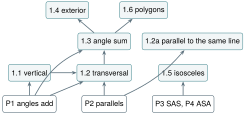
What proves what in GEO01. A proof of any theorem may use only what sits below it.
A proof may use only what sits below its theorem in that map. Proving the angle sum from the exterior angle theorem is circular here, because the exterior angle theorem was proved from the angle sum. Problem GEO01.20 asks you to find exactly this flaw.
A proof by example is not a proof. Measuring one figure, or checking three triangles, shows that a claim is plausible. A proof must work for every figure the words allow.
2.10. You cannot measure a diagram#
Three figures to train your suspicion. The first two are drawn exactly and still mislead the eye; the third is deliberately not to scale, as contest figures sometimes are.
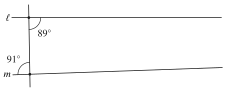
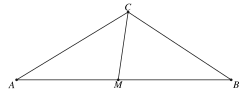
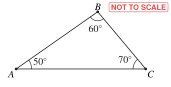
In this track every figure is exact unless it says “not to scale,” so a guess from the figure is a fair estimate. That is what makes the guess-then-prove habit useful: a guess far from your answer is a signal to recheck the work. But a guess is never a reason in a proof.
2.11. Beginner mistakes: a field guide#
Each mistake below has a name, so that whoever marks your work, you included, can say which one it was, and so that your error log can count them.
| Mistake | Symptom | How to catch it | |
|---|---|---|---|
| M1 | Trusting the diagram | A step whose only reason is how the figure looks | The because test: no reason, no step (2.1) |
| M2 | Assuming a midpoint, a bisector, or equal sides | An equality that is not in the givens | Circle every equality you use, and find it in the words (2.10) |
| M3 | Parallel because it looks parallel | Theorem 1.2 used forwards without in the givens | Look for the words or arrows first (2.3) |
| M4 | Circular reasoning | A theorem used to prove something it depends on | Check the dependency map (2.9) |
| M5 | Mixing up the angle pairs | Co-interior angles set equal, or alternate angles set to add to | Trace the letter: F and Z are equal, C adds to (2.3) |
| M6 | The wrong interior angle | An exterior angle that includes its neighbour | Remote means not touching (2.5) |
| M7 | Misreading | An angle placed at the first letter | The middle letter is the vertex (2.1) |
| M8 | Fraction and bookkeeping slips | A dropped term or a slip in | Common denominator first, then a final check that every triangle sums to (GEO01.06) |
| M9 | Proof by example | “I measured it and it was ” | A proof must work for every figure the words allow (2.9) |
3. Worked examples#
Each example starts with a guess. Cover the solution, write your estimate, and try the problem for five minutes before reading on.
3.1. Worked example 1: the bent arrow#
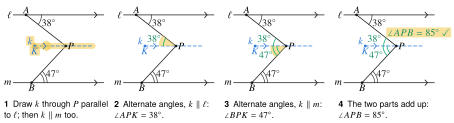
Problem. Lines and are parallel. Point is on , point is on , and point lies between the lines, to the right of both. The angle between and the part of to the right of is , and the angle between and the part of to the right of is . Find .
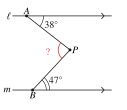
Approach A: a parallel through the bend. The angles we know sit at and at , far from . A parallel through can carry both of them to .
| Statement | Reason | |
|---|---|---|
| 1. | Draw the line through parallel to , and mark a point on it to the left of . | P2: the parallel exists |
| 2. | and (Corollary 1.2a) | |
| 3. | alternate interior angles, , transversal (Theorem 1.2) | |
| 4. | alternate interior angles, , transversal (Theorem 1.2) | |
| 5. | ray lies inside (P1) |
Approach B: make a triangle. Instead of a new parallel, extend a line we already have until it closes a triangle, then use the exterior angle theorem.
| Statement | Reason | |
|---|---|---|
| 1. | Extend past until it meets at . | line crosses , so it is not parallel to (Corollary 1.2a would make it parallel to ); is between the lines, so the extension reaches |
| 2. | alternate interior angles, , transversal (Theorem 1.2) | |
| 3. | is the exterior angle of triangle at (Theorem 1.4) |
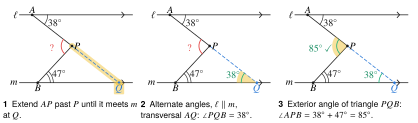
Answer: . How close was your guess?
Comparing the approaches. Approach B is one step shorter because the exterior angle theorem packs a triangle sum and a linear pair into one move. Approach A generalizes: a path that bends many times between two parallels can be split by a parallel through every bend, which gives the zigzag rule of GEO01.13. Both show the same pattern: the angle at the bend is the sum of the two outer angles. Approach B also shows a habit worth keeping: when an angle has no triangle around it, extend a line and make one.
3.2. Worked example 2: an isosceles chain#
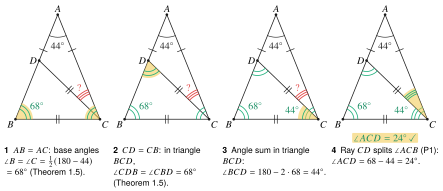
Problem. In triangle , point lies on side with and . If , find .
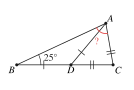
Approach A: chase forward from the given angle. Each isosceles triangle turns one known angle into another.
| Statement | Reason | |
|---|---|---|
| 1. | , so triangle is isosceles with base and (Theorem 1.5) | |
| 2. | exterior angle of triangle at (Theorem 1.4) | |
| 3. | , so triangle has equal base angles at and (Theorem 1.5) | |
| 4. | ray lies inside , because is on side (P1) |
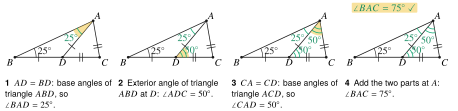
Approach B: let the given angle be a letter. Write instead of and run the same chase: , , , so
Check with the angle sum of triangle : for every , as it must. With : and .
Comparing the approaches. Approach A is the quickest route to the number. Approach B costs one extra line and pays three times over: it shows that is always three times in this figure; it shows the figure exists only when , that is, when ; and the angle sum of triangle becomes a check rather than a step. When a problem gives you one number, try replacing it with a letter: the general answer often explains the specific one.
3.3. Worked example 3: a proof, and a non-proof#
Problem. Lines and are parallel, and a transversal meets at and at . The two co-interior angles on the right of are bisected, and the two bisectors meet at . Prove that .
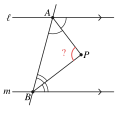
Given: ; on and on ; ray bisects the co-interior angle at on the right of , and ray bisects the co-interior angle at on the right of . To prove: . Plan: the two whole angles add to , so their halves add to , and triangle gets the rest.
Proof. Let the co-interior angle at be and the one at be .
| Statement | Reason | |
|---|---|---|
| 1. | co-interior angles of parallel lines (Theorem 1.2) | |
| 2. | divide step 1 by 2 | |
| 3. | and | definition of a bisector |
| 4. | angle sum in triangle (Theorem 1.3) | |
| 5. | substitute step 2 |
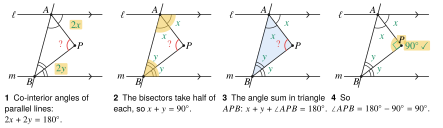
A non-proof, and what is wrong with it. A student writes: “I drew the figure carefully, measured and , and found . So the angle is always .” Every number is correct, and the conclusion happens to be true, but this is not a proof. It checks one figure; the claim is about every figure the words allow (mistake M9). The measurement also brings in protractor error (mistake M1). The student’s work is good evidence, which is exactly what a guess is for, but only the five steps above make it certain.
The paragraph version. Since , the co-interior angles at and add to , so their halves and add to . By the angle sum in triangle , .
3.4. Worked example 4: the five points of a star#
Problem. Five points , , , , are the corners, in order, of a convex pentagon of any shape. Draw the five-pointed star . Prove that the five angles at its tips add to .
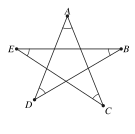
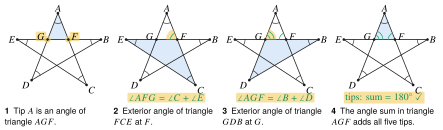
Approach A: two exterior angles and one triangle. Name the crossings on the line : let it meet at and at , as in the figure. Tip is an angle of the small triangle , and each of the other two angles of that triangle is an exterior angle of a triangle whose remote angles are two of the other tips.
| Statement | Reason | |
|---|---|---|
| 1. | exterior angle at of triangle (Theorem 1.4) | |
| 2. | exterior angle at of triangle (Theorem 1.4) | |
| 3. | angle sum in triangle (Theorem 1.3) | |
| 4. | substitute steps 1 and 2 |
Approach B: turn a pencil. Lay a pencil along side at tip , pointing toward . Slide it to and turn it through tip ’s angle so that it lies along ; slide it to and turn it through tip ’s angle onto ; and so on around the star, back to . Every turn is in the same direction, and when you arrive back along the pencil points the opposite way: it has turned through half a revolution, , and the turns were exactly the five tip angles. This is a convincing picture rather than a complete proof as written (one must check that the total is and not plus a full turn), but it explains the number, and challenge GEO01.22 turns the same idea into a proof for bigger stars.
Comparing the approaches. Approach A is a complete proof built from this module’s theorems, and it is the one to write up. Approach B is the mechanism: the star’s tips are the turns of a path that ends up reversed. Engineers meet the same bookkeeping when they add up a vehicle’s heading changes around a route.
3.5. Worked example 5: which regular polygons tile a floor?#
Problem. Copies of one regular polygon are to cover a floor with no gaps and no overlaps, meeting corner to corner. Which regular polygons can do it?
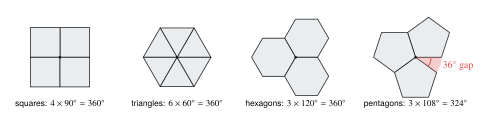
Solution. Where corners meet, the angles around the point must add to exactly , so the interior angle of the polygon must divide exactly. A regular -gon’s interior angle is (Theorem 1.6).
- : , and triangles meet at each point.
- : , and 4 squares meet.
- : , and : three pentagons leave , four overlap.
- : , and 3 hexagons meet.
- : the interior angle is more than (it grows with ) and less than , so divided by it lies strictly between 2 and 3, never a whole number.
Answer: only equilateral triangles, squares, and regular hexagons. That is why tile-based game maps use squares, hexagons, or triangles, and never regular pentagons. Challenge GEO01.24 asks what happens when three different regular polygons share a corner.
4. Practice#
Three tiers. Drill practises one move until it is automatic. Problems need several moves or a written proof. Challenges need an idea you have to find. Every problem has a three-rung hint ladder after the practice set (the [hints] link jumps there): rung 1 is a question, rung 2 points to the idea, rung 3 is a skeleton with blanks. Climb one rung at a time and try again after each. The full solutions, with figures, are in a separate section at the end of the chapter; open one only after you have written your own attempt.
Before every problem with a figure: guess. Write your estimate beside the problem number, then solve, then write the answer and the difference. Keep the column: your guesses should get sharper over the module, and a big gap is a signal to recheck your work.
4.1. Drill#
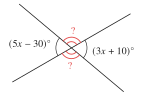
Two lines cross. One angle measures and the angle vertical to it measures . Find and all four angles.
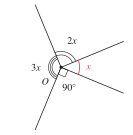
Four rays from a point divide the full turn into four angles: , , , and , in order. Find and check your answer.
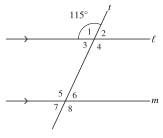
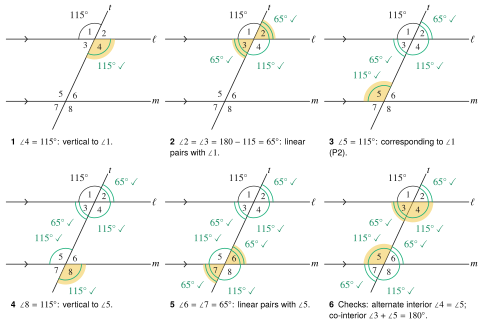
Lines are crossed by a transversal , making the eight angles numbered in the figure. Given , find the other seven, and name the pair type (vertical, linear pair, corresponding, alternate interior, co-interior) you used for each.
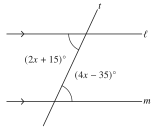
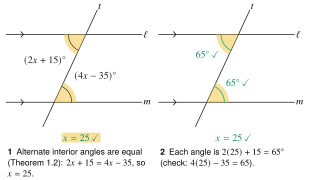
Lines . A pair of alternate interior angles measure and . Find and the angle.
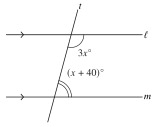
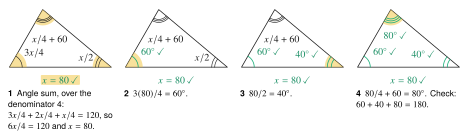
A triangle’s angles measure , , and degrees. Find and the three angles. Show the common denominator on its own line.
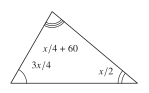
An exterior angle of a triangle measures . Its two remote interior angles measure and . Find all three interior angles of the triangle. What kind of triangle is it?
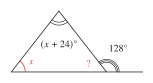
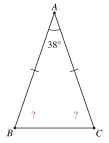
In triangle , and . Find , and the exterior angle at formed by extending past .
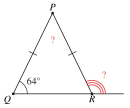
(a) Find the interior angle sum of a hexagon. (b) Find each interior angle of a regular octagon. (c) A regular polygon has interior angles of . How many sides does it have?
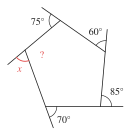
A convex pentagon’s exterior angles, one at each vertex, measure , , , , and . Find , and the interior angle at that vertex.
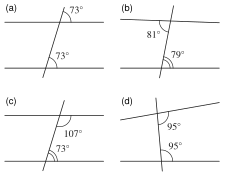
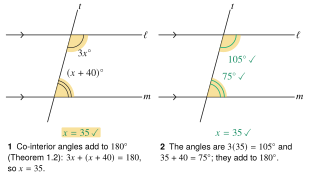
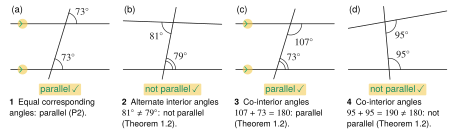
In each case two lines are crossed by a transversal. Say whether the lines must be parallel, and name the fact you used. (a) Corresponding angles of and . (b) Alternate interior angles of and . (c) Co-interior angles of and . (d) Co-interior angles of and .
4.2. Problems#
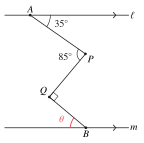
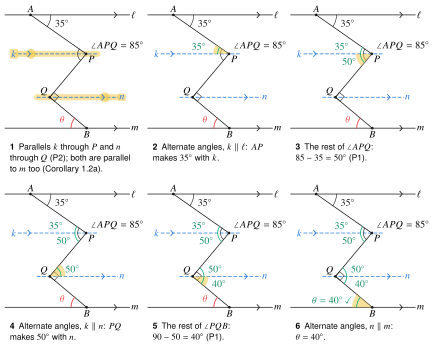
A path with two bends. Lines . A path runs from on to , then to , then to on , bending right, then left, as in the figure. The angle between and the part of to the right of is ; ; and . Find , the angle between and the part of to the left of . Then state a rule that relates the angles at the right-pointing corners to the angles at the left-pointing ones, counting the angles at and as corners too.
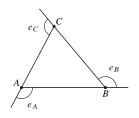
Prove that the three exterior angles of a triangle, one at each vertex, add to . Use the template of section 2.9.
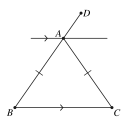
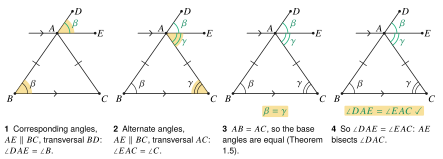
In triangle , . Extend past to a point . Prove that the line through parallel to bisects the exterior angle .
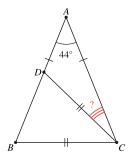
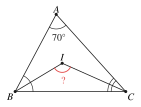
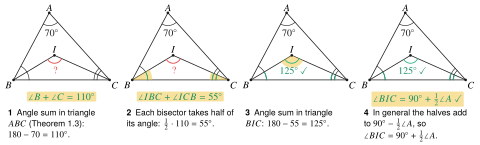
In triangle , , and the bisectors of and meet at . Find . Then prove that in every triangle.
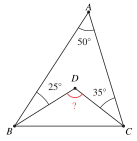
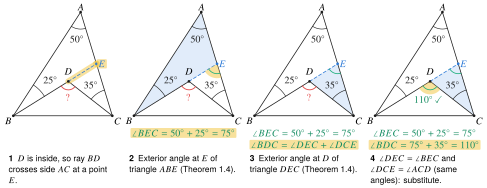
The dart. Point lies inside triangle . Given , , and , find . Then prove that whenever is inside the triangle.
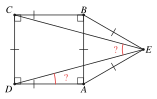
is a square, and is an equilateral triangle drawn on side , outside the square. Find and . (A square has four equal sides and four right angles.)
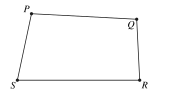
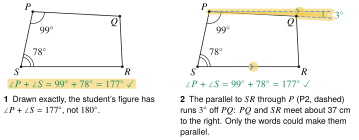
Find the flaw. (a) A student proves the triangle angle sum like this: “Extend past to . By the exterior angle theorem, . Since , we get .” Every line is true. Why is it not a proof of Theorem 1.3 in this module? (b) Another writes: “In quadrilateral , sides and are parallel, as the figure shows, so .” The problem’s words say only that is a quadrilateral. What is wrong, and what would have to be given?
4.3. Challenges#
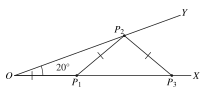
The zigzag between two rays. Rays and make an angle of . Starting at , draw equal segments that zigzag between the rays: , with on , on , and each new point farther from than the last point on its ray. (a) How many segments can you draw, counting ? (b) For which angles can you draw exactly 5 segments?
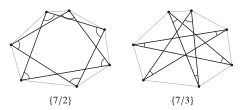
Bigger stars. Seven points are the corners, in order, of a convex heptagon. (a) Join each point to the one two steps ahead, making the star , and find the sum of its seven tip angles. (b) Join each point to the one three steps ahead, making , and find the sum. (c) Conjecture the tip-angle sum of the star , for , and prove it, using this fact about turning: a closed path whose turns all go the same way, and that goes times around, turns through in total.
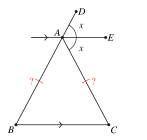
Prove that if the bisector of an exterior angle of a triangle is parallel to the opposite side, then the triangle is isosceles. Then state and prove the converse.
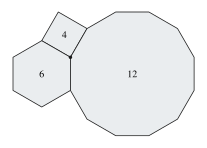
Three polygons at a corner. Three regular polygons, with sides, fit together around a point exactly, with no gap and no overlap. (a) Show that . (b) Find every solution . (c) Optional, for the competitive-programming lane: write a short C++ loop that prints every solution, and compare its output with your list.
5. Toolbox cards#
One card per theorem, one page each, to review like flashcards: cover everything except the title, say the statement aloud, sketch the diagram, then uncover and check. Print this section, or flip through it on screen.
Statement
Angles on a straight line add to (a linear pair); angles all the way around a point add to . When two lines cross, vertical angles are equal (Theorem 1.1).
Reach for it when
Two lines cross anywhere in the figure; an angle sits next to a straight line; you need a second angle at a crossing where you know one.
Watch out
The two angles of a linear pair must share a ray, and their outer rays must form one straight line. Two angles that merely touch do not add to .
Review this card at 2, 7, and 21 days: cover everything but the title, say the statement and draw the diagram, then check.
Statement
If a transversal crosses two parallel lines, corresponding angles are equal (F), alternate interior angles are equal (Z), and co-interior angles add to (C). Conversely, any one of those three facts proves the lines parallel (P2 and Theorem 1.2). Two lines parallel to the same line are parallel to each other (Corollary 1.2a).
Reach for it when
The words or arrows say two lines are parallel (use it forwards); or you must prove two lines parallel (use it backwards).
Watch out
Never use it forwards unless the parallel is given or already proved (M3). F and Z pairs are equal; the C pair is not equal, it adds to (M5).
Review this card at 2, 7, and 21 days: cover everything but the title, say the statement and draw the diagram, then check.
Statement
In every triangle, (Theorem 1.3). Proof: the parallel to through carries and to , beside on a straight line. Consequences: at most one right or obtuse angle; the acute angles of a right triangle add to ; two equal pairs of angles force the third pair equal.
Reach for it when
You know two angles of a triangle, or all three in terms of one unknown; you need to close the loop of an angle chase.
Watch out
It holds in the flat plane only; it depends on the parallel postulate. Name the triangle you apply it to.
Review this card at 2, 7, and 21 days: cover everything but the title, say the statement and draw the diagram, then check.
Statement
An exterior angle of a triangle equals the sum of the two remote interior angles: (Theorem 1.4). It is bigger than either of them.
Reach for it when
An angle sits outside a triangle along an extended side; you want one step instead of an angle sum plus a linear pair; an angle has no triangle around it (extend a line and make one).
Watch out
Remote means not touching: the interior angle at the same vertex is not part of the sum (M6).
Review this card at 2, 7, and 21 days: cover everything but the title, say the statement and draw the diagram, then check.
Statement
If , then ; conversely, if , then (Theorem 1.5, from SAS and ASA). Each base angle is . An equilateral triangle has three angles.
Reach for it when
Two equal sides share a vertex (tick marks, or two radii of one circle in Phase 2); you need to turn an angle fact into a side fact or back.
Watch out
The equal angles sit opposite the equal sides, at the ends of the base, not at the apex. Equal only if given or proved, never because they look equal (M2).
Review this card at 2, 7, and 21 days: cover everything but the title, say the statement and draw the diagram, then check.
Statement
A convex -gon’s interior angles add to , and its exterior angles, one per vertex, add to (Theorem 1.6). A regular -gon has interior angle and exterior angle .
Reach for it when
Any polygon with more than three sides; regular polygons; tilings; a path that turns at corners and comes back to its start.
Watch out
The exterior sum is for every , and the interior sum grows with . For non-convex polygons, count turns the other way as negative.
Review this card at 2, 7, and 21 days: cover everything but the title, say the statement and draw the diagram, then check.
Statement
Copy the figure large and mark the givens. Guess. Name one unknown . Push facts outward one per line, each with its reason (the Workbench). Close the loop with an equation. Check every triangle and line sums correctly, and compare with the guess. Then write: Given, To prove, Plan, numbered steps with reasons, .
Reach for it when
Every angle problem. When stuck: extend a line to make a triangle, draw a parallel through a bend, or replace a given number with a letter.
Watch out
The because test on every line. No step from the figure alone (M1, M2, M3), no circular steps (M4), and no proof by example (M9).
Review this card at 2, 7, and 21 days: cover everything but the title, say the statement and draw the diagram, then check.
6. The mastery gate#
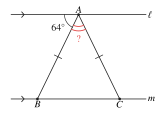
Lines . Point is on , and points and are on , with to the left of and . The angle between and the part of to the left of is . Find .
Each exterior angle of a regular polygon is one fifth of its interior angle. How many sides does the polygon have?
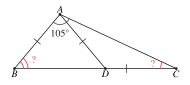
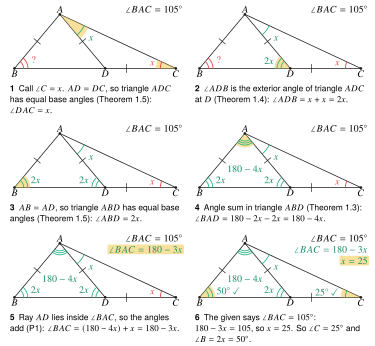
In triangle , point lies on side with , and . Find and .
Prove that the interior angles of every convex quadrilateral add to . Write the proof in full, with a reason for every step, and say where you used the word “convex.”
6.1. Next steps#
- Record the module. Keep a progress record, a spreadsheet or CSV with one row per module, and fill in GEO01’s row: your diagnostic scores by group, the gate result, the teach-back, the first error, and a review date seven days out. Every miss goes into your error log with its category (usually “proof assumptions,” “concept,” or “algebra/calculation”) and the name of its mistake from section 2.11.
- Calculus alongside. If you are studying calculus at the same time, nothing here conflicts with Modules 12–14. Related-rates problems often hide a pair of similar triangles, which GEO03 teaches.
- GEO02, congruence, next on the route that GEO00 maps. SAS as the starting postulate; ASA, SSS, AAS, and the right-triangle rule proved from it; why SSA fails, drawn exactly; perpendicular bisectors and angle bisectors as sets of points; compass-and-straightedge constructions; and the first link to CAD: a triangle is fixed by its three side lengths, which is why three dimensions fully constrain a triangle in a sketch.
7. Development log entry#
Write it in your geometry notebook. It is your record of what you can now do, so write every claim so that a stranger could check it.
8. Stretch (optional)#
- S1. Triangles on a sphere. On a sphere of radius , a triangle made of great-circle arcs has an angle sum larger than by exactly its area divided by , measured in radians (Girard’s theorem). (a) Check it for the triangle with one corner at the North Pole and two on the equator a quarter-turn apart: find its angles, its area (what fraction of the sphere is it?), and the excess. (b) A triangle of flight routes encloses 1% of the Earth’s surface. By how many degrees do its angles exceed ? (c) Which postulate of this module fails on a sphere, and where does the proof of Theorem 1.3 break?
- S2. Turning, and non-convex polygons. Walk around an L-shaped hexagon (a square with a corner removed), counting left turns as positive and right turns as negative. Show that the turns total and that the interior angles still add to . Then explain why the pentagram’s path in worked example 4 turns through : it winds twice.
- S3. Angle chasing as linear algebra. Write worked example 2 as a system of linear equations in the unknown angles (one equation per triangle, per straight line, and per isosceles triangle). How many unknowns and equations are there? Which equation is redundant, and why does the angle sum of triangle turn into a check? A01 treats systems like this in general; a figure’s angles are determined exactly when its system has one solution.
- S4. Angles from coordinates, in C++ (the first step of the computational-geometry bridge, B4). The starter
angles.cpp, in the companion code’sgeo-code/m01folder, computes the angles of a triangle from its corners’ coordinates. Implementangle_at, which returns the angle at a vertex from the dot product and the cross product of two edge vectors, then run the program on a million random triangles. The angle sums come out as plus or minus about : evidence for Theorem 1.3, not a proof of it. The sign of the cross product that you compute along the way is the orientation test (does the path turn left or right?), the most-used predicate in computational geometry. - S5. The corner census in code. GEO01.24(c): enumerate the triples of regular polygons that meet at a point, and extend the search to four polygons at a point.
Hint ladders#
Climb one rung at a time, and try again after each one. Rung 1 is a question, rung 2 points to the idea, rung 3 is a skeleton with the key parts left for you. The problem number takes you back to the problem.
Rung 1: a nudge
Which two of the four angles are vertical angles, and what does Theorem 1.1 say about them?
Rung 2: the idea
Section 2.2, Theorem 1.1; toolbox card 1.1.
Rung 3: a skeleton
, so . The vertical pair is each; each neighbour is .
Rung 1: a nudge
What do the angles all the way around a point add to?
Rung 2: the idea
Section 2.2, the full turn.
Rung 3: a skeleton
, so and . Check that the four angles add back to the full turn.
Rung 1: a nudge
Which angle is vertical to ? Which two angles form linear pairs with it? Which angle at sits in the same position as ?
Rung 2: the idea
Sections 2.2 and 2.3; toolbox cards 1.1 and 1.2.
Rung 3: a skeleton
(vertical); (linear pairs); (corresponding to ); then and .
Rung 1: a nudge
Are alternate interior angles of parallel lines equal, or do they add to ?
Rung 2: the idea
Theorem 1.2(b): trace a Z.
Rung 3: a skeleton
, so , , and the angle is .
Rung 1: a nudge
Do co-interior angles equal each other, or add to ?
Rung 2: the idea
Theorem 1.2(c): trace a C.
Rung 3: a skeleton
, so , , and the angles are and .
Rung 1: a nudge
What do the three angles add to? What is the smallest common denominator of , , and ?
Rung 2: the idea
Theorem 1.3; mistake M8 in section 2.11.
Rung 3: a skeleton
, so and .
Rung 1: a nudge
Which two interior angles is the exterior angle equal to the sum of? Which interior angle forms a linear pair with it?
Rung 2: the idea
Theorem 1.4; toolbox card 1.4.
Rung 3: a skeleton
, so . The third interior angle is . Two equal angles mean, by Theorem 1.5’s converse, that .
Rung 1: a nudge
Which two angles are equal, and what do all three add to?
Rung 2: the idea
Theorem 1.5 and section 2.6’s base-angle formula.
Rung 3: a skeleton
.
Rung 1: a nudge
Which angle equals ? What is left for ? What does the exterior angle at pair with?
Rung 2: the idea
Theorem 1.5, Theorem 1.3, then a linear pair at .
Rung 3: a skeleton
; ; the exterior angle at is .
Rung 1: a nudge
Into how many triangles do the diagonals from one vertex cut a hexagon? What is each exterior angle of a regular polygon with interior angle ?
Rung 2: the idea
Theorem 1.6; toolbox card 1.6.
Rung 3: a skeleton
(a) . (b) . (c) Exterior , so .
Rung 1: a nudge
What do the exterior angles of any convex polygon add to?
Rung 2: the idea
Theorem 1.6(b).
Rung 3: a skeleton
, so ; the interior angle there is .
Rung 1: a nudge
For each case: which condition in P2 or Theorem 1.2 would make the lines parallel, and is it met exactly?
Rung 2: the idea
P2 and Theorem 1.2, read backwards (“the only way to prove lines parallel”).
Rung 3: a skeleton
(a) Corresponding angles equal, so . (b) , so . (c) , so . (d) , so .
Rung 1: a nudge
What did worked example 1’s approach A do at the bend? How many bends are there here?
Rung 2: the idea
Section 3.1, approach A, and Corollary 1.2a.
Rung 3: a skeleton
Draw parallels to through and through . At : , so makes with the parallel through . At : . At : (alternate interior angles). Rule: .
Rung 1: a nudge
Which triangle is isosceles because , and which of its angles are therefore equal?
Rung 2: the idea
Theorem 1.5, twice. Redraw triangle on its own.
Rung 3: a skeleton
. . . .
Rung 1: a nudge
At each vertex, what does the exterior angle add to with the interior angle? How many vertices are there?
Rung 2: the idea
Linear pairs (section 2.2) and Theorem 1.3. Compare the proof of Theorem 1.6(b).
Rung 3: a skeleton
and , so .
Rung 1: a nudge
Call the parallel through line , with on ’s side. Which angle does it make with , and which with ? Name the transversal each time.
Rung 2: the idea
Theorem 1.2 twice (corresponding, then alternate), and Theorem 1.5.
Rung 3: a skeleton
(corresponding angles, transversal ). (alternate interior angles, transversal ). because . So .
Rung 1: a nudge
In triangle , what are its angles at and , in terms of and ?
Rung 2: the idea
The definition of a bisector; Theorem 1.3 in triangle , then in triangle .
Rung 3: a skeleton
. . . In general, .
Rung 1: a nudge
Extend until it meets . Which triangles does that make, and which exterior angles appear?
Rung 2: the idea
Theorem 1.4 twice, as in worked example 1’s approach B.
Rung 3: a skeleton
Let meet at . (exterior angle of triangle ). (exterior angle of triangle ). So .
Rung 1: a nudge
Which sides of triangle are equal? What is ?
Rung 2: the idea
A square’s right angle and an equilateral triangle’s (section 2.6); Theorem 1.5.
Rung 3: a skeleton
, so triangle is isosceles with apex , and base angles . In the same way . So .
Rung 1: a nudge
(a) In the dependency map of section 2.9, what was the exterior angle theorem proved from? (b) Which fact did the student take from the picture?
Rung 2: the idea
Mistakes M4 (circular reasoning) and M3 (parallel because it looks parallel).
Rung 3: a skeleton
(a) Theorem 1.4 was proved using Theorem , so using 1.4 to prove 1.3 is . (b) The words would have to state ; without it, is .
Rung 1: a nudge
Draw the first three segments. What are the base angles of the first isosceles triangle, ? Of the next one, ?
Rung 2: the idea
Theorems 1.5 and 1.4, alternately. The base angles of a triangle must each be less than .
Rung 3: a skeleton
Triangle : base angles and ; exterior angle at is . Triangle : base angles . The -th isosceles triangle has base angles , and it exists only while .
Rung 1: a nudge
At a tip with angle , through what angle does the path turn? How many times does the path of wind around the centre?
Rung 2: the idea
Worked example 4’s approach B, stretch S2, and the walking picture of Theorem 1.6(b).
Rung 3: a skeleton
Total turning , so . : . : .
Rung 1: a nudge
Name the exterior bisector and the extension of . Which angles does the parallel make with and with ?
Rung 2: the idea
GEO01.16 run backwards; Theorem 1.2; Theorem 1.5’s converse.
Rung 3: a skeleton
( angles), ( angles), and (). So , and by .
Rung 1: a nudge
What is the interior angle of a regular -gon? What must three of them add to?
Rung 2: the idea
Theorem 1.6. Then bound : because , .
Rung 3: a skeleton
gives , and . For : , so . For : . Then try and .
Complete solutions: GEO01#
Open a solution only after you have written your own attempt. Compare at the first step where your work differs. A corrected answer is not yet an independent success.
The diagnostic key#
GEO01.D01Show solution
Vertical angles and linear pairs
(the vertical angle), and and (each forms a linear pair with the angle: ). Group A.
Back to GEO01.D01GEO01.D02Show solution
A co-interior pair
. The angle and lie between the parallels on the same side of , so they are co-interior and add to (Theorem 1.2): . A common wrong answer is , from treating the pair as alternate (mistake M5). Group A.
GEO01.D03Show solution
Equal alternate angles or nothing
No. If the lines were parallel, the alternate interior angles would be equal (Theorem 1.2); , so they are not parallel. (They meet on the side where the co-interior angles add to less than .) Group A.
Back to GEO01.D03GEO01.D04Show solution
GEO01.D05Show solution
Base angles, then a linear pair
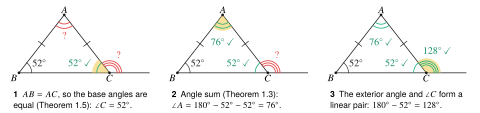
(base angles), so . The exterior angle at forms a linear pair with : . Group B.
GEO01.D06Show solution
Which three parts fix a triangle
SSS, SAS, and ASA force exact copies. SSA does not (two different triangles can share two sides and an angle that is not between them), and AAA does not (same shape, any size). GEO02 draws both failures exactly. Group C.
Back to GEO01.D06GEO01.D07Show solution
Similar triangles from shadows
The sun’s rays make the same angle with the ground for both, so the two triangles have the same shape and their sides are in proportion: , so m. Group C.
Back to GEO01.D07GEO01.D08Show solution
The hypotenuse faces the right angle
. The hypotenuse is the side opposite the right angle (the 15); the legs are the two sides that form the right angle (9 and 12). Group D.
Back to GEO01.D08GEO01.D09Show solution
Half base times height
(a) . (b) The base from to has length 6, and the height is the distance from to that base, which is 5: area . Group D.
Back to GEO01.D09GEO01.D10Show solution
An angle in a semicircle
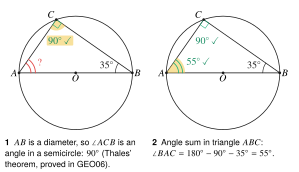
Because is a diameter, (Thales’ theorem, proved in GEO06). Then . Group E.
GEO01.D11Show solution
Two linear pairs
(linear pair), and (linear pair). So . Full credit needs both reasons. Group F.
Back to GEO01.D11GEO01.D12Show solution
The figure is not a given
The argument trusts the diagram (mistakes M1 and M2). A midpoint must be stated in the words or proved; a figure, even an exact one, can hide a difference of one part in ten (section 2.10’s second trap). Group F.
Back to GEO01.D12Practice#
GEO01.01Show solution
Vertical angles are equal
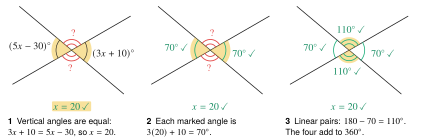
Answer: ; the angles are , , , . The marked angles are vertical, so they are equal (Theorem 1.1): , so and . Each is (check: ). Each neighbour forms a linear pair with a angle: . Check: .
GEO01.02Show solution
A full turn
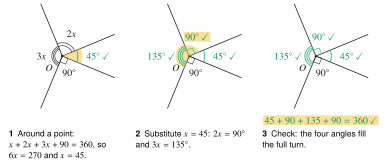
Answer: ; the angles are , , , . Angles around a point add to : , so and . Check: .
GEO01.03Show solution
Eight angles from one
Answer: and . (vertical to ). (each forms a linear pair with ). (corresponding to , P2). (vertical to ). (linear pairs with ). Two checks: and are alternate interior angles, and both are ; and are co-interior, and .
GEO01.04Show solution
Alternate interior angles are equal
Answer: , and the angle is . (Theorem 1.2), so and ; each angle is (check: ).
GEO01.05Show solution
Co-interior angles add to 180 degrees
Answer: and . (Theorem 1.2), so and . The angles are and ; they add to .
GEO01.06Show solution
Common denominator first
Answer: ; the angles are , , and .
The angles are , , and . Check: . The usual slip is writing as when changing denominators (mistake M8): rewrite each fraction on its own line first.
GEO01.07Show solution
The exterior angle, then its partner
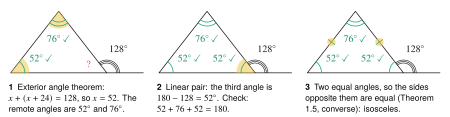
Answer: , , and ; the triangle is isosceles. The exterior angle equals its two remote interior angles (Theorem 1.4): , so and . The remote angles are and . The third interior angle forms a linear pair with the exterior angle: . Check: . Two angles are equal, so the sides opposite them are equal (Theorem 1.5, converse): the triangle is isosceles.
GEO01.08Show solution
GEO01.09Show solution
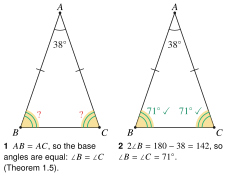
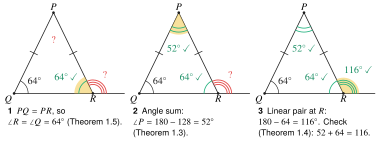
Base angles, apex, exterior
Answer: ; the exterior angle at is . , so (Theorem 1.5). Then (Theorem 1.3). The exterior angle at forms a linear pair with : . Check with Theorem 1.4: .
GEO01.10Show solution
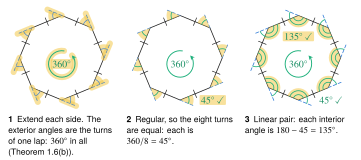
Triangles inside, one turn outside
Answer: (a) ; (b) ; (c) 15 sides. (a) . (b) . (c) Each exterior angle is , and the exterior angles add to , so . Check: .
GEO01.11Show solution
The exterior sum is always 360 degrees
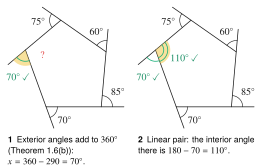
Answer: ; the interior angle there is . (Theorem 1.6(b)), so , and the interior angle is .
GEO01.12Show solution
Parallel only if the angles say so
Answer: (a) parallel; (b) not parallel; (c) parallel; (d) not parallel. (a) Equal corresponding angles: parallel by P2. (b) Unequal alternate interior angles: by Theorem 1.2 the lines would need equal ones, so they are not parallel. (c) Co-interior angles add to : parallel by Theorem 1.2. (d) Co-interior angles add to : not parallel. In the figure, (b) looks parallel and is not; it is section 2.10’s first trap again.
GEO01.13Show solution
A parallel through every bend
Answer: . Rule: the angles that open to the left (at , and at ) add to the same total as the angles that open to the right (at , and at ): .
| Statement | Reason | |
|---|---|---|
| 1. | Draw lines through and through , both parallel to ; they are parallel to too. | P2; Corollary 1.2a |
| 2. | makes with at . | alternate interior angles, , transversal |
| 3. | makes with at . | ray along splits (P1) |
| 4. | makes with at . | alternate interior angles, , transversal |
| 5. | makes with at . | ray along splits (P1) |
| 6. | alternate interior angles, , transversal |
The same bookkeeping works for any number of bends, which is where the rule comes from: each parallel passes an angle from one side of a bend to the other, so every angle is counted once on each side.
GEO01.14Show solution
Two isosceles triangles sharing side CB
Answer: .
| Statement | Reason | |
|---|---|---|
| 1. | (Theorem 1.5) and | |
| 2. | : triangle has equal base angles at and (Theorem 1.5) | |
| 3. | angle sum in triangle | |
| 4. | ray lies inside , since is on side (P1) |
Notice that : triangles and have the same angles. GEO03 names that: they are similar.
GEO01.15Show solution
Three linear pairs minus one triangle
Given: triangle with exterior angles , , , one at each vertex. To prove: . Plan: each exterior angle and its interior angle make ; take away the triangle’s .
| Statement | Reason | |
|---|---|---|
| 1. | , , | linear pairs (P1) |
| 2. | add the three equations | |
| 3. | Theorem 1.3 | |
| 4. | subtract step 3 from step 2 |
This is Theorem 1.6(b) for , and it is also the walk around the triangle: three turns make one full turn.
GEO01.16Show solution
Corresponding plus alternate plus isosceles
Given: ; on ray past ; line through parallel to , with on the same side of line as . To prove: . Plan: carry and up to with the parallel.
| Statement | Reason | |
|---|---|---|
| 1. | corresponding angles, , transversal (P2) | |
| 2. | alternate interior angles, , transversal (Theorem 1.2) | |
| 3. | (Theorem 1.5) | |
| 4. | , so bisects | steps 1–3; ray lies inside |
GEO01.17Show solution
Half of what is left
Answer: . (Theorem 1.3). The bisectors take half of each: . In triangle , . In general. , so . Check with : . (The point is the triangle’s incentre, the centre of the circle that touches all three sides; GEO07 and GEO17 meet it again.)
GEO01.18Show solution
Extend a side, twice exterior
Answer: . Proof of the rule. Because is inside the triangle, ray crosses side at a point between and .
| Statement | Reason | |
|---|---|---|
| 1. | exterior angle at of triangle (Theorem 1.4) | |
| 2. | exterior angle at of triangle (Theorem 1.4) | |
| 3. | and | same angles: is on , and is on |
| 4. | substitute |
With the numbers: .
GEO01.19Show solution
Two isosceles triangles hide in the square
Answer: and .
| Statement | Reason | |
|---|---|---|
| 1. | sides of the square; sides of the equilateral triangle | |
| 2. | the square’s angle and the triangle’s angle sit side by side at (P1) | |
| 3. | triangle is isosceles (Theorem 1.5) with apex | |
| 4. | the same argument on the other side: | |
| 5. | rays and lie inside (P1) |
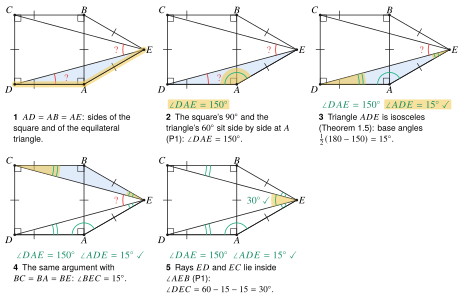
GEO01.20Show solution
Circular, and diagram-trusting
(a) In this module the exterior angle theorem was proved from the angle sum (section 2.9’s map). Using it to prove the angle sum is circular reasoning (mistake M4): the argument would be valid only in a development where Theorem 1.4 had been proved some other way, without Theorem 1.3. (b) The parallel was read off the picture (mistake M3). To conclude you need in the givens, or a proof of it. The figure is drawn exactly from the student’s own quadrilateral, and in it : the sides are from parallel, and nobody can see that.
GEO01.21Show solution
Base angles climb by the vertex angle each time
Answer: (a) 9 segments. (b) Exactly 5 segments when . Write . Triangle has , so its base angles at and are both (Theorem 1.5), and its exterior angle at is (Theorem 1.4). Triangle has , so its base angles at and are ; the exterior-angle step (in triangle ) then gives at for the next triangle, and so on. The -th isosceles triangle has base angles , and a triangle’s two base angles must each be less than (their sum is less than ). So the triangles exist for .
- (a) : but , so the triangles run . Triangle adds segment , and comes first: segments.
- (b) Exactly 5 segments means the triangles run to and stop: , so . (At exactly , the fifth triangle would need two base angles, so it does not exist.)
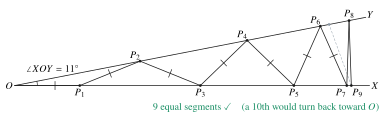
GEO01.22Show solution
Turning counts the tips
Answer: (a) ; (b) ; (c) the star has tip-angle sum . Walk the star’s path. At a tip with angle the path turns through , the angle between the direction it arrived in and the direction it leaves in. Every turn goes the same way: on a convex polygon, three corners taken in their cyclic order always turn the same way, and with the corners before and after each tip are in that order. The path goes times around (its total turning matches the regular star’s, where the count is plain to see), so by the turning fact its turns total :
(a) : . (b) : . Checks: the pentagram gives (worked example 4), and gives , the polygon angle sum (Theorem 1.6).
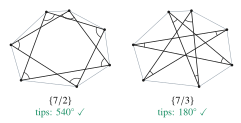
GEO01.23Show solution
The parallel forces equal base angles
Given: triangle ; on ray past ; ray bisects ; . To prove: .
| Statement | Reason | |
|---|---|---|
| 1. | corresponding angles, , transversal (P2) | |
| 2. | alternate interior angles, transversal (Theorem 1.2) | |
| 3. | bisects | |
| 4. | steps 1–3 | |
| 5. | converse of Theorem 1.5 |
The converse: if , the bisector of the exterior angle at is parallel to . That is GEO01.16 from the other direction: there you drew the parallel and proved it bisects; here, since the bisector of an angle is unique, the parallel through that GEO01.16 shows to be a bisector is the bisector.
GEO01.24Show solution
A Diophantine equation from a corner
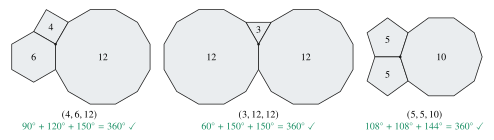
Answer: ten triples: , , , , , , , , , . (a) A regular -gon’s interior angle is . Three of them fill the point: , so . (b) Since , , so ; and .
- : . Multiply by : , so . With : , giving , , , , .
- : , so : , giving , , .
- : with , so and . gives ; gives , not a unit fraction.
- : with forces .
(c) A loop in C++ that tests with integers, never with floating point:
for (int a = 3; a <= 6; ++a)
    for (int b = a; b <= 42; ++b)
        for (int c = b; c <= 42; ++c)
            if (2 * (b * c + a * c + a * b) == a * b * c)   // 1/a + 1/b + 1/c == 1/2
                std::printf("(%d, %d, %d)\n", a, b, c);
It prints the same ten triples. (Why is enough? The largest below is , which leaves , so .) Only some of these corners extend to a tiling of the whole plane; , for example, cannot, which a later module’s stretch explores.
The mastery gate#
GEO01.25Show solution
Alternate angles, then an isosceles triangle
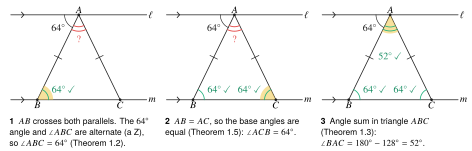
Answer: . The angle between and the part of to the left of , and , are alternate interior angles for the transversal , so (Theorem 1.2). , so (Theorem 1.5), and (Theorem 1.3).
GEO01.26Show solution
Exterior plus interior is 180 degrees
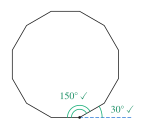
Answer: 12 sides. Let the exterior angle be . Then the interior angle is (linear pair), and . Multiply by 5: , so and . The exterior angles add to , so . Check: the interior angle is , and .
GEO01.27Show solution
Let the unknown be the smallest angle
Answer: and . Let .
| Statement | Reason | |
|---|---|---|
| 1. | : triangle has equal base angles at and (Theorem 1.5) | |
| 2. | exterior angle at of triangle (Theorem 1.4) | |
| 3. | : triangle has equal base angles at and (Theorem 1.5) | |
| 4. | angle sum in triangle | |
| 5. | ray lies inside (P1) | |
| 6. | , so | given |
So and . Check: .
GEO01.28Show solution
Split by a diagonal, and use convexity
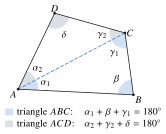
Given: a convex quadrilateral . To prove: . Plan: the diagonal cuts it into two triangles whose angles make up its angles.
| Statement | Reason | |
|---|---|---|
| 1. | Draw the diagonal . | two points determine a segment |
| 2. | lies inside and inside . | is convex, so its diagonals lie inside it |
| 3. | and | angle addition (P1), using step 2 |
| 4. | angle sum in triangle (Theorem 1.3) | |
| 5. | angle sum in triangle (Theorem 1.3) | |
| 6. | add steps 4 and 5 and regroup with step 3 |
Where convexity was used: step 2. In a non-convex (dart-shaped) quadrilateral, one diagonal lies outside, and splitting along it fails; the other diagonal still works, so the theorem survives, but the proof must choose the right diagonal.
The teach-back rubric (gate item 2). A complete teach-back (1) draws the parallel to one side through the opposite vertex; (2) names the two pairs of alternate interior angles and the transversals that make them; (3) says the three angles at the vertex fill a straight angle; (4) names the parallel postulate as the step that supplies the parallel line and makes the alternate angles equal; (5) says that on a sphere there are no parallel lines, so the construction fails and the angle sum is larger than ; and (6) takes at most six sentences.
Back to GEO01.28Stretch notes#
S1. (a) The polar triangle has three angles, sum . It covers one eighth of the sphere, area , so the excess is radians, , matching . (b) Area gives an excess of radians, : the angles add to . (c) P2 fails, since any two great circles meet, so step 1 of Theorem 1.3’s proof (draw the parallel through ) has nothing to draw. S2. Walking the L-shaped hexagon counterclockwise, five corners turn left by and the inner corner turns right by : . Its interior angles are five right angles and one angle: . The pentagram’s path turns through at each tip, so it turns through in all: two full turns, because it winds around the centre twice. (Worked example 4’s pencil instead turns through at each tip and flips its direction of travel, so it totals . A walker’s heading turns through . The two counts describe different motions, so and do not contradict each other.) S3. With unknowns , , , , , and : the equations are (isosceles ), (triangle ), (straight line at ), (isosceles ), and (triangle ). Five unknowns, five independent equations, one solution. The angle sum of triangle is a sixth equation that follows from the others, which is why it only checks. S4. One good implementation of angle_at takes the two edge vectors and from the vertex and returns std::atan2(std::abs(cross(u, v)), dot(u, v)), converted to degrees. The alternative, std::acos(dot / (|u||v|)), loses precision for angles near and , where the cosine changes slowly, and can even produce NaN when rounding pushes the ratio a hair past 1. The sign of cross(u, v) says whether the path turns left (positive) or right (negative) at the vertex. S5. Four polygons at a point satisfy ; the solutions with are , , , and .
Retention and readiness#
In two days, redo GEO01.14 and GEO01.18 without looking. In seven days, redo worked example 1 both ways from a blank page, and make up a fresh isosceles-chain problem in the style of GEO01.27, checking that its figure exists as worked example 2’s approach B does. In 21 days, review all seven toolbox cards. Log every miss under its mistake name from section 2.11. Move on to GEO02 only after the mastery gate in section 6 passes.