T01: Systems and performance engineering
On this page
- A. Prerequisites and observable goals
- B. The central question: what resource actually limits this workload?
- C. Layout changes what the machine must fetch
- D. Reason about bottlenecks and synchronization
- E. A reproducible experiment can reject your favorite hypothesis
- F. Worked budget and system-level interpretation
- G. Independent practice
- H. Complete solutions: T01
- I. Retention and readiness
A. Prerequisites and observable goals#
C03 C++ lifetimes; C06–C10 data structures, architecture, and concurrency; C14 measurement; A04 uncertainty.
Explain a data-layout hypothesis, measure a bounded kernel, separate algorithmic work from machine effects, and choose a reliability/performance tradeoff with evidence.
Level: Advanced-entry track. Suggested first specialization for engine-related work, not a permanent career assignment.
B. The central question: what resource actually limits this workload?#
Performance work begins with a defined task and a budget: frame time, request latency, throughput, memory capacity, energy, or recovery time. These objectives can conflict. Batching persistence may improve throughput but increase the amount of recent work waiting to be saved. Caching may reduce reads while consuming memory and creating invalidation complexity. A fast average does not establish an acceptable tail or deadline behavior.
Count useful work before choosing low-level tricks. Replacing a quadratic scan with an appropriate spatial index may remove far more work than vectorizing the scan. Once an algorithm is appropriate, representation, allocation, branching, synchronization, and data movement matter. A profiler can locate time or resource consumption; a microbenchmark can isolate one hypothesis. Neither automatically identifies the change that improves the whole application.
For an engine, a useful question is not “is ECS faster?” but “which components does this update read and write, how many entities are active, how are they laid out, and which other systems share their lifetime?” An architecture name does not determine cache traffic or synchronization cost. J05 applies this habit to an immutable spatial-query snapshot with a brute-force oracle.
C. Layout changes what the machine must fetch#
An array of structures (AoS) places all fields of one entity together. A structure of arrays (SoA) places one field from many entities together. Suppose a particle contains eight 4-byte floating-point fields, but one kernel reads only velocity and updates position . The logical useful data per entity is one velocity read plus one position read and write. AoS may fetch cache lines containing unused fields; SoA can make the needed arrays contiguous.
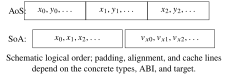
AoS can be attractive when most fields of a small number of entities are used together. SoA can help streaming kernels over a few fields and may facilitate vectorization. Hybrid blocked layouts can balance concerns. The correct choice depends on access patterns, not a universal superiority rule. Alignment and padding change actual object sizes; measure sizeof and inspect a target rather than calculating layout solely from field names.
Allocation also has a lifetime dimension. Reusing a scratch buffer can reduce allocator work when capacity and ownership are controlled. An arena can free a group of objects together, but pointers into it become invalid when it resets. Pooling without a clear lifetime protocol can turn a performance optimization into use-after-free or stale-handle bugs. A generation counter can detect some stale handles, but wraparound, reuse, and concurrency still require a contract.
D. Reason about bottlenecks and synchronization#
A lower-bound style model compares compute work and memory traffic. If a kernel needs operations and moves bytes, its time cannot realistically beat both the machine’s compute and bandwidth constraints; a rough model is for effective compute rate and bandwidth . Those effective rates are measured or bounded quantities, not marketing peak numbers. Cache reuse, write allocation, vectorization, and dependencies can change the relevant traffic and attainable rates.
Parallelism adds coordination. A shared atomic counter updated for every entity can serialize otherwise independent work. False sharing occurs when independent variables share a coherence unit and different cores repeatedly write them, causing coherence traffic despite no logical data dependence. Separating hot counters or batching updates may help, but alignment padding also consumes memory and depends on the target. A data race is a correctness violation; false sharing is a performance interaction between otherwise properly synchronized or distinct data.
Work partitioning must account for load balance and overhead. Static equal-size ranges are simple for uniform work; a bounded work queue can balance variable jobs but adds synchronization. Immutable snapshots allow readers to avoid mutation races while paying build and publication costs. A snapshot is not free: memory can temporarily contain both old and new versions, and readers must keep the version they use alive.
E. A reproducible experiment can reject your favorite hypothesis#
The lab updates for particles, 20 passes per timed invocation, using AoS and SoA representations. It allocates and initializes outside the timed region, performs one excluded warm-up for each, alternates order over seven repetitions, and validates matching final checksums. The object size reported in this Linux/GCC build is 32 bytes.
The reference run recorded AoS median ms and SoA median ms. These are nearly equal in this small shared-container experiment. They do not support a dramatic SoA speedup. The compiler may transform loops, the working set and cache hierarchy matter, and a single environment does not isolate all effects. The appropriate conclusion is that this experiment did not demonstrate a practically large difference, not that layout never matters. Exact commands and environment are in the verification ledger.
A more complete investigation would vary entity count, fields touched, pass structure, and thread count; inspect generated code; collect hardware counters where permitted; and test representative application traces. Those are continuation experiments, not measurements claimed to have been performed here. Keep the original baseline and validate every modified implementation before trusting its timing.
F. Worked budget and system-level interpretation#
Suppose a frame takes ms: ms rendering, ms simulation, and ms other work. A verified optimization halves only simulation, yielding ms, a speedup of , not . The local improvement is real but bounded by the untouched work. If the optimization also introduces a ms synchronization stall, the frame worsens to ms. Measurements must include the actual integration boundary.
For a service, tail behavior can matter more than average work. A queue that is stable under ordinary load can grow during bursts; bounded capacity makes overload explicit. Reliability work includes timeouts, cancellation, graceful shutdown, recovery tests, and observability. A fast path that corrupts state on shutdown is not a successful optimization. Review C10 closure and J03 transaction recovery before optimizing either.
G. Independent practice#
F foundation C standard course work T transfer S optional stretch L runnable lab or project. Attempt the complete set before opening its solutions.
A 32-byte particle record has eight floats. A kernel reads only and and writes . Explain a plausible SoA advantage and a workload where AoS may be preferable. Distinguish logical useful bytes from measured memory traffic.
A workload spends of time in an optimized region that becomes three times faster. Compute the ideal overall speedup with all other costs fixed. State two reasons an actual measurement may differ.
Two threads update separate counters, but throughput falls as both become active. Explain how false sharing differs from a data race and propose a controlled experiment that could support or reject the false-sharing hypothesis.
An engine replaces per-frame allocations with an arena reset at frame end. A worker may still use a pointer into the arena afterward. Identify the correctness defect and propose an ownership/lifetime design before discussing performance.
Rebuild and run cpp/layout_benchmark.cpp. Predict the compared access patterns, verify checksums, and report the actual seven-repetition medians with environment and timing boundary. Modify a separate starter copy to touch more fields or change size, preserving equivalent work. Treat that modification as an experiment whose result may contradict your prediction.
Optional small hints
For T01.02, normalize original time to one. For T01.03, keep the number of operations and synchronization semantics fixed while changing placement. For T01.05, do not present a single fastest sample as the result.
H. Complete solutions: T01#
Compare the first step where your work differs. A corrected answer is not yet an independent success.
T01.01Show solution
Access patterns determine whether proximity is useful
SoA places successive and values contiguously, potentially reducing fetched unused fields and enabling efficient vector loads. AoS may be preferable when processing one entity requires nearly all its fields or when entity-level copying and locality dominate. The logical operation reads two floats and writes one, but actual traffic can include whole cache lines, write allocation, writeback, and reuse. Therefore multiplying 12 bytes by the number of entities is not automatically a measured DRAM-traffic count.
Back to T01.01T01.02Show solution
Apply the improvement only to the affected fraction
Original time is . New ideal time is , so speedup is . Synchronization or setup costs may increase; cache behavior may change; the optimized region’s fraction may differ on another workload. The calculation assumes fixed work and no interactions. It is a useful bound-style model, not a substitute for integrated timing.
Back to T01.02T01.03Show solution
Shared coherence is not shared abstract state
A data race involves conflicting unsynchronized accesses to the same memory location under the language’s rules. False sharing can involve different locations on the same coherence line, each correctly owned, whose writes cause line transfers. Compare counters placed together with counters deliberately separated under the target’s layout, keeping work, thread placement policy, and timing method equivalent. Retain repeated samples and inspect relevant coherence evidence if tools permit. Improvement after padding supports but does not alone prove the proposed mechanism because layout can change other effects too.
Back to T01.03T01.04Show solution
Storage reuse cannot precede the last use
Resetting the arena invalidates or reuses storage while a worker still references it. The problem is a lifetime violation, not merely allocator overhead. One design joins all frame jobs before reset. Another gives each in-flight frame its own arena and retains it until all readers finish. A third copies the required data into owned work items. Compare memory, latency, and synchronization only after the design guarantees that no worker uses reset storage. A pointer remaining numerically unchanged does not preserve the original object’s lifetime.
Back to T01.04T01.05Show solution
Complete measured kernel and interpretation
The reference excludes allocation and initialization, includes 20 update passes per sample, alternates measurement order, and checks final equality. Its output is an empirical result from the current machine. The reference medians show near parity, so the solution’s main result is a sound experiment and a restrained interpretation, not a promised optimization. A changed-fields extension has no single predetermined timing answer; an acceptable report states the hypothesis, validates equivalent results, and explains uncertainty.
#include <algorithm>
#include <chrono>
#include <cmath>
#include <cstddef>
#include <iostream>
#include <numeric>
#include <vector>
struct Particle { float x,y,z,vx,vy,vz,mass,spare; };
using Clock = std::chrono::steady_clock;
template<class F> double timed(F f) {
    const auto start = Clock::now();
    f();
    return std::chrono::duration<double,std::milli>(Clock::now()-start).count();
}
double median(std::vector<double> samples) {
    std::sort(samples.begin(),samples.end());
    return samples[samples.size()/2];
}
int main() {
    constexpr std::size_t n=200000;
    constexpr int passes=20, repetitions=7;
    std::vector<Particle> aos(n);
    std::vector<float> x(n), vx(n);
    for (std::size_t i=0;i<n;++i) {
        aos[i]={static_cast<float>(i%1024),0,0,0.25F,0,0,1,0};
        x[i]=aos[i].x; vx[i]=aos[i].vx;
    }
    auto a=[&] { for(int p=0;p<passes;++p) for(auto& e:aos) e.x+=e.vx*0.01F; };
    auto b=[&] { for(int p=0;p<passes;++p) for(std::size_t i=0;i<n;++i) x[i]+=vx[i]*0.01F; };
    a(); b(); // warm-up excluded
    std::vector<double> ta,tb;
    for(int r=0;r<repetitions;++r) {
        if(r%2==0) { ta.push_back(timed(a)); tb.push_back(timed(b)); }
        else { tb.push_back(timed(b)); ta.push_back(timed(a)); }
    }
    double ca=0,cb=0;
    for(std::size_t i=0;i<n;++i) { ca+=aos[i].x; cb+=x[i]; }
    if(ca!=cb) { std::cerr<<"checksum mismatch\n"; return 1; }
    std::cout<<"n="<<n<<" passes="<<passes<<" repeats="<<repetitions
             <<" sizeof_particle="<<sizeof(Particle)<<"\n"
             <<"aos_median_ms="<<median(ta)<<" soa_median_ms="<<median(tb)
             <<" checksum="<<ca<<"\n";
}I. Retention and readiness#
Retrieve C09 locality, C10 ownership and synchronization, and A04 uncertainty. Readiness requires independently diagnosing one bottleneck and defending a reproducible comparison, including a result that fails to support your initial idea. Continue through J05, then deeper C++ object-model study, OS internals, profiling, allocators, storage/I/O, and production reliability under mentorship or substantial project review.