Module 28: Alternating series, absolute convergence, and controlled error
On this page
- A. Prerequisites and observable goals
- B. The central idea: cancellation can produce convergence
- C. Definitions and the alternating-series theorem
- D. Why the next-term bound works
- E. A reliable classification order
- F. Worked examples
- G. Independent practice
- H. Complete solutions: Module 28
- I. Retention and readiness
A. Prerequisites and observable goals#
Positive-series tests, partial sums, and inequalities.
Distinguish absolute from conditional convergence, verify the alternating-series hypotheses, and bound an approximation with correct next-term indexing.
B. The central idea: cancellation can produce convergence#
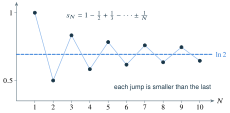
Positive series accumulate in only one direction. Alternating signs can cancel enough to create a finite limit even when the absolute magnitudes have infinite total. That distinction matters for both error estimates and rearrangement. A sign pattern is not itself a convergence proof; the magnitudes need to behave in a controlled way.
C. Definitions and the alternating-series theorem#
A series is absolutely convergent if converges. Absolute convergence implies convergence of . A convergent series that is not absolutely convergent is conditionally convergent.
For , if is eventually nonincreasing and , the alternating series converges. When the decreasing condition applies throughout the omitted tail,
The remainder has the sign of the first omitted term, and the limit lies between the adjacent partial sums . These are sufficient hypotheses. A nonmonotone magnitude sequence might still yield convergence, but this theorem would not justify it without further work. [O2Alt]
Conditional convergence does not permit arbitrary rearrangement while preserving the sum. Absolute convergence does. This is a property of infinite sums: every finite reordering preserves a finite total, but taking limits after increasingly different groupings is an additional operation. Advanced rearrangement proofs are optional; recognizing the restriction is essential.
D. Why the next-term bound works#
For a decreasing positive magnitude sequence, even partial sums form an increasing sequence, odd partial sums a decreasing sequence, and each even sum stays below each later odd sum. The gap between adjacent partial sums is , so both subsequences have the same limit. The limit is trapped between those neighbors, proving both convergence and the error estimate. This argument explains why checking monotonic decrease and term decay is more than a ritual.
Absolute convergence implies convergence because every signed tail has magnitude at most the corresponding absolute tail. When the latter can be made arbitrarily small, so can the original tail. The converse fails because cancellation can make signed tails small even when their absolute totals are large.
E. A reliable classification order#
Test absolute convergence first when a familiar positive-series comparison is available. If it holds, stop: you have the stronger conclusion. If the absolute series diverges, test the signed series separately. For alternating signs, establish positivity of magnitudes, eventual monotonicity, and limit zero. Only then label the series conditional. For approximation, write the first omitted index explicitly; the error bound is not generally the last included term.
F. Worked examples#
A conditional series. The alternating harmonic series converges because decreases to zero. Its absolute series is harmonic and diverges. Thus it is conditional. The error after terms is at most ; this does not require knowing its exact sum, which will later be connected with .
An absolute series. For , the absolute series is a convergent -series. Therefore convergence is absolute, even though the alternating test could also establish the weaker fact of convergence.
A stopping criterion. For an alternating series with , requiring error at most means . Thus suffices under the theorem’s hypotheses. This is a bound from the first omitted term, not an assertion that the actual error equals that term.
G. Independent practice#
F foundation C standard course work T transfer S optional stretch L runnable lab or project. Attempt the complete set before opening its solutions.
Classify as absolute, conditional, or divergent.
Classify .
Does converge? Explain before applying any named alternating test.
For , compute and give a certified interval containing using adjacent partial sums.
How many initial terms of suffice for absolute error at most by the alternating remainder bound?
Classify , checking both signed and absolute behavior.
A student says an alternating-series error bound proves that the error equals the next term. Use after its first two terms to disprove this.
Define and for . All are positive and tend to zero. Show that nevertheless diverges. Which alternating-test hypothesis fails?
Optional small hints
For M28.04, is an upper bound and a lower bound. For M28.06, compare the absolute series with its logarithmic integral. For M28.08, compute the even partial sum by pairing consecutive terms.
H. Complete solutions: Module 28#
Compare the first step where your work differs. A corrected answer is not yet an independent success.
M28.01Show solution
Cancellation rescues a divergent magnitude total
The magnitudes decrease to zero, so the alternating series converges. The absolute series has exponent and diverges. Therefore convergence is . Both halves of that label have been established.
Back to M28.01M28.02Show solution
Use the stronger absolute test first
For , . The absolute series converges by comparison, so the original series is . It is not conditional merely because it has alternating signs.
Back to M28.02M28.03Show solution
The terms must tend to zero
The magnitudes tend to one, and the signed even and odd subsequences tend to and . Thus the terms do not tend to zero, so the series diverges by the term test. There is no need to inspect monotonicity after this decisive failure.
Back to M28.03M28.04Show solution
Adjacent sums trap the limit
The third partial sum is . The fourth is . Since the positive magnitudes decrease to zero,
Also and overestimates. The interval gives more sign information than the absolute-error inequality alone.
Back to M28.04M28.05Show solution
Use the first omitted denominator
After included terms, the first omitted magnitude is . Requiring it at most gives , or . Thus terms suffice. The included term denominator would be the wrong index for the standard remainder bound.
Back to M28.05M28.06Show solution
Check the two series separately
The function is positive and decreasing for and tends to zero, so the alternating series converges. Its absolute integral is , proving divergence of the positive series by the integral test. Therefore the original convergence is .
Back to M28.06M28.07Show solution
An inequality does not claim equality
The geometric sum is . Its first two terms sum to , so the actual error is . The next term has magnitude . Thus : the theorem’s bound is valid but not exact. The omitted terms partly cancel each other.
Back to M28.07M28.08Show solution
Shrinking terms and alternating signs are still insufficient
The even partial sums satisfy
Hence the series diverges. The magnitudes fail eventual monotonicity: for , . These upward jumps occur indefinitely. The counterexample shows why simply checking is not enough for the alternating theorem.
Back to M28.08I. Retention and readiness#
Return to M27.07 and M26.04. Explain all three possible labels: absolute, conditional, divergent. Advance when you can justify a numerical stopping rule and state whether its approximation is above or below the sum.