Module 19: Length, surface area, work, fluid force, and mass
On this page
- A. Prerequisites and observable goals
- B. The central idea: ask what a tiny piece contributes
- C. A compact dictionary with assumptions
- D. Why the length and balance formulas work
- E. A modeling decision procedure
- F. Worked examples
- G. Independent practice
- H. Complete solutions: Module 19
- I. Retention and readiness
A. Prerequisites and observable goals#
Substitution, definite integrals, geometric distances, and units.
Translate a physical or geometric contribution into an integral and distinguish length, area, force, work, mass, and balance.
B. The central idea: ask what a tiny piece contributes#
The integral itself does not decide what quantity is being added. A short curve piece contributes length; a thin layer of fluid contributes force or work depending on the question; a short rod piece contributes mass according to its density. The reliable method is to derive the small contribution before integrating it. Units expose many wrong models immediately.
C. A compact dictionary with assumptions#
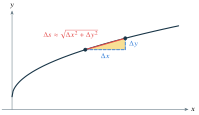
For a continuously differentiable graph on , its arc length is
Rotation about the -axis has surface area , when the parametrization describes the intended surface without duplicate tracing. This is the lateral swept surface, not automatically its end caps.
Work by a one-dimensional force parallel to displacement is . For a Hooke spring, measures the required quasistatic pulling force at extension from natural length. To lift fluid, a layer’s contribution is weight times lifting distance. Hydrostatic pressure at depth is for constant mass density , so force on a horizontal strip of width is . Pressure is not force until multiplied by area.
For a rod with linear density , mass is and center of mass is , assuming finite positive mass. For a uniform planar region between , area and centroid are
These are geometric balance formulas for uniform density; variable density must be included in the moments. Application sources: [O2Apps].
D. Why the length and balance formulas work#
A tiny curve segment has horizontal change and vertical change approximately . Pythagoras gives length approximately ; polygonal approximations converge to the integral for sufficiently smooth curves. Rotating the segment sweeps an approximately frustum-shaped band, giving circumference times slanted length in the limit.
A center of mass is the point at which signed turning effects balance. For masses at positions , balance about means . Solving gives . Replacing masses by small density-times-length pieces gives the integral formula. This explains why an unweighted average of endpoint positions is generally wrong for a nonuniform rod.
E. A modeling decision procedure#
Name the output quantity and required units. Pick a coordinate with a clear origin and direction. Express the small piece, its density or force, and any distance factor. Set bounds from the actual object, not the name of the formula. Integrate and check signs, units, limiting cases, and physical plausibility. A center of mass of positive material must lie within the range of positions occupied; a positive work-to-lift calculation cannot produce negative energy.
F. Worked examples#
Length of a line. For on , . The endpoint displacement is , whose Euclidean length is . The derivative supplies the slope, not the height.
A pump model. A vertical cylindrical tank has cross-sectional area and water depth . Measure height upward from the bottom; the outlet is at height . A layer has volume , weight , and lifting distance . Thus
Multiplying total weight by the full tank height would wrongly pretend every layer begins at the bottom.
An algebra step that matters. For on , and . The square root of is not .
G. Independent practice#
F foundation C standard course work T transfer S optional stretch L runnable lab or project. Attempt the complete set before opening its solutions.
Find the arc length of for .
Find the arc length of on .
Find the lateral surface area produced by rotating on about the -axis. Compare with a cone formula.
A spring requires N to hold it m beyond its natural length. Find the work to stretch it from m to m beyond natural length.
A cylindrical water tank has radius m and water depth m. Pump all water to an outlet m above the water surface. Use kg/m and m/s.
A vertical rectangular gate is m wide and extends from the water surface to depth m. Find the total hydrostatic force on one side, using the same as M19.05 and atmospheric pressure canceled on the two sides.
A rod on m has density kg/m, with expressed in meters. Find its mass and center of mass.
Find the centroid of the uniform region between and on . Check its position against the geometry.
Optional small hints
For M19.05, use height above the bottom; the lift is , not always . For M19.06, use depth below the surface. For M19.08, first compute the area, then both first moments.
H. Complete solutions: Module 19#
Compare the first step where your work differs. A corrected answer is not yet an independent success.
M19.01Show solution
A constant slope gives a constant length factor
Since , . The endpoints differ by horizontally and vertically, so the straight-line distance confirms the answer.
Back to M19.01M19.02Show solution
Differentiate before substituting into arc length
Here and . Therefore
The integrand is positive and well-defined across the entire interval.
Back to M19.02M19.03Show solution
Surface area contains slanted length
The radius is and the arc-length factor is . Thus . This is a cone of radius and slant height , giving lateral area . The base disk of area is not part of the swept lateral surface.
Back to M19.03M19.04Show solution
Calibrate the spring constant
Hooke’s model gives N/m. The work is . Multiplying the final force by the entire displacement would overestimate this varying-force work. The integral’s units are Nm.
Back to M19.04M19.05Show solution
Weight times each layer’s lifting distance
At height , a layer has volume and weight . The outlet is at height , so
An independent check uses the average lifting distance m for this uniform cross-section and multiplies by total weight N.
Back to M19.05M19.06Show solution
Pressure becomes force after multiplying by strip area
At depth , pressure is N/m. The horizontal strip area is m, so . There is no additional lifting-distance factor: this is force on a gate, not pumping work.
Back to M19.06M19.07Show solution
Density weights the positions
Mass is kg. The first moment is kgm. Thus . This lies to the right of the midpoint, where the material is denser, and inside the rod.
Back to M19.07M19.08Show solution
Compute moments of a uniform lamina
The area is . Its moment for the coordinate is , so . For the vertical coordinate,
Thus the centroid is . At , the boundaries are and ; the computed height lies between them. This is a plausibility check, while the moment equations provide the derivation.
Back to M19.08I. Retention and readiness#
Revisit M18.07, M12.06, and M17.07. Explain why work includes a distance factor while hydrostatic force does not. Complete the Calculus I assessment after this module, then repair the specific error categories rather than restarting the entire course.