C13: Partial failures, retries, and distributed consistency
On this page
- A. Prerequisites and observable goals
- B. The central question: what do you know after silence?
- C. Build a deduplication invariant, not a slogan
- D. Retries can amplify an outage
- E. Clocks and agreement
- F. A precise CAP thought experiment
- G. Independent practice
- H. Complete solutions: C13
- I. Retention and readiness
A. Prerequisites and observable goals#
C10 concurrency; C11 transactions; C12 transport and message framing.
Model ambiguous failures, specify a retry-safe operation, distinguish consistency models, and explain a bounded CAP argument without the misleading “pick any two” slogan.
Level: Degree core introduction; no distributed consensus implementation or deployment claim.
B. The central question: what do you know after silence?#
A local call is analyzed within one process and may return, raise, or fail to terminate. A remote call introduces another process, a network, persistent state, and uncertainty about their relative progress. A timeout says a deadline passed without the expected response. It does not distinguish a request that never arrived from a request that committed but whose reply was lost.
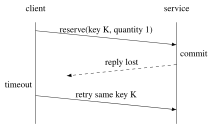
The dashed arrow represents a simulated missing reply, not evidence that the service rolled back. The retry must preserve the operation’s identity. Generating a new key for every transmission defeats deduplication because the service sees different logical operations.
An idempotent operation has the same relevant effect when repeated as when performed once. Assigning a resource’s desired state can be idempotent under appropriate semantics; incrementing a balance generally is not. HTTP’s method-level idempotence is a semantic contract, not a guarantee that arbitrary application code behaves correctly. Even an idempotent effect may produce different responses over time; define what your API promises. [HTTP]
C. Build a deduplication invariant, not a slogan#
For each logical request key, store a fingerprint of the normalized payload and the result. If the key already exists with the same fingerprint, return the stored result without reapplying the change. If it exists with a different fingerprint, reject the conflict. If it is new, apply the effect and record the key/result in the same durable transaction.
Why the same transaction? Recording the key first can lose the effect after a crash: a retry finds a completed-looking record and skips work never performed. Applying the effect first can duplicate it after a crash: a retry finds no record and applies it again. Atomic commit removes this gap within the database’s durability and isolation guarantees. External side effects, such as sending an email through another service, do not automatically become part of that transaction. An outbox pattern records a pending message in the transaction; its delivery still requires a receiver-side deduplication or other explicit semantic policy.
The desired invariant is: a committed request record corresponds to exactly one committed application of that logical operation, and subsequent matching retries reuse its result. This is a statement about the defined operation and retention period, not a magical guarantee of exactly-once delivery over an unreliable network. Expiring request records changes the guarantee: a very late retry may become indistinguishable from a new request.
D. Retries can amplify an outage#
A bounded retry policy considers an overall deadline, maximum attempts, exponential delay, randomized jitter, and which errors are retryable. Retrying a malformed request is unlikely to help. Retrying every request immediately after a server slowdown increases load precisely when capacity is constrained. Queue bounds and admission control turn overload into explicit rejection or deferred work instead of unbounded memory growth.
Suppose an operation receives at most three attempts. Even if each attempt independently succeeds with probability , the chance of at least one success would be . Real outage failures are often correlated, so this simple model should not justify aggressive retries. Observe attempt counts and total logical operations separately: a surge in request rate may be retry amplification rather than new demand.
Caching and replication also require semantics. A cache can serve stale data; its time-to-live is not a proof that a value is current. A replicated log can improve fault tolerance, but replicas may lag. Read-your-writes, causal consistency, sequential consistency, and linearizability are different contracts. Linearizability asks whether each operation can be placed at one instant between invocation and response in an order respecting real-time precedence. It is stronger than merely returning some value that was once stored.
E. Clocks and agreement#
Wall clocks can disagree or move because of adjustments. A timestamp alone does not prove that one event caused another. A happens-before relation orders events within a process and from message send to corresponding receive, then closes transitively. Lamport-style logical clocks can preserve this order: if happens before , then . The converse is false; a smaller logical timestamp does not establish causation.
Consensus is agreement on a value or ordered log under a stated failure model. A majority’s overlap with another majority is a useful safety ingredient, but it is not a complete consensus algorithm. Terms, voting rules, log restrictions, persistence, commit rules, and recovery all matter. Raft is an appropriate continuation because its paper explains these mechanisms and their relationship to safety. The lab here does not implement Raft and does not turn a single SQLite database into a fault-tolerant distributed cluster. [RAFT]
F. A precise CAP thought experiment#
Consider an atomic read/write register replicated across two groups separated by a partition that can prevent messages indefinitely. A write of a new value completes in the first group. A later read reaches the second group. That group cannot distinguish this history from one in which a different write completed on the other side. If it must always eventually return a register value without communication, some history will receive the wrong value. If it waits indefinitely for the missing information, it loses the required availability.
Thus the theorem’s conflict concerns linearizable register behavior and a response to every request at nonfailed nodes in a model allowing partitions. It is not a claim that every application chooses two features forever or that an error response automatically provides useful register availability. Normal operation may provide both fast responses and strong semantics; the difficult choice appears in failure histories allowed by the model. Different operations in one product can choose different policies. A public profile picture may tolerate staleness while a scarce-item reservation must not oversell. Gilbert and Lynch’s Perspectives on the CAP Theorem gives the assumptions and indistinguishability argument used here. [CAP]
G. Independent practice#
F foundation C standard course work T transfer S optional stretch L runnable lab or project. Attempt the complete set before opening its solutions.
A client times out after submitting a debit. Give two execution histories consistent with that observation and explain why blindly submitting a new debit is unsafe.
A service commits a stock decrement, then separately inserts a request key. Place a crash between those steps and trace the retry. Propose a transaction boundary that fixes this gap.
For an initial register value , a write of completes on partition side A before a read begins on side B. Explain the linearizability/availability conflict when B cannot communicate with A. Why does a constant-value service not provide the same example?
Two events have logical timestamps and . Must the first have caused or happened before the second? Give a counterexample. Then propose three useful metrics for diagnosing a retry storm without logging secret request payloads.
Implement starters/retry_lab.py: a ledger with request-key deduplication, conflicting-payload rejection, and a simulated lost reply after the effect is recorded. Matching retries must return the original result without another debit. Explain explicitly why this in-memory lab is not durable or concurrent; J03 supplies a transactional version.
Optional small hints
For C13.02, identify what evidence remains after the crash. For C13.03, compare two histories that look identical to B. For C13.05, simulation should lose the response after recording the logical result, not before performing the operation.
H. Complete solutions: C13#
Compare the first step where your work differs. A corrected answer is not yet an independent success.
C13.01Show solution
Silence leaves more than one possible history
The request may never have reached the service, so no debit occurred. Alternatively, the service may have debited and committed, but the response was lost or delayed. Both produce a client timeout. A new logical debit can therefore charge twice in the second history. Preserve the original request key, query operation status if the protocol supports it, and retry under an explicit policy. A timeout is evidence about the client’s waiting interval, not an authoritative account-state result.
Back to C13.01C13.02Show solution
Close the crash window
After the decrement commits but before the key is stored, a crash leaves reduced stock and no deduplication record. The retry sees a new key and decrements again. Put the conditional stock update and insertion of the key, normalized payload, and stored result in one transaction. A crash then leaves either both committed or neither committed under the database’s guarantees. This fixes the described database-state gap; it does not cover an unrelated external effect or all storage hardware failures.
Back to C13.02C13.03Show solution
Two indistinguishable histories require incompatible replies
Real-time precedence requires the later read to return in a linearizable execution, absent an intervening write. But B has the same local evidence in a history where A instead completed a write of . B cannot choose a value that is correct in both histories without receiving information. Waiting forever violates the required eventual response; answering can violate correctness. A service that always returns a mathematical constant needs no changing shared state or cross-partition coordination, so it does not instantiate this register argument. The theorem’s service specification matters.
Back to C13.03C13.04Show solution
Logical order does not imply causal order
Two disconnected processes can independently reach clock values and without exchanging messages. Neither event need happen before the other. The clock construction preserves causal precedence in one direction only. Useful retry-storm metrics include attempts per logical request, rate of deadline expirations or retryable failures, and queue depth or in-flight requests. Add latency distributions by attempt number when useful. Correlation identifiers should be opaque and access-controlled; do not place tokens, passwords, or full personal payloads in logs merely to make debugging easier.
Back to C13.04C13.05Show solution
Complete simulated ledger
The reference stores the payload and result before optionally raising a simulated timeout. A subsequent matching call therefore returns the stored result. Its dictionary and balance are process-local and unsynchronized; restart loses the records, and interleaved callers are outside its specification. Those limits are part of the solution, not small omissions to ignore.
"""C13.05: an explicit simulation; not durable distributed storage."""
class Ledger:
    def __init__(self, balance: int):
        self.balance = balance
        self.results: dict[str, tuple[int, int]] = {}

    def debit(self, key: str, amount: int, lose_reply: bool = False) -> int:
        if not key or type(amount) is not int or amount <= 0:
            raise ValueError("key and positive integer amount required")
        if key in self.results:
            previous_amount, result = self.results[key]
            if previous_amount != amount:
                raise ValueError("idempotency key reused with a new request")
            return result
        if amount > self.balance:
            raise ValueError("insufficient balance")
        self.balance -= amount
        self.results[key] = (amount, self.balance)
        if lose_reply:
            raise TimeoutError("simulated lost reply AFTER commit")
        return self.balance

if __name__ == "__main__":
    ledger = Ledger(10)
    try:
        ledger.debit("request-1", 3, lose_reply=True)
    except TimeoutError:
        pass
print(ledger.debit("request-1", 3), ledger.balance)I. Retention and readiness#
Retrieve the C11 transfer transaction and C12 transport/application distinction. Advance when you can place the commit point on a failure timeline and say what a retry can safely assume. Continue with the local transactional service J03; read a consensus paper only after you can restate its failure model and safety claim.