
Pick an Origin
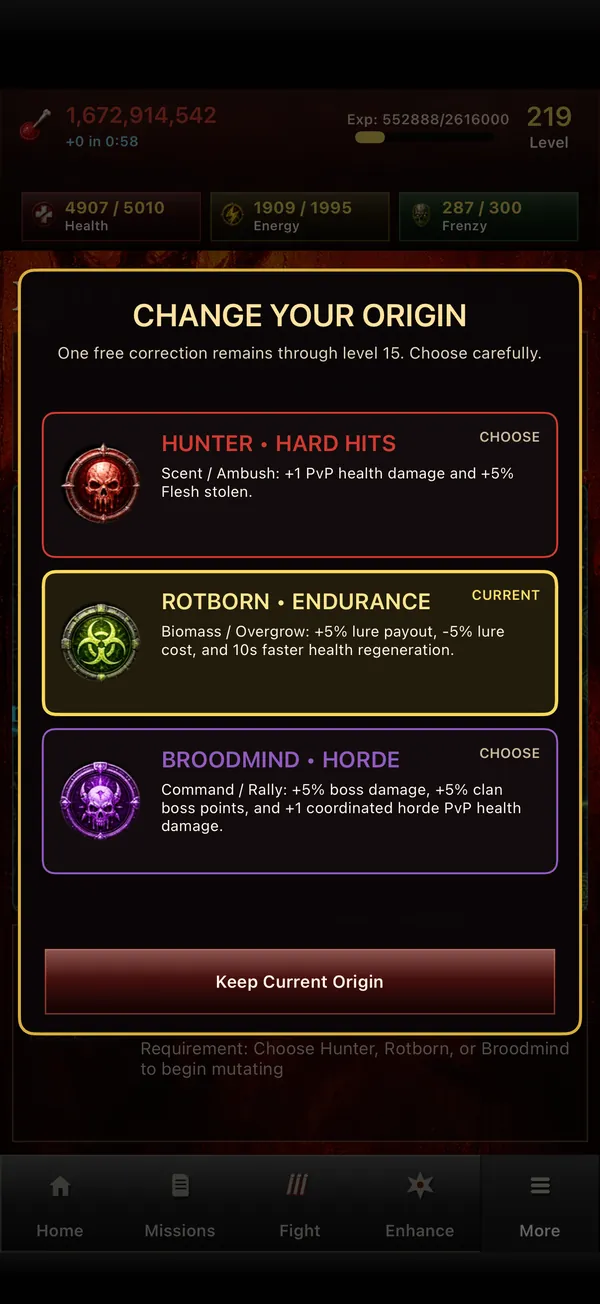
| Origin | Focus | Passive |
|---|---|---|
| Hunter | Hard hits | Scent / Ambush: +1 PvP health damage and +5% Flesh stolen |
| Rotborn | Endurance | Biomass / Overgrow: +5% lure payout, −5% lure cost and 10 s faster health regeneration |
| Broodmind | Horde | Command / Rally: +5% boss damage, +5% clan boss points and +1 coordinated horde PvP health damage |
You get one free Origin change through level 15, so experiment early.
The grid
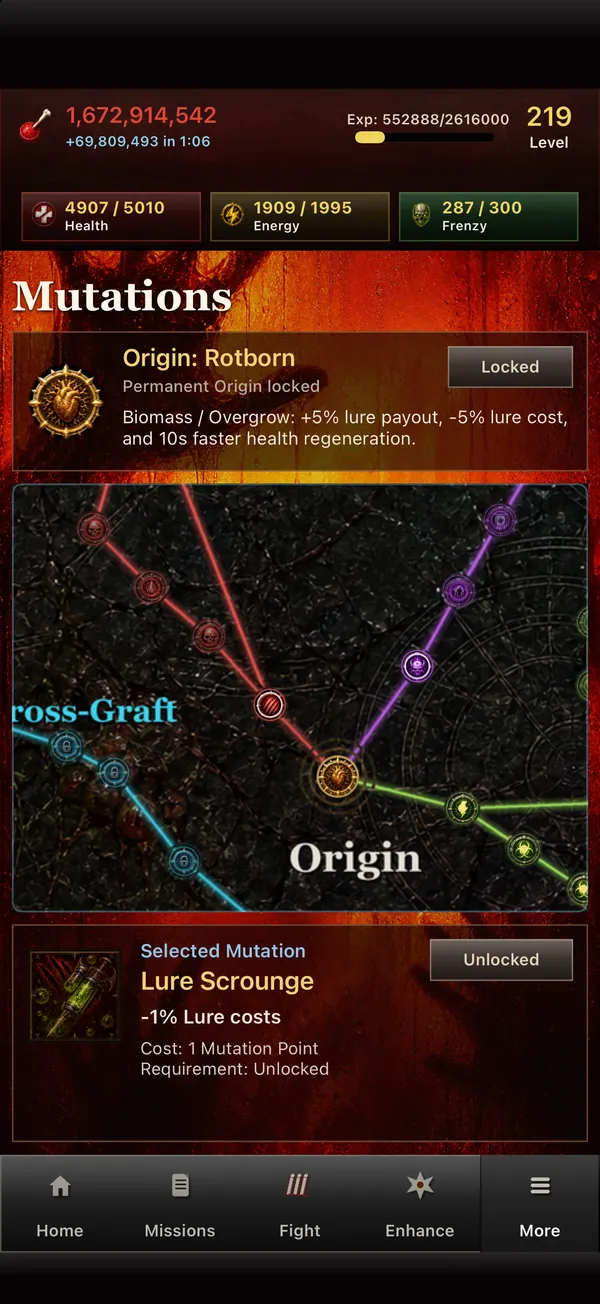
The Mutation grid has 194 nodes: your Origin, ten starter nodes, three branches of 54 nodes (Hunter, Rotborn and Broodmind), three Apex mutations and 18 Cross-Grafts. You grow outward from what you already own; a node opens when it touches one of yours.
| Node | Cost |
|---|---|
| Starter and branch nodes | 1 to 2 Mutation Points |
| Cross-Grafts | 2 to 3 points, some also need Graft Keys |
| Apex mutations | 7 points |
Where Mutation Points come from
- Mission mastery: 1 point for every mastery rank.
- Your First Night strike on the Morgue Titan.
- Stronghold vaults, alongside Graft Keys.
Apex mutations
| Apex | Bonus |
|---|---|
| Red Apex | +5 PvP HP damage |
| Green Apex | +5% Flesh payout |
| Purple Apex | +5% boss damage |
Cross-Grafts
Cross-Grafts bridge two branches and ask for nodes in both. The strongest also need Graft Keys from Strongholds. A few examples:
- Blood Accounting: PvP Flesh you steal copies +2% into your clan treasury.
- Emergency Feeding: successful PvP attacks restore 5 HP (10-minute cooldown).
- Shortened Flesh Cycle: your Flesh payout cycle runs 5 minutes faster.
- Nest Treasury: boss Flesh rewards copy +2% into your clan treasury.
- Pack Ambush: +3 PvP HP damage while you're in a clan with a usable horde of 10.
Build directionsFighters lean Hunter toward the Red Apex. Economy players lean Rotborn for lures and the Green Apex. Boss and clan players lean Broodmind toward the Purple Apex. Cross-Grafts reward committing to two branches instead of three.
Relics
Relics are the other permanent PvP layer. Six wait in the Reliquary, each with its own reveal, and once claimed its bonus never switches off:
| Relic | Bonus | How to claim |
|---|---|---|
| Crimson Cleaver | +7% PvP HP damage | Crimson Moon pass and 500 Crimson Butcher takedowns, or the archive hunt |
| Gallows Fang | +20 PvP HP damage | 10,000 fights won and 250 Hit List kills |
| Executioner's Chain | +35 PvP HP damage | 25,000 fights won and 750 Hit List kills |
| Widowmaker Brand | +50 PvP HP damage | 50,000 fights won and 1,500 Hit List kills |
| Red Tribunal Seal | +75 PvP HP damage | 75,000 fights won and 3,000 Hit List kills |
| Massacre Engine | +100 PvP HP damage | 100,000 fights won, 5,000 Hit List kills and max Rend on 3 permanent bosses |
Updated October 8, 2026. The game shows the current costs and rewards; live balance can change, and this guide follows it.