Social progression guide
Undead Forever Clans & Hordes
Your horde is the personal network that expands your fighting force and bonus allocation. Your clan is one organized team with a roster, ranks, treasury, weekly standings, broadcasts, and shared contribution.
Horde or clan?
The game uses both words because they solve different problems.
Personal scale
Horde
Build horde relationships through player invitations and invite codes. Your total and usable horde affect personal combat scale and unlock a pool of allocatable bonuses. Players can participate in a horde without belonging to the same clan.
Organized team
Clan
Join one clan roster with membership ranks, invitations, settings, broadcasts, donations, treasury activity, standings, and weekly member contribution. Clanmates coordinate, but they do not automatically replace your horde.
Build a horde with a purpose
Horde growth is not only a vanity count. The account distinguishes total horde size from usable horde, and the combat/economy systems care about the usable force and the gear that supports it.
As horde capacity grows, bonus points can be allocated among Income, Mission XP, Mission Flesh, Clan Points, and PvP Steal. That turns recruiting into build strategy: two players with the same horde size can support different daily loops.
Choose horde bonuses
Allocate toward the activity you will repeat, then revisit the mix when the account's goal changes.
Income
Raises gross timed income before upkeep. Useful when the equipment and horde economy has enough scale for every payout cycle to matter.
Mission XP and Flesh
Two separate levers for leveling speed and mission cash flow. Choose the bottleneck rather than assuming both always need equal investment.
Clan Points and PvP Steal
Clan Points turns personal activity into stronger team contribution; PvP Steal makes successful attacks more lucrative. Both reward active play, but in different social lanes.
How weekly clan contribution works
The roster's weekly contribution number reflects activity, not only donations or account level.
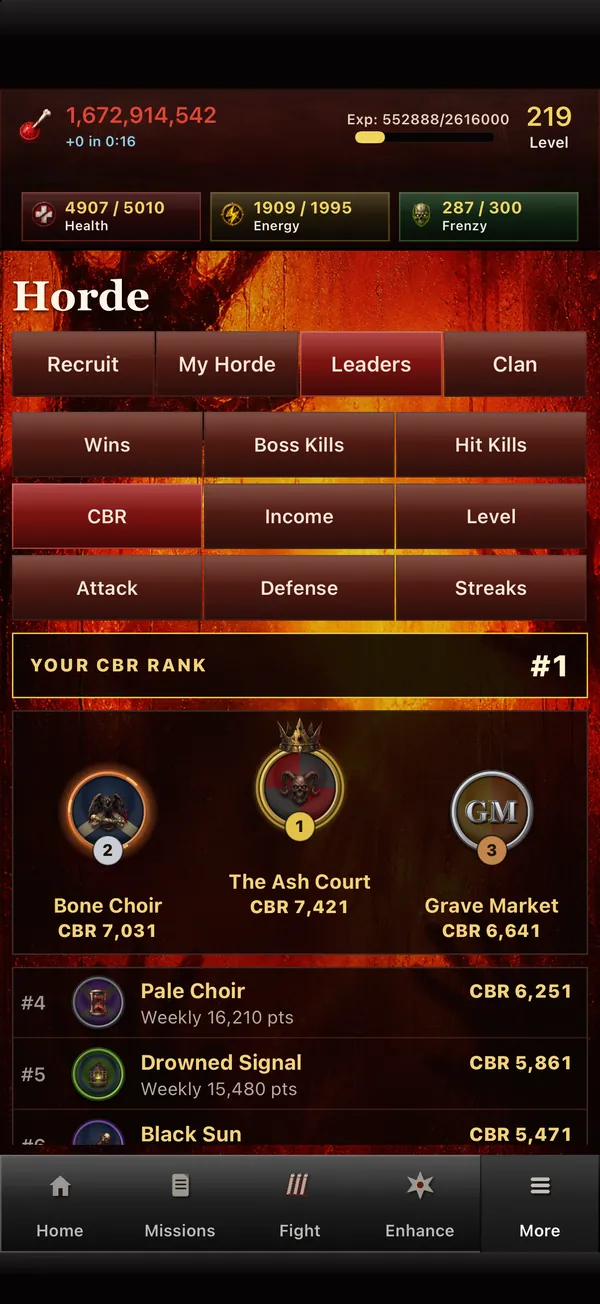
The current clan roster calculation combines weekly attack points, mission points, and Hit List points for each member. That means a useful clan can include different kinds of active players: fighters, mission grinders, and bounty hunters all move the weekly total through their own loop.
World-boss attacks also award clan contribution through the boss system. Colony mutations and horde Clan Points allocation can improve this cooperative lane, while some late cross-grafts copy a portion of PvP or boss earnings into the clan treasury.
A healthy clan should make the score legible: set one attainable activity target, post it in broadcasts, and recognize contribution across missions, attacks, Hit Lists, and bosses instead of rewarding only the highest-level member.
Clan operations
The strongest clan is organized enough to help without turning a mobile game into a job.
- Recruit for activity and fit. Level matters, but a player who contributes consistently and communicates can be more useful than a silent high-level account.
- Use ranks deliberately. Leaders and officers have management responsibility. Promotions should reflect trust, moderation judgment, and willingness to help the roster.
- Give the treasury a goal. Donations feel meaningful when members know what the reserve is for. Avoid asking for resources without a visible reason.
- Broadcast one clear objective. A current boss, weekly score push, recruiting need, or resource goal is easier to act on than a wall of permanent rules.
- Coordinate boss windows. Persistent boss health lets members contribute at different times, but a planned final push helps the clan capture contribution before a respawn window.
- Keep the social layer safe. Use reports, blocks, roster controls, and moderation when recruiting or rivalry turns into harassment or spam.
Three useful player roles
A roster becomes memorable when people can be valuable in different ways.
The recruiter
Maintains invite flow, welcomes new players, and helps members distinguish horde growth from clan membership.
The contributor
Builds weekly score through a reliable mix of missions, PvP, Hit Lists, or boss attacks and makes the clan active whenever others log in.
The coordinator
Uses broadcasts, ranks, treasury goals, and boss timing to turn many small individual actions into visible team progress.